In all the stages of its history the Arab lands never knew a stage so wearied and dark as their stage in the early and middle Ottoman era, in which they were afflicted with feebleness, decline, and stagnation.
Nor, likewise, did the world of Arabism ever know in its history a dawn, a stirring, an awakening, and a leap swifter than the dawn of the renaissance, the stirring of thought, the awakening of life, and the leap of the nation that moved the Arabs and impelled them to recover their spiritual, intellectual, scientific, independent, and literary glories at the close of that era.
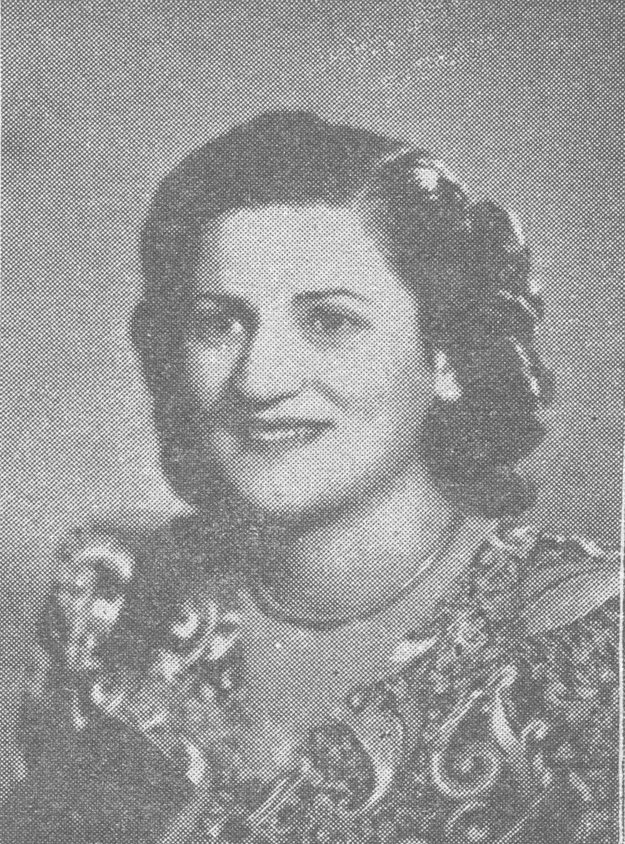
Whoever looks closely and fairly at that sudden Arab liberating renaissance cannot but believe that free Lebanese thought was its sun, its wellspring, and its creator. And he cannot but acknowledge that the free Yazijis were in the vanguard of those who carried the banner of thought — in language, in letters, in guidance, and in liberation — and that Warda al-Yaziji was among them the fragrant rose in spirit and in character, and was with them a striving soldier — nay, a fighting heroine — in the cause of a free life, a sound language, a living literature, a better society, and national independence; in the cause of Arabic and of Arabism, with the gifts God had stamped upon her, the knowledge her
father imparted to her, and the care her brothers bestowed upon her, which pushed her and her mission forward!
Our Rose opened her eyes upon life in the year 1838, and no sooner had her mind opened in earliest youth than poems of verse and passages of prose were flying to her ears... Here was her father, Sheikh Nassif, composing verse and exquisite prose; and here were her two brothers, Ibrahim and Khalil, two lion cubs following after their father; and the girl Warda sat with them, studied with them and under them, composed verse and prose, polished and corrected morphology, grammar, and poetry... So she grew up among the dictionaries, the anthologies, and the diwans, searching and delving, absorbing the best of speech and of maxims, and reciting the best of discourses, poems, and anecdotes.
This literary and social atmosphere in home and homeland inspired in "the Rose of the Arabs" what it inspired of letters, society, and patriotism, which appeared in her poetry and her prose while she kept a woman's feeling, her devotion, and her zeal for family and homeland and the duties of religion and of this world. None of that prevented her from being a wife and a mother. Nor did any of it stand between her being a lady of the house and the guide of a family in household management, and learning, the spreading of knowledge, and attendance at circles and gatherings.
She was in truth man's partner in his life and his companion in his struggle, whether that man was her father, her husband, or her brother.
And Warda al-Yaziji called upon her sisters, the women of the East, to learning and knowledge and to resembling the women of the West in substance, not in husk, so that they might thereafter rightfully
demand full equality with man.
She praised scholars and the learned, extolled the homeland and its patriots, congratulated the distinguished and excellent, and wept the loss of the righteous and the parting of faithful loved ones... And our Rose lived beautiful, leafy, and fragrant, for eighty-five years, in which she saw the turnings of time and of power, the development of learning and the wonders of the days, and in which she achieved what she wished of an existence rich in noble works... She closed her eyelids in the year 1924, content and at peace.
She was, and remains, as her contemporaries called her, "the Rose of the Arabs"; her diwan was "The Rose Garden" and "the rose of the gardens of poetry"; and her articles in "al-Diya'," her brother's magazine, and in others, were the radiance of sound prose and eloquent speech...
But may God forgive the historians, for they have taken no care to make a collection of her entire production, nor a biography of her long life, nor an artistic, psychological, analytical study of the personality of this unique and immortal lady.
Will my sisters, the women of letters, then bestir themselves to take up selections of this leader's poetry and prose, publishing and analyzing them, and to bring to light what has vanished of the story of her life, by inquiry and in detail!...
Beirut — Nahiya Ghulmiyya
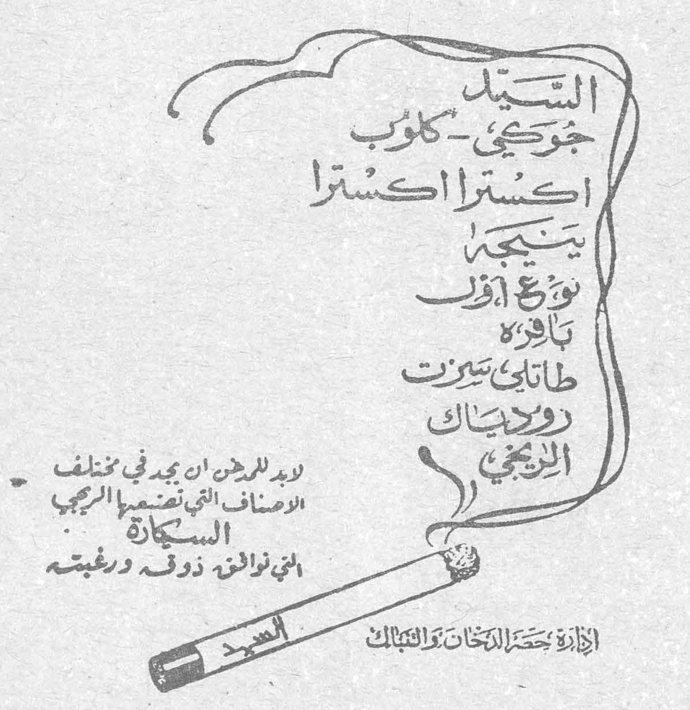
An Advertisement of the Tobacco and Tombac Monopoly Administration
Mr. Georgi Kolb — Extra Extra — Bnige — First Grade — Tabra Taba — Beirut — Rodik Aliji
Let the customer know that among the various brands the company offers he will find the cigarette that agrees with his taste and his desire.
The Tobacco and Tombac Monopoly Administration
Al-Said