for all people everywhere, as UNESCO wants it. My government wants knowledge to reach every corner of the world. It wants to encourage developments in every science. It wants the arts and letters of every country to be known in every other country.
It wants intellectual freedom for all the peoples of the world.
• The lecture of Mr. Jacini, head of the Italian delegation to UNESCO, turned upon "Man." The lecturer centered his subject on humanity and on the culture that respects the personality of man and enriches it, and he expanded in setting forth the values and conceptions contributed by the countries of the Mediterranean, upon which culture has been built.
"Man is he who lives and feels and turns in upon himself," says Dante — that is, man is he who watches himself, criticizes himself, builds himself up, and drives himself toward development, progress, and elevation.
The lecturer gave proof of a deep, abounding, opulent culture.
• On the second of December the choir of the Lebanese Academy of Fine Arts presented the "Divine Mass" of Beethoven, under the direction of Mr. Alexis Boutros.
The Minister of National Education invited to this concert a select company of connoisseurs of splendid classical art.
• The UNESCO Month committee had entrusted to a group of men of letters the task of publishing selections from the Lebanese writers in the three languages: Arabic, French, and English.
The English selections have appeared; they gather seventeen writers in a choice of those of their works that show their personality and their standing.
• There have arrived in Beirut artistic canvases by French artists, sent by the French museums to be exhibited here on the occasion of the UNESCO Month.
These canvases are, for the
most part, what French artists painted of "the East" during visits they made.
This exhibition has been called "The East as the French Artists Saw It."
• On the first of December was opened the "Modern Art" pavilion, organized by the UNESCO administration itself and filled with its own collections.
As for the canvases exhibited, they are colored engravings printed from a selection of the most famous canvases of modern art in Europe, of the various artistic tendencies and styles. The canvases shown are very well
known to the people of art and its devotees.
• The Lebanese performer and composer Anis Fuleihan gave a concert in the Dunia Hall, in which he presented to the Beirut public pieces from the masterworks of modern musical art. Artistic circles in Beirut regretted that a large number of connoisseurs of fine art were unable to obtain the invitation cards, which were distributed here and there but did not reach those who deserved them.
The hope had been great that this brilliant Lebanese artist would find the atmosphere befitting him.
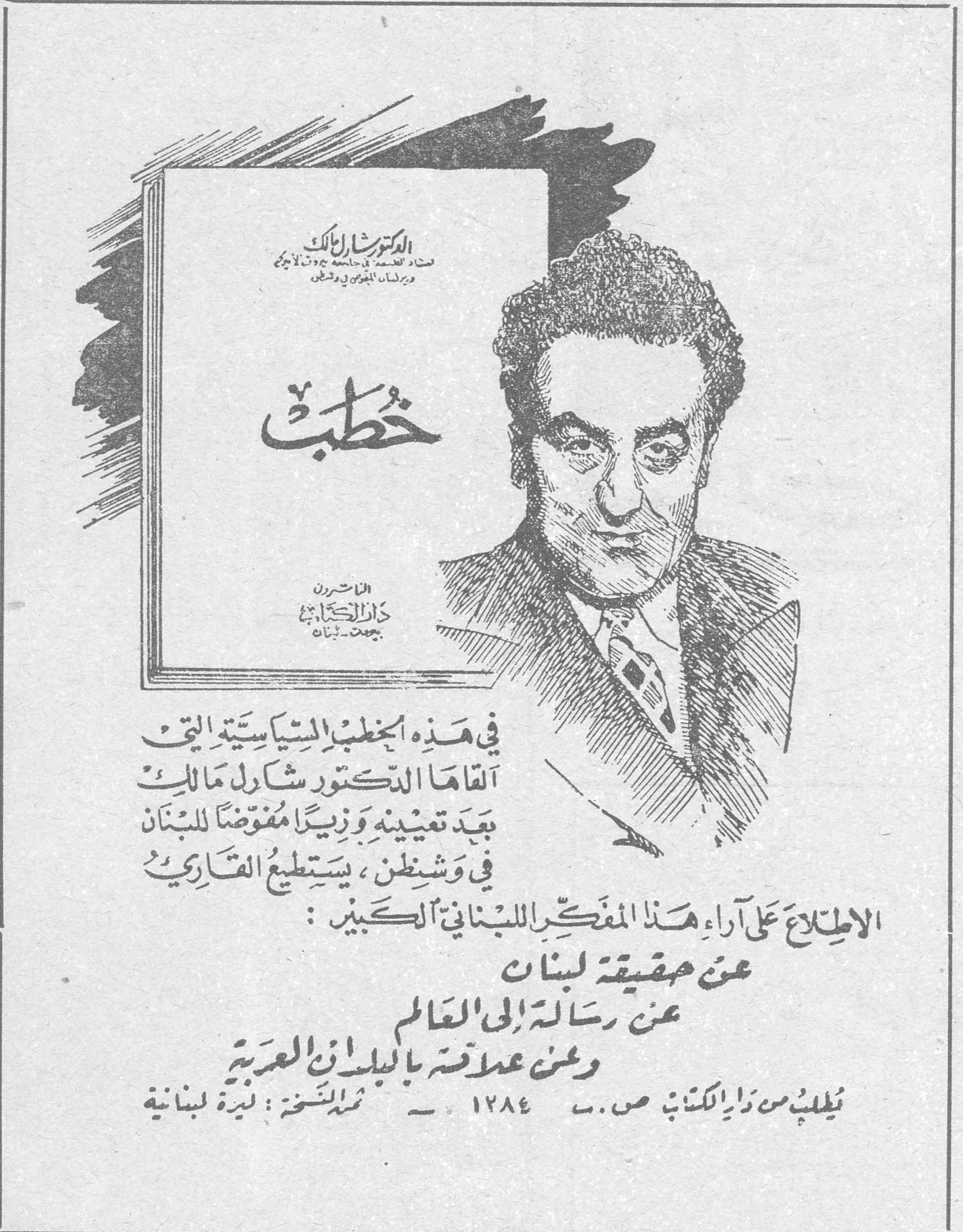
Speeches — Dr. Charles Malik
Dr. Charles Malik
Professor of Philosophy at Georgetown University
Lebanon's Minister Plenipotentiary in Washington
Speeches
Publishers
Dar al-Kitab
Beirut — Lebanon
In these political speeches, which Dr. Charles Malik delivered after his appointment as Lebanon's Minister Plenipotentiary in Washington, the reader can acquaint himself with the views of this great Lebanese thinker:
on the truth of Lebanon
on its message to the world
and on its relation to the Arab countries
Order from Dar al-Kitab, P.O. Box 1284 — Price per copy: one Lebanese lira