Lebanon has been through the ages a meeting place of all those who, fleeing from oppression and injustice, sought refuge among its open hills. It was not strange, therefore, that when our Arab brethren in Palestine had to flee for their lives last May, the people of Lebanon took upon themselves the task of allowing unrestricted entrance to thousands upon thousands of Palestinian refugees fleeing from the atrocities of the Zionists.
It is not my intention, however, to give you the story of the Arab refugees in Lebanon, nor in the other Arab countries to which they came outside of Palestine. Those refugees, though they constitute a new and urgent problem for these countries, are, comparatively speaking, well cared for. I have a more dreary story to bring before the attention of our readers, a picture which may not be as vividly clear to them as that which they see before their own eyes, yet it is more pathetic and in need of more urgent and immediate attention.
It is the story of those who for lack of transport, money, supplies, and above all of water, could not flee further than the nearest districts of Palestine still in Arab hands. They came mainly from Safad, Acre and Nazareth. But the problem was intensified when Ramleh, Lydda and the surrounding villages fell to the Jews. Whereas in the majority of cases, the refugees left their homes without taking any goods with them whatsoever, in the case of Ramleh and Lydda, the Jews stripped them of whatever money or jewelry they carried with them at the time they had, under pressure, to relinquish their homes. Many of these people travelled on foot and arrived to their final destination in the most desperate condition; a number of them, having to pass through waterless areas, died on the way.
These people settled mainly in the central part of Palestine which includes the Arab part of Jerusalem, Jericho, Ramallah, Nablus, Tul-Karem and Jenin, together with the villages neighboring these places. In this area the total number of refugees was
determined, on October 2nd 1948, to be 237,000 people, of whom 130,000 were completely without any form of shelter, except the shelter of trees. (1)
It should be noted that the original population of the area in Palestine which harbours today 237,000 refugees, is only 300,000. Thus, for every 100 of the original inhabitants there are 79 refugees. In some villages the ratio is even more drastic. In the village of Beer-Zeit, of the Ramallah district, the number of refugees is 6800, out of whom 4800 are living under trees, the village having given accomodation to about 2000.
The most crying need, in that area however, is for tents and blankets for those who are living under trees or under the open skies. Food, clothing and medical supplies constitute the next serious problem. What is being done?
Apart from the meagre rations regularly distributed by the Transjordan government, contributions have been negligable for that area. To date (mid-October), only 2500 tents had been allocated to Palestine, through Sir Raphael Cilento, Director, Disaster, Relief
Project. These tents have sheltered 25,000 people, at the rate of 10 persons per tent, leaving 105,000 people still to be cared for. The last cold spell caused the death of a number of children and old people. Unless those 105,000 people are sheltered in the very near future, the great majority of them must perish from exposure during the winter season. Besides, the health of the original population of that area will be seriously jeopordized through the outbreak of epidemics.
The problem of the Arab refugees from Palestine constitutes the more urgent phase of a bigger national crisis for all the Arab countries. Any measures taken to alleviate the suffering of these people is but a palliative of a temporary nature. A more permanent solution should be found very soon.
by : Lily Badre
(1) The statistics and facts in this article have been secured from the reports of the Refugees Committee in Palestine, by the kind assistance of Mr. Musa Nasir, member of the Committee.
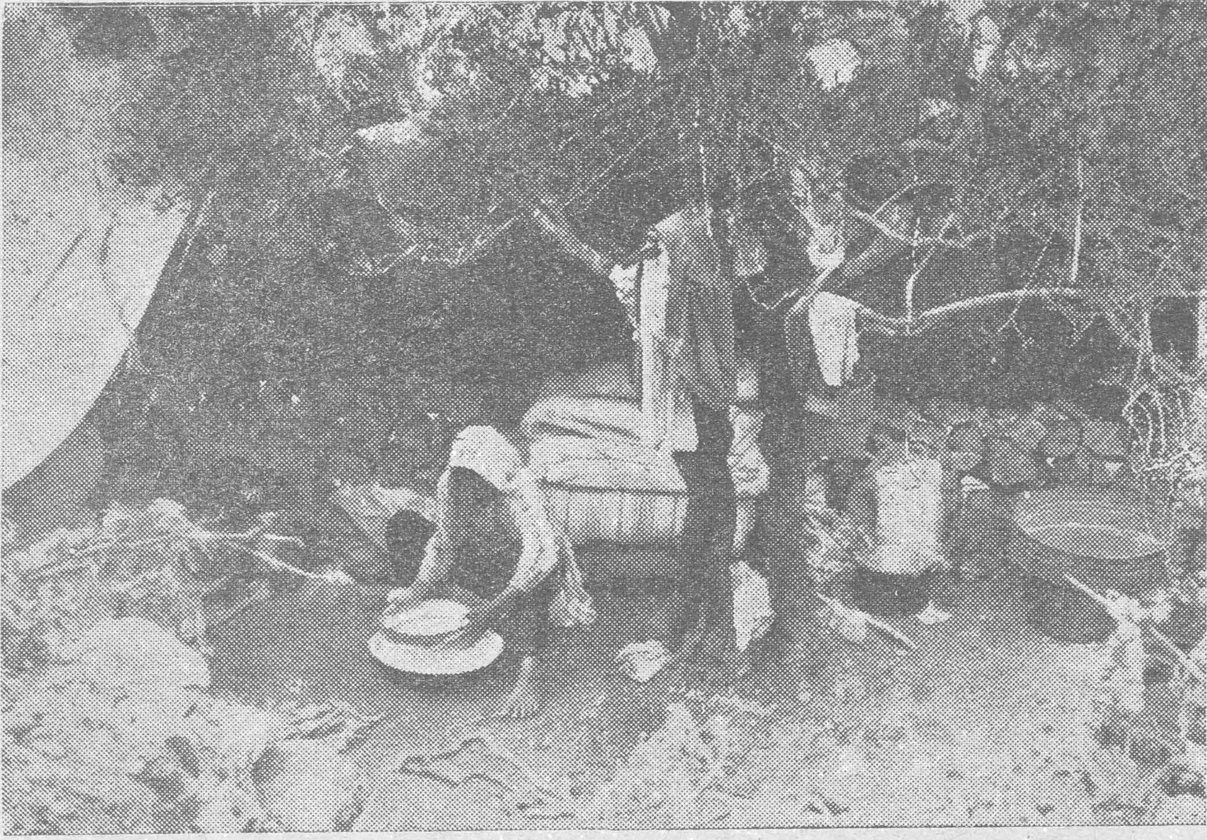
A WOMAN FROM LYDDA SETTING UP HOUSE IN THE FIELDS