For the Lebanese people, Christmas is among the great and foremost feasts, for which they make elaborate preparation from both the religious and the civil standpoints:
Some of the devout among them go to great lengths in performing works of piety, such as visiting the houses of worship, giving charity to the poor, and restricting their food to plain bread moistened with water, or taken with some dried fruits and boiled grains, dry or seasoned with sour and salt, free of any condiment—even of oil. Among their most particular devotions is fasting from the morning of the day before the feast until after the great Mass celebrated at midnight.
It has been the custom in the villages for the parish priests to prepare their schoolchildren to master the Christmas hymns, ordering them to write them out on special parchments and to adorn them with whatever they can inscribe of bright tracings and drawings recalling the events of the feast and its symbols—such as the grotto, the donkey, the ox, the ewes, the shepherds, the Magi, and the snow—crowning all this with the hymn of peace, and using in their writing various kinds of ink, especially red and blue. As for the girls at home, foremost among their concerns from the first of the month is the preparation of dishes of
earthenware, metal, or glass, which they fill with soil mixed with some household grains, such as wheat, lentils, broad beans, and chickpeas, and which they keep watering until the grains sprout and grow lush and green. When the feast comes, they adorn with them the grotto which they set up in their homes as a memorial, or the small wooden altar which they hang on the wall of their bedrooms, usually before one of the pictures of the Nativity or some other picture—all this to draw down the blessing of the feast upon what they have stored or planted of these grains, which then remain, as they believe, in abundance with them, their vessels never emptying.
The Grotto
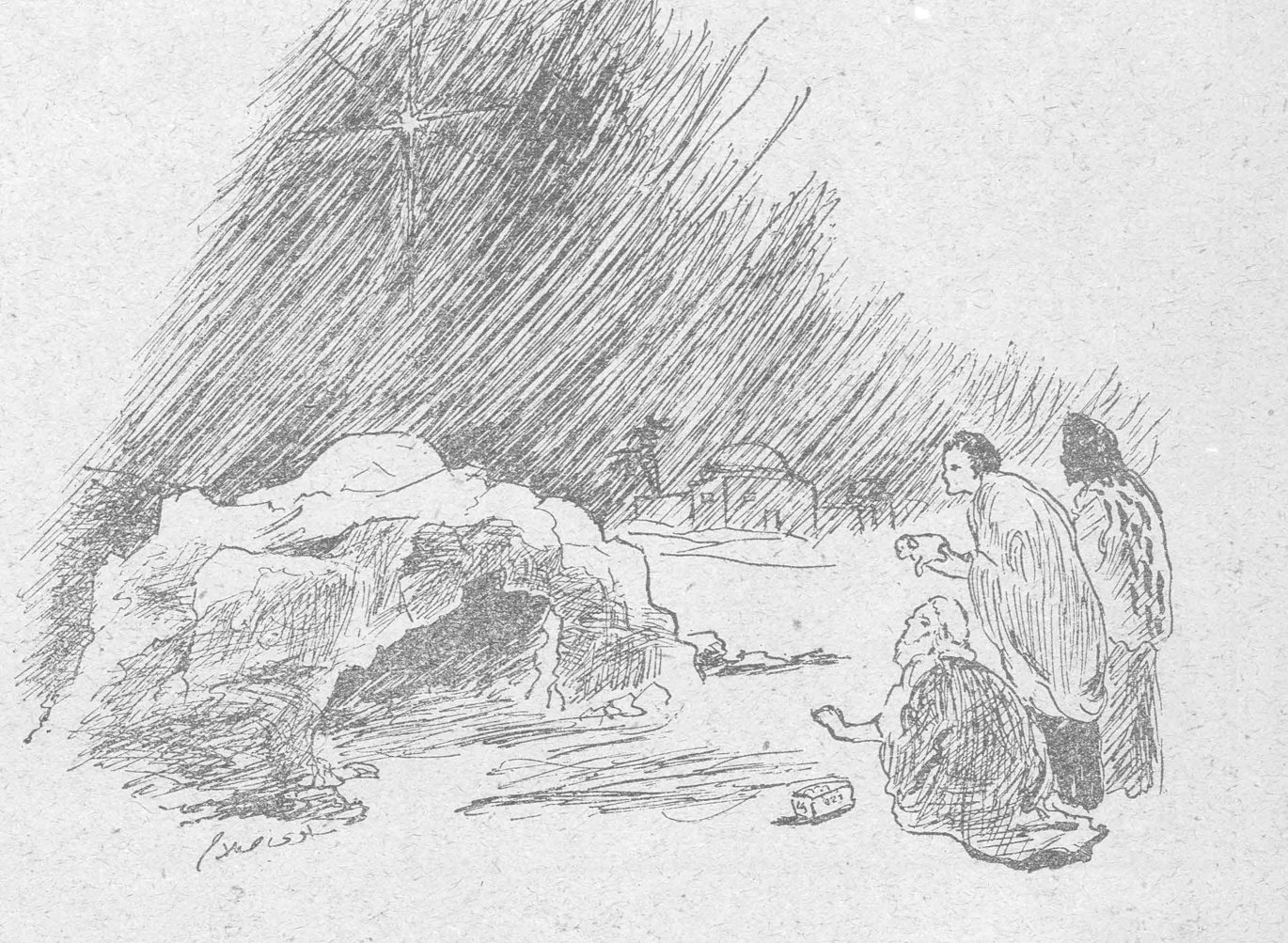
The grotto is, in origin, a curious custom which the Lebanese took over from an age whose date cannot be exactly fixed. With it they represent the birth of the
Child between the Virgin and Saint Joseph, with the donkey and the ox—the two traditional animals—beside them, then the flocks of sheep, then the shepherds with their reed pipes, come to the grotto guided by the light of the star and the hymns of the angels. In these days it is rare for a church or a house to be without this grotto, so that we have no choice but to count it among our national traditions particular to Christmas. It is well known that customs, like people, travel and move about, then settle down and become native.
The Tree
As for the Christmas tree, it is of recent currency. It is usually taken from the pine, which keeps its green in winter, and is set up in homes, institutes, clubs, and shops. On it are hung candles, or electric lights where these exist, alongside clusters of fruit, bags of sugared almonds, strings of sweets, and all kinds of toys, clothes, and ornaments; of these they give to their children and their guests, and sometimes they set some apart for the poor.
The Gifts
As for the custom of exchanging gifts at Christmas, it arose originally in remembrance of the gifts of the Magi. Some say it is taken from the New Year's gifts known as the bistrina; for Christmas and New Year's were, for a stretch of time, one single feast, and were then separated—but the custom of gift-giving clung to them both, as many people still practice it now, especially those in comfortable circumstances. In old Lebanon the gifts were most often kinds of sweets, which the women would prepare on the eve of the feast for a blessing; the most famous of these were zalabiya, ma'karoun, and cakes made with ghee, adorned with tracings and designs.