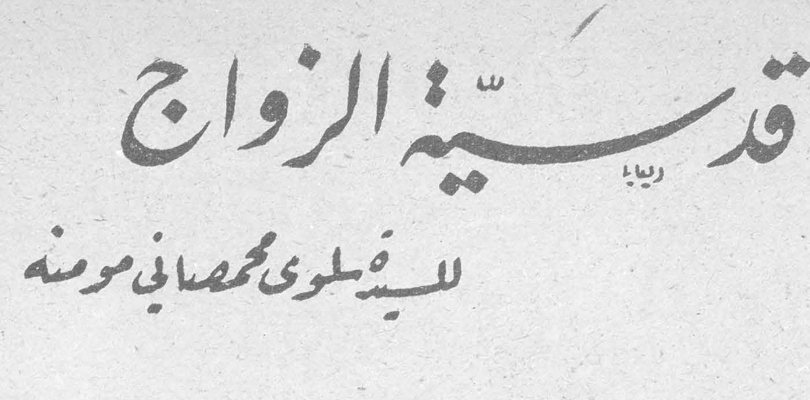
The most important of contracts in human relations, and the most sacred of documents, is the contract of marriage and its deed. For marriage is the bond which God has blessed and which He willed to be made firm by uniting spiritual ties.
In ancient times, before the coming down of the heavenly religions, the bond that united the members of the family among the Romans and the Greeks was derived from their religious creed. Religion alone was the fundamental principle of the law of the ancient family.
Hence the family's existence, in its reliance on religion, was safeguarded and stable—differing entirely from what it would have been had it relied on feelings and natural inclinations, or on birth and bodily powers.
It was the custom of Latin and Greek writers to designate marriage by words indicating that it was a religious act. Pollux, who lived in the time of Antonius, one of the Roman emperors, said: "Marriage was designated of old by a word whose meaning is: the sacred ceremony."
Among the Greeks the bride would wear a white gown; and white was the color of dress on religious occasions and in religious acts. Around her they would sing a sacred religious hymn, and they would hold religious ceremonies in the bride's house, and then in the bridegroom's house upon the wife's arrival.
Time has recounted to us, in the depths of the histories, the stories of mankind. We have seen that the most important mark of civilized nations is their esteem for the marriage relation as the symbol of the social order and the foundation of individual happiness; they adopted it in their civil laws just as their heavenly laws sanctioned it. We have seen also that nations in their death throes incline to neglect and to disdain the sanctity of marriage by acts that violate its established order. Such nations incline, in the whole of their conduct, away from the life of earnestness toward a life of amusement,
frivolity, and dissipation. This frivolity and that neglect have been among the chief causes of the decline of spiritual and moral forces—a decline which usually leads to corruption, and thence to deterioration and ruin.
Such conditions in the life of nations bring in their train the defeat of woman in the field of dignity, and the retreat of man in the field of heroism, gallantry, and manly virtue.
This, beyond dispute, dampens the forces of good in the depths of the human soul, and will drag man toward that heavy materialism which drowns him in the depths of the barren self. The darkness of selfishness then closes upon his heart in the abysses of passions and the untracked wastes of dreams; and ambitions pounce upon his spirit with their deadly fangs, extinguishing in it the light of love and devotion.
Every individual—man or woman—who approaches marriage must know that it is a sacred bond, and a way to a paradise purified of selfish interests, in which hatred, rancor, and egoism melt away, and in which love and devotion, sacrifice and selflessness, live. If the bond of marriage is respected, and surrounded with the reverence it requires, the tower of the family is sheltered from collapse; the rising generation is preserved from confusion and anxiety, and kept from pessimism and delusion—which blackens before its sight the fields of striving—so that the paths of noble deeds open before it, and personalities come forth with their limitless possibilities and their unconquerable powers.
Let man know, then, that every crime within the sanctuary of the family is counted a crime
against society, destructive of the homeland's very existence, destructive of man's conscience, annihilating his contentment, his happiness, and his hopes. As for those who have tied their marriage with the tie of material gain, their trade has not profited; rather, they are losing merchants. For how often we observe that a woman has married a man solely for his wealth and his money, and no sooner is the money gone than family life becomes a hell in whose blaze woman and man alike are scorched. And how often we have heard that a man has married a woman out of desire for her abundant money, whereupon strife arises between the two—she holding back and hoarding, he demanding and coveting—and the matter ends in discord and bitter, dreadful misery. How many tragedies are enacted upon the stage of such a marriage!
There has swept over us from the West a violent wave of materialism which has stamped this age with a stamp that invites no optimism, and which has created among us problems that have led, in many families, to the directing of their members toward a single goal: the amassing of money. All this goes back to the extravagance and prodigality that present-day life demands, and to woman's inclination to imitate others in the means of luxury and adornment. So some have set about amassing money by every manner of means, lawful and unlawful, until many have gone so far as to commit crimes, sacrificing individuals—nay, at times sacrificing nations and homelands—on the altar of greed and the love of money.
We know that the love of money is among the causes that loosen the bonds of marriage. Ambitions and greed are poisons running in the veins of the family, causing sickness, moral death, and the dissolution of character. They are glowering clouds in the sky of the home,