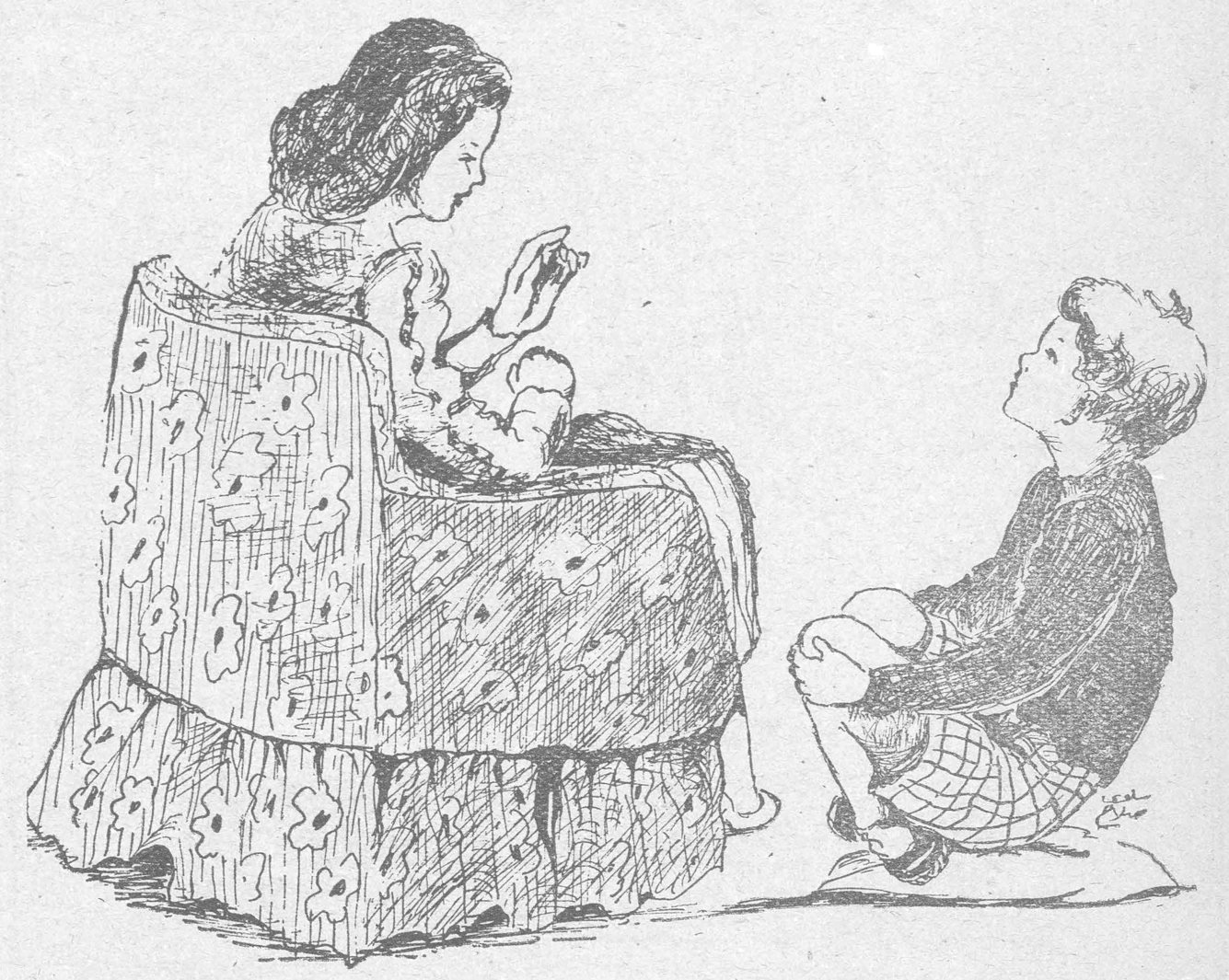
Samir is kneeling on the floor among copybooks and books of various colors, blank sheets of paper and others with writing on them, all of it scattered around him on the floor.
He picks up a copybook and then throws it down; he scatters the books angrily, but in this jumble he cannot find the history copybook he is hunting for. He is late for school, and he must find this copybook to take with him. Now here he finds the arithmetic book he had been hunting for these several days past without success — what a coincidence! He is glad of it, but just now he wants the history copybook. Why does one find a thing when one has no need of it? Samir leaves the arithmetic book and goes back to searching for the copybook, muttering in a low voice.
At that his big brother Asaad asks him: — What are you muttering like that? — I'm not muttering. — Oh yes you are; I saw your lips moving.
What were you saying under your breath?
Samir was annoyed at his brother's prying, because he is always mocking him and making game of him — and especially because these things must not be said out loud in front of everyone. But he had never learned to lie.
So after a moment he answered, abashed: — I was saying an "'addiyeh" for the lost things.
Asaad laughed long and loud, and said to his mother, who was sitting on a sofa in another corner of the room: — Look at Samir — he says an "'addiyeh" to find the book he lost.
Then he stepped over the scattered books and copybooks and went out of the room, still laughing.
Samir's eyes brimmed with tears and he went back to searching once more without hope, watching the books loom and dance through his tears. Then his mother came up to him and began asking: — Have you looked through the whole bookcase? — Yes, all of it. — On the table? — There too. — In the drawer? — In the drawer... no...
He had forgotten the drawer — here was a hope opening before him. His mother goes to the drawer and takes out what is in it: there are copybooks and pencils, a toothbrush, a bag of colored marbles, a snarl of string, a single sock, a piece of chalk, a handkerchief, a box with dead butterflies in it, an overcoat button, and a sugared almond. His mother did not stop to scold him for this untidiness of his, or for the presence of all these things in his book drawer, but looked among the copybooks and saw the history copybook. — Is this it? Samir looked at it and rejoiced: — That's it! He took it and hurried off to school.
Samir came back from school in the afternoon carrying his books, and stopped in front of a shop's glass window: there is the beautiful shawl he wants to buy, colored between gray and green. He wants to give it to his mother on her feast day, two weeks from now; she had longed for it one day as she was passing
this way with him. His father is always scolding him, and his brother Asaad mocks him and torments him; but she is tender with him and helps him. He will buy her the shawl with the coins he has been saving in a little money box for more than five months, giving it a rattle