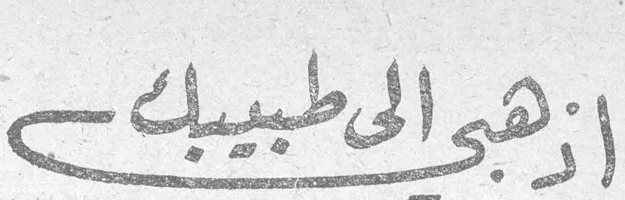
In recent years medicine has been able to postpone the death of the chronically ill by many years, compared with the state of things in the past generation. But the general feeling is that postponing death by several years is not enough, so long as the patient lives out his last years in pain and tears, certain that his end is inevitably near!
The chief cause of the failing state of health in which we find ourselves is that most of us do not consult a doctor until the disease has reached its utmost degree and a complete cure of the patient has become impossible — for by then the disease will have wrought its havoc upon him and forced him to bear its burdens for the rest of his life...
Medicine in this age is not content merely to add to your life several years of constant aches; what concerns it is to grant you, with all the skill at its command, vigor and health, and that you should live happy, as a working member of your home and your circle. And this can only be when the doctor is able to root out the disease in its first stages, or to prevent it from taking hold in our bodies.
In recent years medicine has taken great strides in the examination of the blood, and has devised extremely delicate instruments that enable it to detect the condition of the heart, the liver, the kidneys, and the pancreas, and any disorder that may come upon them, before these organs are affected and before a person feels ill. No one can deny the importance of these discoveries, for they enable the doctor to safeguard the health of his patients and to cut short their chronic diseases to a very great degree!
There are today new methods of analyzing the various secretions and of detecting the particles of cancer at their first formation and removing them without the least difficulty. This discovery will have an important part in lowering the
percentage of mental diseases and of the diseases of the reproductive organs in women.
Nor has medicine stopped at this point; it has widened out into the study of predispositions to the various diseases transmitted by heredity, and of the diseases that arise from a particular deficiency in foodstuffs. We are therefore left with no excuse for exposing ourselves to these diseases and failing to guard against their onset; and the best means to that end is to visit our own doctor every few months, to make certain that our bodies are sound and far from falling into any disease...
We do not exaggerate when we say that with some modern doctors the first medical examination takes up a whole half-day! In it he goes into the history of the members of the family and any weakness that may possibly exist, and the history of illness in the person himself, with minute and ample details of the course of his daily life, the kinds of food he likes and eats to excess, the number of hours he sleeps, the quantity of coffee and tea and drinks he takes, and so on... He dwells upon his emotional life — its success or its failure — and he does not leave off his questions and proceed to his medical examination until he has information
enough to discover any deficiency and to reach a satisfactory result with it.
It is beyond dispute that the hope of a complete cure is more likely when the doctor is able to discover the disease in its first phases; but when the condition of the disease grows grave and the organs concerned are struck with damage, cure then becomes difficult, and the patient remains in a state of constant guardedness and perpetual aches.
Therefore, if we desire lasting health and happiness, it behooves us to remain — while we are still in our full health — in constant touch with our doctor, to make sure that no nets are being spread for us in secret within our bodies, into whose snares we might fall suddenly and without prior warning; and to remain fully conscious of the family health defect to which we are more exposed than other people. If, for example, the disease of "diabetes" runs in our family, let us avoid excess in taking carbohydrates of every kind, and let us have our blood tested for this disease before its condition grows worse, showing itself in stages with which cure becomes impossible.
And it was said of old: "A dirham of prevention is better than a qintar of cure."