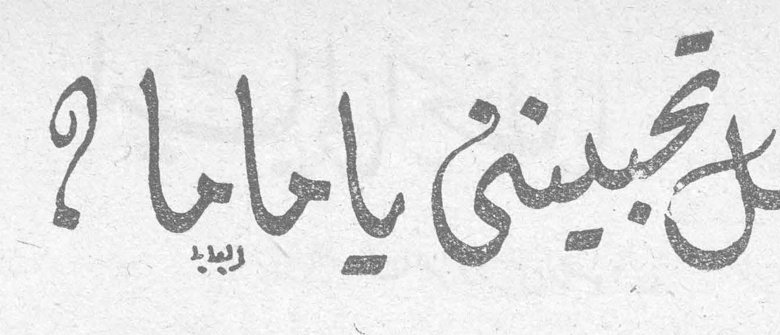
"Do you love me, Mama?" my child said to me once, his eyelids relaxing gently as he lay in his bed, drowsiness creeping into his eyes with a soft, tender creep. I clasped him to my breast and kissed him eagerly and assured him of the strength of my love; and my little one clasped me to his breast in turn, hugging me with both his arms; his face broke into a sweet smile and a quiet serenity, his eyelids closed as the petals of a rose close at night, and he dozed off on my breast with, upon his lips, phantoms from a happy, tranquil world.
"Do you love me, Mama?" A question my child asked, lying on my breast between drowsing and waking, in those brief moments when a child's mind is empty, fragile and surrendered, sleep hovering with its fluttering wings over his eyes. It awakened in my soul that night, and on the nights that followed, much astonishment and wonder, and many deep stirrings of the soul; and I kept asking myself what had led him to this question, turning over in my imagination all that I could remember of the incidents of my life with him and his life with me, hoping to discover what might be the cause of this anxiety in my child's heart..
That day I felt that my child needed something other than the clothing that warms his body, other than the food that nourishes his blood; I felt that he needed what is greater, more lasting, and nobler: he needed my love — all my love. My love alone nourishes my child, for his spirit needs warmth from my spirit, and his body needs a garment from my body; and all else is vain, without meaning and without value to him.
And this child of mine is one of the children of this country who need pure, deep love and go searching for it in the arms of their mothers and fathers. For clothing does not warm
the heart, and food does not nourish the spirit; and giving, and even toil and drudgery for our children's sake — none of this secures for them that serenity of spirit which they find only in our love and our tenderness.
"Do you love me, Mama?" And what mother does not love her child, does not give him of her heart and her life, so that his heart and his life may remain his own? Yet this love very often takes on forms of treatment that work upon these tender, sensitive souls in different ways; and in the light of these effects this childhood is reared, carrying in the depths of its soul many far-reaching feelings that accompanied it in its earliest days.
And this love that I mean is not the flabby love that rules mothers in the rearing of their children, under which the child's character turns vicious and the spirit of domination and mastery grows in him, until he becomes in the house the commander and forbidder whose demand is never refused; nor is it that fearful, cowardly love which dreads the breaths of the breeze and the rays of the sun, under which the child grows up cowardly and afraid.. nor that love pent up in the breast of father and mother, which takes on dull outward forms of harshness, sternness, and violent coldness, and which breeds in the child the spirit of revolt and the bent toward anxiety and rebellion — but the gentle, quiet love, the mutual affection, the kindly companionship, and the serene, tender atmosphere that floods the house with joy and beauty. The love I mean is the love in which the child's heart is at home with the heart of his father and his mother,
with no artificial barrier of gravity and scowling and counterfeit convictions standing between him and that heart, so that he lives lost and a stranger in his own house and between his own parents..
How often we hear a mother scolding her child for the dirtiness of his clothes and his hands, or for something he has done: "I don't love you any more, with you in this filthy state!" And the little one steals away without uttering a word.. His mother imagines that in saying this she has used with him the gentlest of the methods of upbringing, the one furthest from wounding him; and it escapes her that such a harsh phrase has set between her and her son a barrier he can never afterward cross, and that she has smashed his small heart with a cruel blow.. He does not fear her hand reaching him with a hard slap, nor does he much dread her depriving him of his toys and his food; but he dreads greatly the loss of her love — and he asks for nothing but her love.
Such a mother uses her affections as a whip with which to lash her children, and forgets that this child will never again be at ease with life, will never live in a happy atmosphere, once he believes he has lost his mother's love — that love which is the most precious thing a child possesses, and the thing he most eagerly clings to..
And how many a child in this country has grown up without his spirit being fed its spiritual food: his father takes care to fulfill his duties toward him in the best manner, without giving the emotional side of his life any serious attention. He never addresses him,