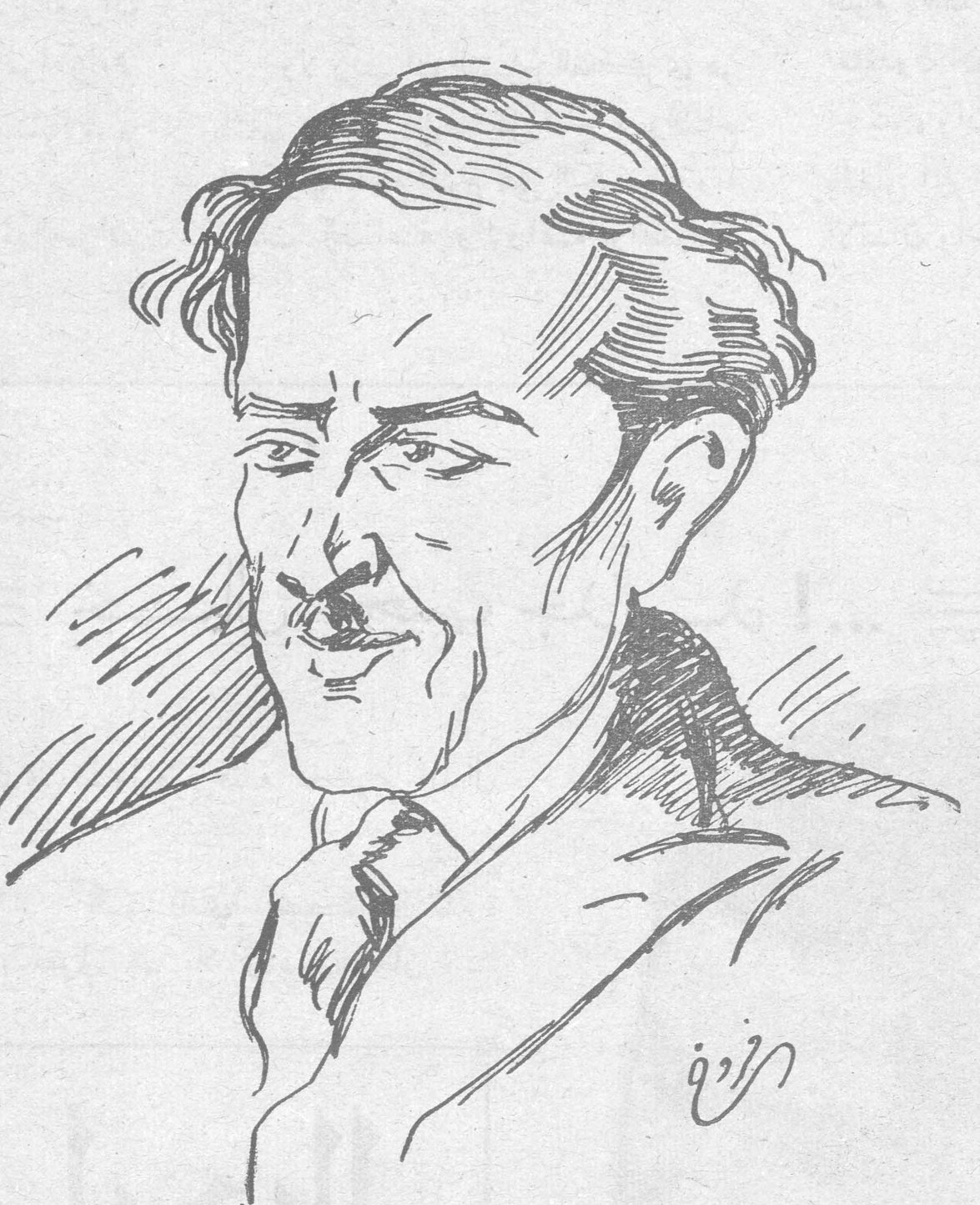
On the twenty-seventh of January 1947 the great poet Elias Abu Shabaka died. Radio Lebanon commemorated the anniversary, and there spoke on the occasion Messrs. Omar Abu Risha, Fouad Hobeiche, Abdul Latif Sharara, Antoine Karam, and Fouad Suleiman. "The Woman's Voice" is glad, in its turn, to honor this precious memory, and so devotes these pages to the beloved poet.
The disease walked in Abu Shabaka's arteries and mingled with his blood; the white corpuscles were devouring their red companions with the gait of one confident of his dominion, assured of his victory... Neither electricity, nor liver extract, nor the other treatments could halt its march. The poet did
not grasp the gravity of his disease, and none of us, his companions, knew the true cause of the symptoms that assailed him. At one time they would tell him they were the symptoms of an enlarged spleen, and he would believe what they said and repeat it to us; at another he himself supposed they came from a piece of shanklish he had eaten over a glass of arak — for he had scarcely dozed off in his bed before he awoke to pains spreading through his veins, beside which the pains of a woman in hard labor are not worth mentioning.
He kept to his bed in Zouk a full month after what he imagined to be shanklish poisoning. Then the doctors advised him to move to the hospital, since the means of treatment would be more plentiful for him in Beirut than in Zouk. He did so. In the hospital the pains returned upon him, insistent, crushing, engulfing. Medicine stood before them baffled, bewildered, helpless, watching the disease's advance and possessing nothing but morphine to soften agonies that wore down the body and drained the spirit — while the sick man bore them with a wondrous patience,
neither complaining nor grumbling, in hope of the speedy recovery with which the doctors kept comforting him out of pity for his youth, and in answer to what they read in his eyes of his attachment to life; for he had loved it for the sake of his "Layla," and had come to desire it in spite of its frowning and scowling upon him. He would assure the friends who came to visit him that in a few days he would be back in Zouk, drinking from the water of its famous spring, anointing his eyes with the sights of its countryside, his ears delighted by the chirping of its sparrow.
When I visited the poet late in the afternoon of Saturday, January 25, 1947, I saw a Catholic priest in liturgical
vestments coming out of his room, having heard his confession and furnished him with the divine sacraments. I knew then that the hour of parting from this earth had drawn near. My eyes brimmed with tears; I stopped a moment and wiped them, then walked on and entered the room, forcing a smile. I drew near the sick man's bed, cheering him and poking fun at the doctors, recalling how often they go wrong in their diagnoses, and telling my own story with them, when they sentenced me to a speedy death five years before.
The poet's lips parted in a forced smile, and he said in a faint voice, as though following a dream:
— ...A little sparrow! It flew, it flew, and it came down... What can a little sparrow do?!
That fading phrase was the last thing I heard from Abu Shabaka's lips, for he breathed his last at about four o'clock on the morning of Monday, January 27, 1947, in the arms of "Ghalwa" — Ghalwa, upon whose love his heart had opened, and upon whose image his eyes were closed...