
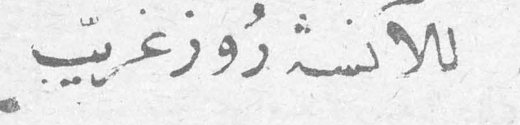
Here is a subject “in the air,” as they say in English. The phrase fits it, first, because it has been so for some time, since it formed one of the subjects of a parliamentary session whose members passed it by without a glance, while some newspapers and some circles of conversation took it up with a little comment and much coolness; then the curtain fell and it flew off into the air.
When the members of the Chamber rejected the proposal on the ground that it was premature and that woman among us is not fit to vote at the present time, not one of them thought — in all fairness — to examine whether all men among us are more qualified to vote than women. And if women have been denied this right on account of the spread of ignorance and illiteracy among them, is it not just that illiterate men be denied this right as well, and that voting be confined to the educated alone, men and women alike?
The subject of woman and her emancipation is almost a settled matter in the advanced Western circles; rarely do you come upon a subject in their magazines that takes up such a question as “Was woman created for the home?” or this other: “Is it permissible for a woman to work outside the home?” or “Does woman have the right to vote?”
And rarely do you find a Western magazine of general culture that sets apart among its sections a section for woman, because it leaves that to the women's magazines and because its studies treat woman and man alike in every branch of culture and work. The international magazine
“Time,” for example, whose contents take up all the faces of modern life — politics, education, religion, science, art, cinema, sports, books — gives woman no special page; indeed its talk of famous women is no less abundant or important than what it writes of famous men, and the pictures of prominent women in it are no fewer in number than the pictures of men.
We publish below the names of the countries in which woman exercises her political rights...
Albania, Germany, Argentina, Australia, Austria, Belgium, Brazil, Byelorussia, Canada, Chile, China, Korea, Costa Rica, Cuba, Denmark, the Dominican Republic, Ecuador, the United States, Finland, France, Great Britain, Guatemala, Hungary, Iceland, India, Ireland, Italy, Japan, Luxembourg, Mongolia, New Zealand, Norway, Pakistan, Panama, the Netherlands, the Philippines, Poland, Romania, San Salvador, Siam, Sweden, Czechoslovakia, Turkey, the Ukraine, the Soviet Union, the Union of South Africa, Uruguay, Venezuela, Yugoslavia.
Where woman has been denied her rights:
As for the countries in which she does not have the right to exercise her political rights, they are: Afghanistan, the Kingdom of Saudi Arabia, Bolivia, Chile, Colombia, Egypt, Abyssinia, Greece, Haiti, Honduras, Iran, Iraq, Lebanon, Liberia, Nicaragua, Peru, Portugal, Syria, Transjordan, Yemen.
Some time ago one of the American magazines conducted a poll among married men, asking them, among other things: “Do you approve of the wife's working outside the home?” — and 90% of them answered: No. Yet despite this negative stand on the man's part, the number of married women work
ing outside the home keeps growing day after day. The Western woman fills every minute of her time with some work; housework occupies her, since servants are few and their wages high in the Western lands; but as soon as she is done with it and finds before her a measure of leisure, she hastens out of the house to take up some work, for pay or as a volunteer, out of her belief in the necessity of her mental and cultural growth.
The progress of the modern woman moves with an astonishing speed to which the figures testify. The women of England struggled seventy-four years to obtain the right to vote (1846–1919), and the women of America struggled about a hundred years until they obtained it in 1920. In 1915 women's suffrage was confined to England, New Zealand, and Australia. But in the latest period, between 1915 and 1938 — that is, in less than twenty years — women's suffrage came to include twenty-five states, to which were added, after 1938, France and the two states of India and Pakistan.
And if our women recall what the strugglers among the leaders of the women's movement in Europe endured in the last century — man's persecution, his cruelty, and his mockery — the troubles they themselves meet from the partisans of reaction among us will seem