"Music is the purest form of art and the truest expression of beauty in its form and its spirit... it is the eloquent silence that nature inspires in our hearts." — Tagore
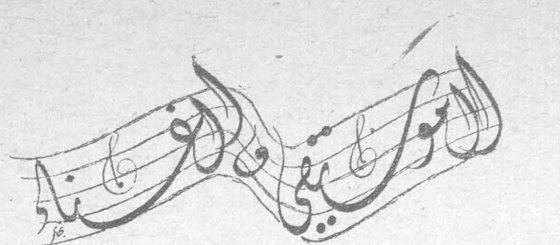
"In the heart there is a virtue
that the power of speech could not bring forth in words, so the soul brought it forth in melodies." — From the sayings of the Arabs
Early man, in the ages before history, felt only
the material needs — food, clothing, and shelter; but the turning of man's demands and his thoughts kept pace with the turning of time and its conditions, and the history of the ancient civilizations tells us that man was not content with meeting the material needs, but began to feel a loftier and more complete need: to express what passed through his mind and what stirred within his soul. So he discovered speech, then the rhymed kind of it, then the metered and rhymed, and he began to set it to melody — and thus he came to know song. The oldest poetry was sung in the temples and the gatherings, and the oldest meanings contained in sung poetry were for sanctifying the gods and glorifying them and chanting in their worship, and for voicing the impulses of longing and passion; and perhaps for this reason the ghazal is among the oldest known purposes of Arabic poetry, its traces still preserved in the opening of the pre-Islamic ode in all its various purposes. For this reason, too, one says "he chanted poetry," not "he spoke poetry," because poetry was originally for chanting and song. Thus the Greek poet Homer would roam the streets of Athens chanting his sweet melodies, carrying his delicate lyre, complaining of his lot, weeping over his sorrows, exulting in his joys... Song is ancient among the old civilized peoples; and before the Arabs took it over from the Persians and the Byzantines they had only the camel-driver's chant and the recitation, which they called "al-rukbaniyya." The first of the people of Mecca to carry foreign song over into Arabic was "Sa'id ibn Misjah": he passed by the Persians as they were building the Sacred Mosque in the days of Abdullah ibn al-Zubayr and heard them singing in Persian, so he recast their airs in Arabic verse and took the best of them, and he was the first to perform Arabic song in Mecca; he
was the teacher of Ibn Surayj, the famous singer. It is also said that the first to sing to the oud was a young man of the people of Medina called "Sa'ib Kha'ir," who likewise carried melodies over into Arabic from the Persians; and from him took Ma'bad, and Ibn Surayj as well, and Jamila, and 'Azza, and others. The first among the Arabs to compose the hazaj was a man called "Tuways," who was nicknamed the Melting One... because he sang: "Love has so wasted me that from my passion I almost flew." And when the Muslims entered al-Andalus at the beginning of the eighteenth century and spread their arts and their culture there, the Westerners imitated their manners and their letters, for these were the highest model of taste and perfection. But al-Andalus itself was not affected by culture and the sciences as it was affected by music and song — that in the age of the blended literature, the age of the muwashshahat and the zajal and sung poetry; for the muwashshah, for all its artistic value, is a child of the soil of al-Andalus in its music, and borrowed from the Arabs in its mold. God inspired His creatures and wakened their talents, and ordained for some of them a share of His gifts that rest upon grasping the essence of beauty, giving free rein to the imagination, fineness of the sense of hearing, and abundance of feeling and of tears — those gifts or endowments which we touch in the canvases of painters, the melodies of poets, the pieces of musicians, and the writings of men of letters. The fine arts draw the man who is bound to them by a spiritual tie — the man who weeps at the weeping of the musician and the poet, who applauds with delight whenever he discovers one of the manifestations of art and beauty, who thrills and sways at the hearing of plaintive airs, and who knows the imitation of nature; and so his spirit rises to what
has no end, from touching the enchanting divine power and discovering its secrets. That is the end which every artist and every appreciator of art aims to reach, for every perfect art is a splendid picture of God's making, written by His hands during the artist's trance. And music is perhaps the most widespread of the arts among people of all their classes and degrees of learning, for the unlettered and the educated, the old man and the child, are all fully prepared to savor melodies and to understand them; whereas poetry, painting, sculpture, and the other fine arts require wide knowledge and sound taste in order to distinguish the beautiful in them from the ugly, and to be able to understand, criticize, and analyze them. Music, in Tagore's phrase, "is the purest form of art and the first expression, the truest statement of beauty in its form and its spirit; indeed it is the nearest tongue for subduing the heart, and it is nothing but a bounded description of the infinite — it is the eloquent silence that nature inspires in our hearts with the delights of its scenes." And I recall what one of the sages of the Arabs said: "In the heart there is a noble virtue that the power of speech could not bring forth in words, so the soul brought it forth in melodies." Add to this that man is created with a love of music and stamped with an affinity for it, for nothing quiets him in his cradle but the measured lullaby and the soft, mellow tones that turn the sharp-tempered infant into a calm and gentle child who listens intently to what he hears; and no sooner have his ears grown familiar with the tender voice than he sinks into deep slumber. And if such is the effect of music upon man as a child, what must its effect be upon him as a youth, when his feelings have begun to grow with the growth of his body and his mind?!