divorce, each has the right to take half of the property common between them, and both parties are obliged to look after the portion belonging to the other and not to injure it in any way. Thus the wife was given economic equality with her husband. This law is general among all the inhabitants of Scandinavia, and a proposal was presented last year to change and amend this law.
But how is the problem of the wife solved—the wife who works outside the home? A solution appeared there that was not destined to succeed: the one calling for the payment of a fixed salary to the wife who does not work outside her home; but this did not last long, and was rejected. Yet when the feeling came to prevail that rights and duties are equal between the two sexes, and that it is the duty of every individual to attend to the family's support, a law was issued fixing the value of the woman's work in the home and pronouncing it equal to the man's work outside. The husband must pay his wife the expenditure necessary for running the house, and she has the right to receive this amount at fixed times, since she is not to be made to ask for it every time she needs something. She likewise has the right to know her husband's income, and he hers in the same way. And where the woman performs the household duties herself, the husband must bear her personal expenses alongside the expenses of the family's life and the children's schooling.
But how is this problem solved if one of them, or both, should attempt to refuse to inform the other of his income? Here the two resort to the courts, which decide the dispute—and in the margin it must be mentioned that the courts in Sweden work only upon such family cases, since crime plays no part there, and freedom is given to every individual; and for all that, their soil does not breed criminals as our soil does, especially in these days—and if the two persist, the court then decrees divorce; and such separation happens often, and for such a reason. And speaking of divorce: the wife has the right, as the husband has, to demand it, and
the separation is accomplished in two stages. The first is the separation of the two spouses for the space of a year, in the hope that distance may endear the one to the other anew, so that they return to married life; and at the second session they decide together either reunion or final separation, and in this latter case they settle upon who shall undertake the upbringing of the children, and the amount the husband must pay is fixed in case the mother takes the children. Thus they lodge a paper in the court declaring their inability to live together for the reasons stated, and afterward they obtain the divorce paper—that is, after the passing of the year since the first session, as we have said. Among the general causes that warrant divorce in that far-off land are: the separation of the spouses for three years, or the failure of each to share with the other the same views and aims; marital infidelity is likewise an important cause, and imprisonment for two or three years, and contagious diseases are grounds for divorce as well.
There is another very common problem, namely the position of unmarried mothers; it remained a real problem throughout the past twenty-five years, but it has now found some solution. For the mother and the child there are special homes offering her the necessary care and a comfortable living; perhaps the motive is to encourage the increase of offspring after that general decline in the number of the population in 1932 and 1933. Care, in their
view, is the essential thing, and the manner, however disgraceful it may be, is of no consequence: the sin is not the child's fault, and in this case the children's teeth must not be set on edge when the fathers eat sour grapes; and so long as he has been born, he is a child of the state and has the same rights as other, legitimate children. This is their view of such a question, and it differs altogether from our view, ours in the East; it differs likewise between town and village—the view of the latter draws near to ours without quite equaling it—and this is the case in most, if not all, the countries of the Western world.
The illegitimate child has the right to take his mother's name if she wishes, provided that the father pay her his expenses; and if the mother declares that a certain man is the father of her child, and the blood test indicates otherwise, he must pay the expenses. In Denmark a single child may have nine fathers, and no more...!! And this truly is the joke of jokes!! And the father in such a case must pay the expense of the child's upbringing and schooling.
As for the law of inheritance, it accords woman the same right as man. If she dies, her husband's family and her own family divide the inheritance—this if the two have no children; but if children exist, they take everything, and no one else inherits at all. Woman has the same rights in the courts
as man: she signs contracts and bills, and writes her testa
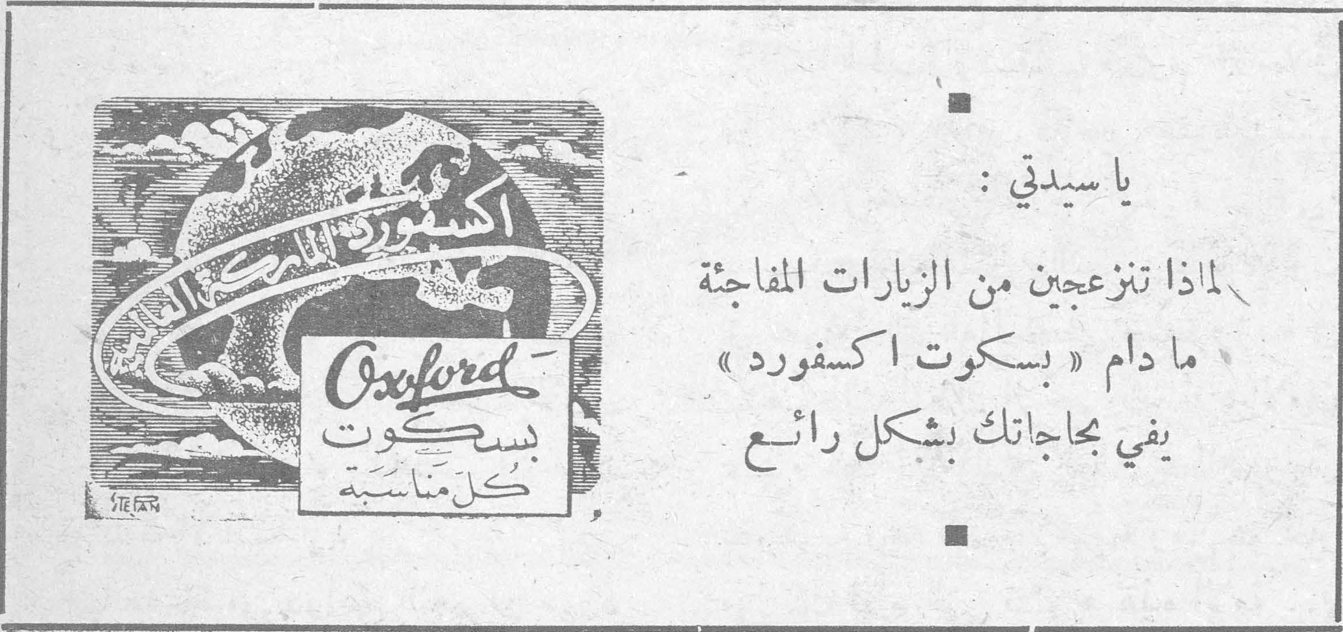
Oxford Biscuits
Oxford
Oxford
Biscuits
For every occasion
Madam:
Why be upset by unexpected visits, so long as "Oxford Biscuits" meet your needs splendidly?