magazine will continue its humane mission of carrying this voice, the woman's voice, high in every part of the Arab lands, and especially the voice of motherhood, which creates the new generations. "The Mother and the Child" is supervised by a committee of Iraq's noble ladies, who are: Mrs. Ismat Sabah al-Sayyid, Mrs. Ma'ida Haydari Mahmud, Miss Bahiya Farajallah (the reader will find an article by her in The Woman's Voice), and Mrs. Almas Kina.
A new women's magazine has appeared in Baghdad, "Bint al-Rashid," whose proprietor and editor-in-chief is Miss Durra Abd al-Wahhab.
It is a literary, social, and artistic magazine appearing twice a month. The fourth issue of this magazine has reached us, containing a number of subjects of interest to woman; a band of ladies in the sister country took part in editing it.
To "Bint al-Rashid" in Iraq, "The Woman's Voice" in Lebanon wishes steady progress and success.
Miss "Nazik al-Malaika" is a poetess rich in feeling. About a year ago she brought out her collection of verse, "Lover of the Night," the first collection the poetess has published.
She is also preparing a verse epic of one thousand two hundred lines entitled "The Tragedy of Life," and another collection whose poems were composed after "Lover of the Night."
Her first collection found favor with the critics and poets of the Arab world.
Miss Nazik intends to travel soon to England, to pursue in its great universities the study of English literature; she is working for a doctorate in letters.
There is no doubt that the poetess's presence in the land of the great Shakespeare will allow her imagination to soar in spacious airs.
Mrs. Widad Sakakini is counted among the active women of letters of Syria. She has an abundant production of stories and studies. The latest work the writer Sakakini has produced is the story "Arwa Bint al-Khutub," a tale whose events took place in Damascus a thousand years ago. She has brought it out in an elegant style, and in a dress more elegant still.
Margaret Truman, daughter of President Truman, has caused an economic crisis in the United States.
Government circles were taken by surprise by a grave statement published by the Daily Express in London and attributed to Margaret Truman, in which the first young lady of the United States says that she has decided not to eat potatoes from this day forward, so that her weight may not increase.
America's potato growers and exporters rose up in arms at this statement, and Mrs. Mildred Dober, the potato queen of America, promptly sent a telegram to the White House asking whether the statement attributed to Margaret Truman was true. The White House was obliged to issue an official statement in Margaret Truman's own words, in which she said:
What has been attributed to me is not true; I have never for a single day stopped eating potatoes.
The Albanian radio keeps pressing the Yugoslav women, urging them to undertake a bloody struggle to do away with Marshal Tito.
This appeal was sent out on the occasion of International Women's Day, and it was delivered over the Tirana radio by Pera Ivanović, pres
ident of the High Court of Justice in Montenegro, who had fled from Yugoslavia after the split between Tito and the Cominform.
In 1916 the literary queen of Romania, Elisabeth, wife of Carol I, died. She was famous under the name of Carmen Sylva, and the literary queen was buried beside a small river which she had mentioned in many of her works. The peasants of that region always made it their custom to scatter roses on the literary queen's grave on every occasion.
But Ana Pauker, Romania's minister, decided for some reason that the memory of Carmen Sylva, former queen of Romania, did not deserve to occupy the minds of the people of Romania to this extent, and so she ordered her bones taken out of her grave and burned. And after the burning was done, she ordered the ashes that were left of her strewn in the river, believing that she had thereby wiped out her memory forever from the minds and hearts of the Romanians.
But when the time came for the observance of the anniversary of the literary queen's death, many of the inhabitants of Romania gathered on the riverbank at the spot where the queen's ashes had been cast, and there they threw their bouquets of flowers and roses.
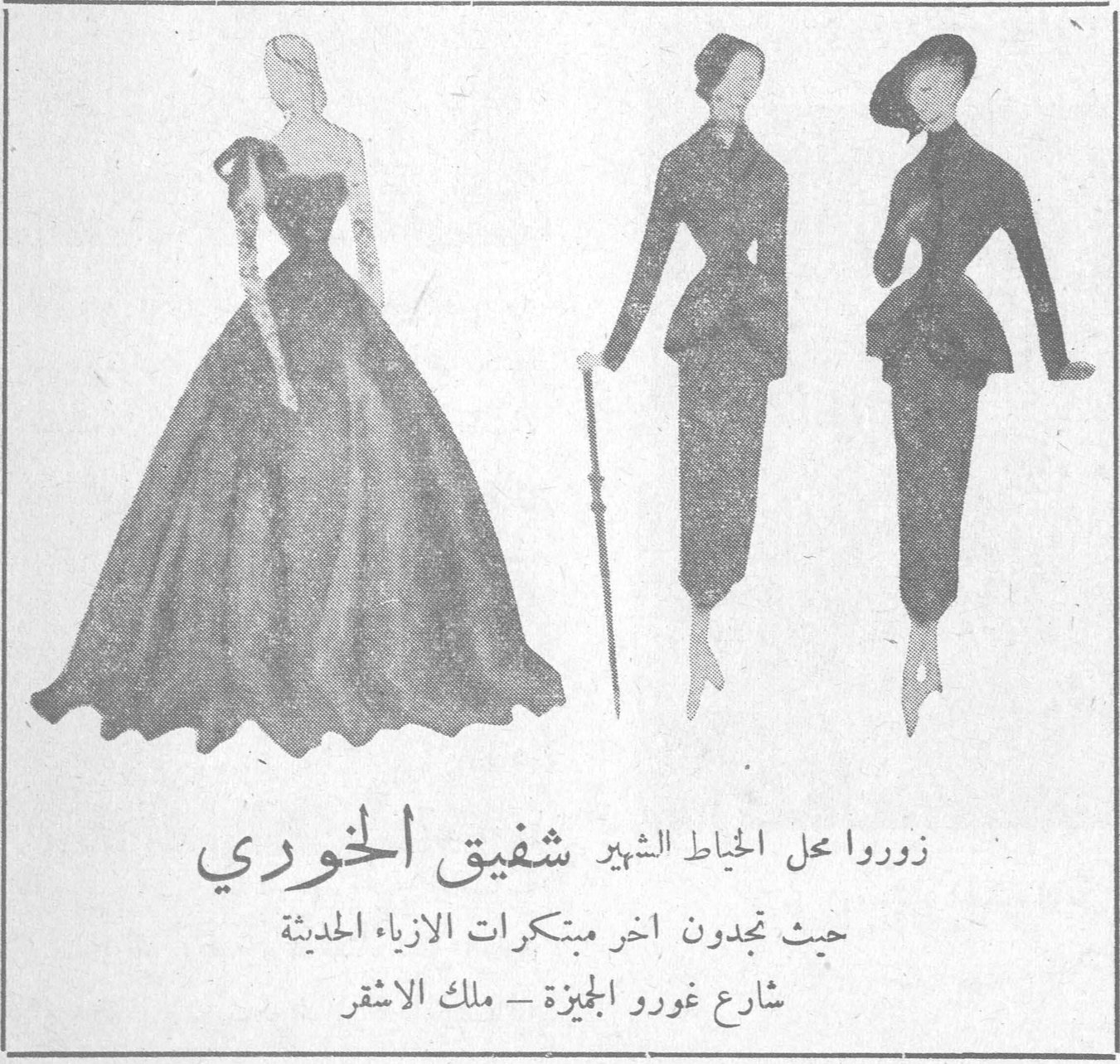
Visit the shop of the famous tailor Shafiq al-Khoury,
where you will find the latest creations of modern fashion.
Gouraud Street, Gemmayzeh — Achkar Building