Amid the depths of sorrow and the succession of calamities, the call of "the Voice" reached me, asking me to record the renaissance of woman and her activity in Palestine, and her keeping pace with the caravan of world women's progress, for its special conference issue... Palestine!? What has she to do with the caravan now, when she has fallen, her brow bowed low, her ribs bruised blue, despoiled of her being, her wounds grievous...? Can Palestine march on, when hope has been dashed and darkness has followed upon darkness... and where is the way!? Where, O guide of the road — you have strayed!
Where is the way — O leaders of the caravan — when the beacon has gone out, the banner has been furled, the assembly has fallen silent, and the dwellings stand empty?! Hush! There go their caravans pressing on with the departure, and there is their caravan-singer, his call ringing out across the horizons, shaking hearts and striking the ears. Palestine after Andalusia..!? God be with you... You fall slain, and after today shall no one remember you? Shall no flags flutter across your expanses, no processions march!? Nay — the angels there circle about the fallen heroes, bending tenderly, crying: Softly! Passerby, stand humble and bareheaded; do not tread the ground with your feet, for that is the resting place of the martyrs; every spot of it is a garden for them, and upon every hill stands a banner of their struggle!
... And what is there, O strong and eloquent "Voice," but sorrow and tears and the flood of blood?! Alas for Palestine — is there any dressing for her wounds?! Then let these lines on the renaissance of woman there be drawn from the flow of that ink and the inspiration of this struggle, for in it she has a message and a record... And what a renaissance the Palestinian woman has made, and what a fight!? Despite the successive revolts, which numbered eight from 1920 to the beginning of 1948, and despite the meager
allocations for education in the era of colonialism, which did not exceed four percent, she was able to cut her way steadily forward. We see her passing through the stages of primary education, then secondary, then making her way to the universities of East and West in pursuit of learning, afterward taking up in them the reins of teaching and social work, practicing medicine, and reaching the government offices; and we see illiteracy dwindling in the great cities until it is on the verge of vanishing. Thence that renaissance sprang from a comprehensive national consciousness, whose effects have shown themselves in the various fields of social and cultural activity, radiant and far-reaching...
So much for the cities. As for the Palestinian countryside, where hundreds of villages are scattered, the village women had no more than ten small schools, in which they spent a period not exceeding two years; and this brief span of study, together with the absence of social and cultural activity in their surroundings, could not have living results. Yet their sacrifice on
the field of battle takes its place in the book of the struggle as one of its shining, immortal lines! This activity flourished in the cities, and perhaps the most brilliant proof of the sense of national responsibility is the rising up of women workers in the cultural field and their shouldering the burden of founding private primary and secondary schools, to keep the general standard of learning from collapse and retreat during the ordeal! In the social field, her activity multiplied, until the number of women's
associations in the Arab city of Jaffa reached seventeen when they formed themselves into a single rank — for the fight — after the partition resolution. Jerusalem — the capital — likewise marched in the vanguard and took part in every field, and this activity extended to the rest of the cities.
I turn now to that activity and those efforts in the District of Samaria — the cultural center of the district — where they are concentrated in three institutions: the Women's Union, Child Welfare, and the Department of Social Affairs...
The Women's Union, before its affiliation with the Egyptian Union in Cairo in 1938, was an association founded through the efforts of its late president, Miss Mariam Hashim, in 1931, under the name of the Arab Ladies' Association; owing to compelling political considerations it was not registered until 1945. Since that time it has striven a blessed striving in charitable works, in teaching illiterate women, in caring for the orphans of the martyrs and sending the older among them to asylums
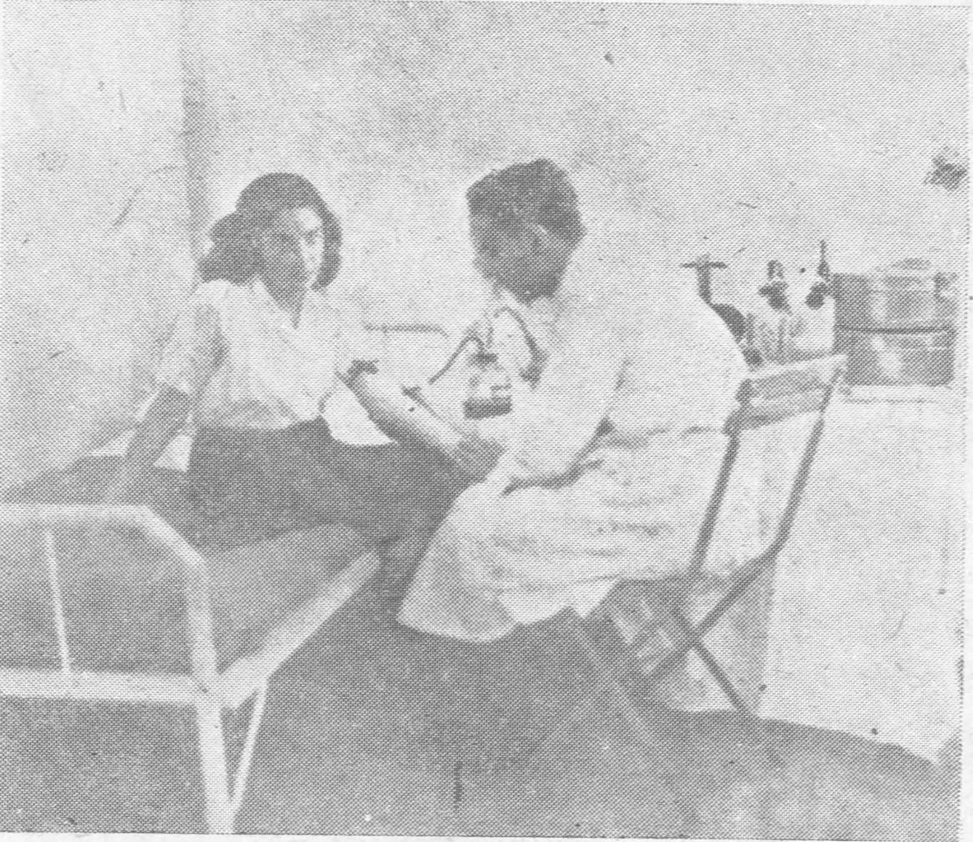
Miss Hala Nabulsi gives her blood...