Mrs. Edvick Shayboub, editorial secretary of The Woman's Voice — and we shall not favor her; we shall say of her what we believe to be true.
Mrs. Shayboub has passed, in her radio talks, through several phases.
In her first talks she took an educational direction, and she was at the head of those who offered views on the rearing of children.
Then we saw her take, in some of her subjects, a national direction — in her talks on “compulsory conscription” and other subjects.
Her latest subject on the radio was of another kind: “Woman's Mission.”
It is as if Mrs. Shayboub draws her inspiration from the circumstances through which our life is passing. In the days when she was directress of the kindergarten, she lived for that childhood.
And in the days when the women's congresses convened in Beirut, she lived for “Woman's Mission.”
And woman's mission, as Mrs. Shayboub says, is to reform herself, her surroundings, and her home before she demands equality with man.
It is a sound opinion, and we agree with her on it entirely.
We think that Mrs. Shayboub — though her subjects meet with great success among the listeners — we would wish her to return to that sweet, soft, gentle atmosphere.
Her style is good, though it lacks a certain warmth, and the meaning sometimes betrays her. Her voice is one of the most beautiful on the microphone, and her errors are rare.
And with what a style the woman of letters lectured on Gandhi! On this man who called for the pursuit of truth, which is God; on this man who calls for purity of body and spirit, loftiness of thought, and moderation in life.
It is as if the writer, speaking of this man who comes near to being perfect, had grasped the imperfections of modern man, and the defilement in this material civilization, its scramble for matter and its squandering of the powers of the spirit.
Miss Ghorayeb's style was a graceful one, with a sweetness and harmony wholly suited to the subject; her language is excellent, and her voice above average.
Miss Nahla Marwa is new to the world of broadcasting; to this day her broadcasts have not exceeded two. We believe that when the radio presented her, it presented an excellent women's element. She treats her subject with understanding and with much sincerity and love.
Her latest subject is inspired by the pleasant atmosphere in which she lives among the children of the American University of Beirut.
Education Is an Art — read the piece in “The Woman's Voice” and you will know the atmosphere from which Miss Marwa drew her inspiration.
Her voice is good, her style fine — let her watch out for the grammatical errors.
Salma Sayegh once filled the whole eye of literature; she wrote and made speeches that shook hearts and platforms. We who were raised on the melodies of the author of “The Breezes” ask ourselves today whether Salma Sayegh is still at the summit.
Whoever hears her speak from behind the microphone — with such warmth, such exquisite harmony of thought and style, such sweet music, such a clear, distinct
voice — will say that Salma is still herself: pure of style, and elegant in it.
As for me, to this day I know no style with the warmth that is in Salma Sayegh's.
But the great woman of letters, in her latest subject and in others, seems to be setting down old memoirs... Why does she return so often to the past?
Is there not, in our present life, in our present life, in all the struggle around us and within us, matter for inspiration?
And are there many pens like Salma Sayegh's to record this violent struggle in our life?
Salma Sayegh's pen must not slacken.
“Udhayna”
Note: our appointment is with the next issue.
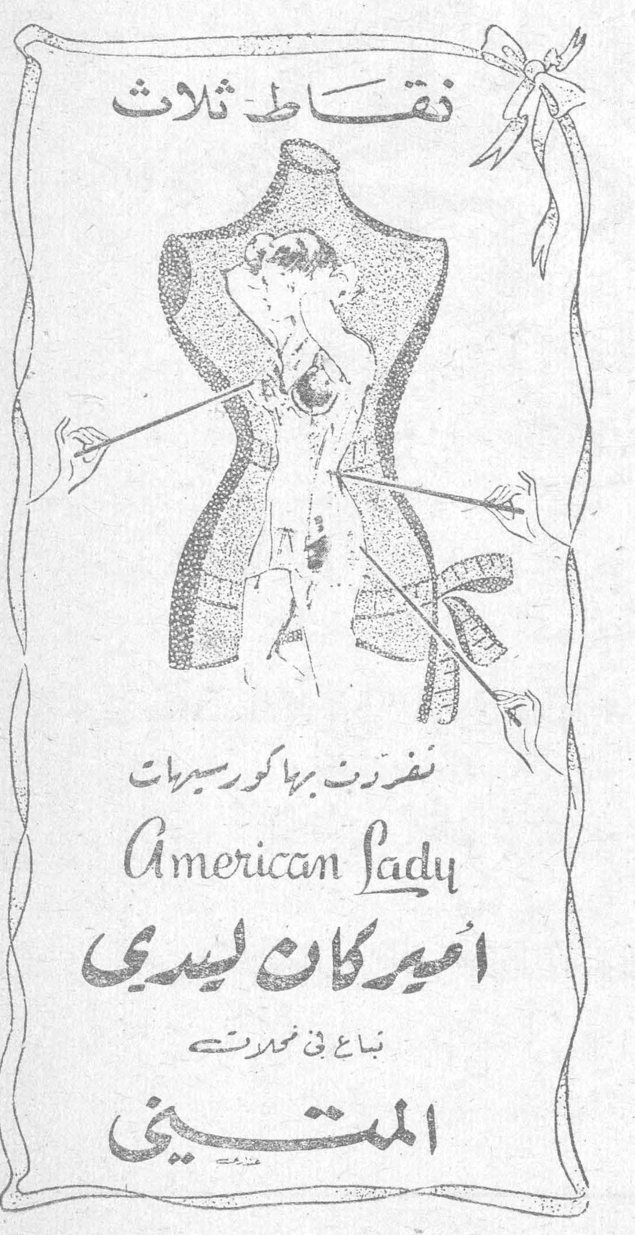
Three points
fulfilled by the corsets of
American Lady
American Lady
Sold in the stores of
al-Metni