The conclusion of the practical guidance article we published in the last issue, by the able educator Mrs. Nazik Sarkis.
Here are some of the habits which become traits that stay with the child through life, if their planting and direction are done well. I shall mention four of them:
First — Economy. Ibn al-Wardi said: Between extravagance and miserliness there is a station, and either of the two, grown excessive, kills.
And this truth we see every day in our country and in our circle.
The child cannot grasp the efforts his father expends to earn money, nor the hardships he endures to provide him with comfort and a sufficiency of food, drink, and clothing; and however much you tell him about this, he cannot understand its meaning. So it is well to apply this lesson practically. Suppose you assign him a monthly sum to spend as he pleases, since it is his own property: persuade him of the necessity of saving a part of it — however small — in a money box you provide him for this purpose, and he will learn the pleasure of saving out of income. It will often happen that before the month's end he spends this allowance and comes to you asking to buy some thing or other: beware of giving it to him. Let him taste the bitterness of the punishment of squandering and heedlessness. And it is well to fix a wage for certain tasks you ask of him, so that he grows used to the pleasure of earning by work, and learns that money does not come of itself but in return for the work a person does — the payment matching the work, small if it is small and large if it is large.
Second — Self-reliance. The child has by nature a searching, probing mind. When he looks at the sea or the sun or the stars or the moon or the airplanes, these appear to him as great mysteries, and often he wants to know how they came
to be, and why they came to be, and who made them; so we must encourage him to ask questions and to inquire, and explain every question to him fully.
In his lessons and his games we should encourage him to work out causes and arrive at results, and give him the chance to handle all the tasks that call for some resourcefulness and invention in a way that is his own, not in a way that is ours. A learned man once said: "Nothing is ever done but that there exists another sound way of doing it." This direction must be given to boy and girl alike; for we have accustomed our girl to a life of dependence and reliance on others, so that she has settled into being lazy and dependent, without personality, content in life with the food and clothing her father or brother provides her — her gifts overgrown with rust, buried in the cradle before anyone
could learn whether there were gifts in her at all.
Third — The Value of Time. Our children begin life possessing a precious capital: time, which is theirs and which no rival disputes with them. Human nature demands eight hours for nourishment and rest; school demands another eight hours; and the remaining eight hours are theirs to dispose of as they please. Here lies our sacred duty: to direct them and accustom them to the use of these hours. Let us set aside a portion for stories — and in these the children find delight — telling them of the lives of the great self-made men who, by using their leisure hours, achieved discoveries and inventions by which they benefited humanity, provided us with comfort and ease, and delivered mankind from deadly plagues that used to destroy millions of children and grown-ups alike
before their inventions — men
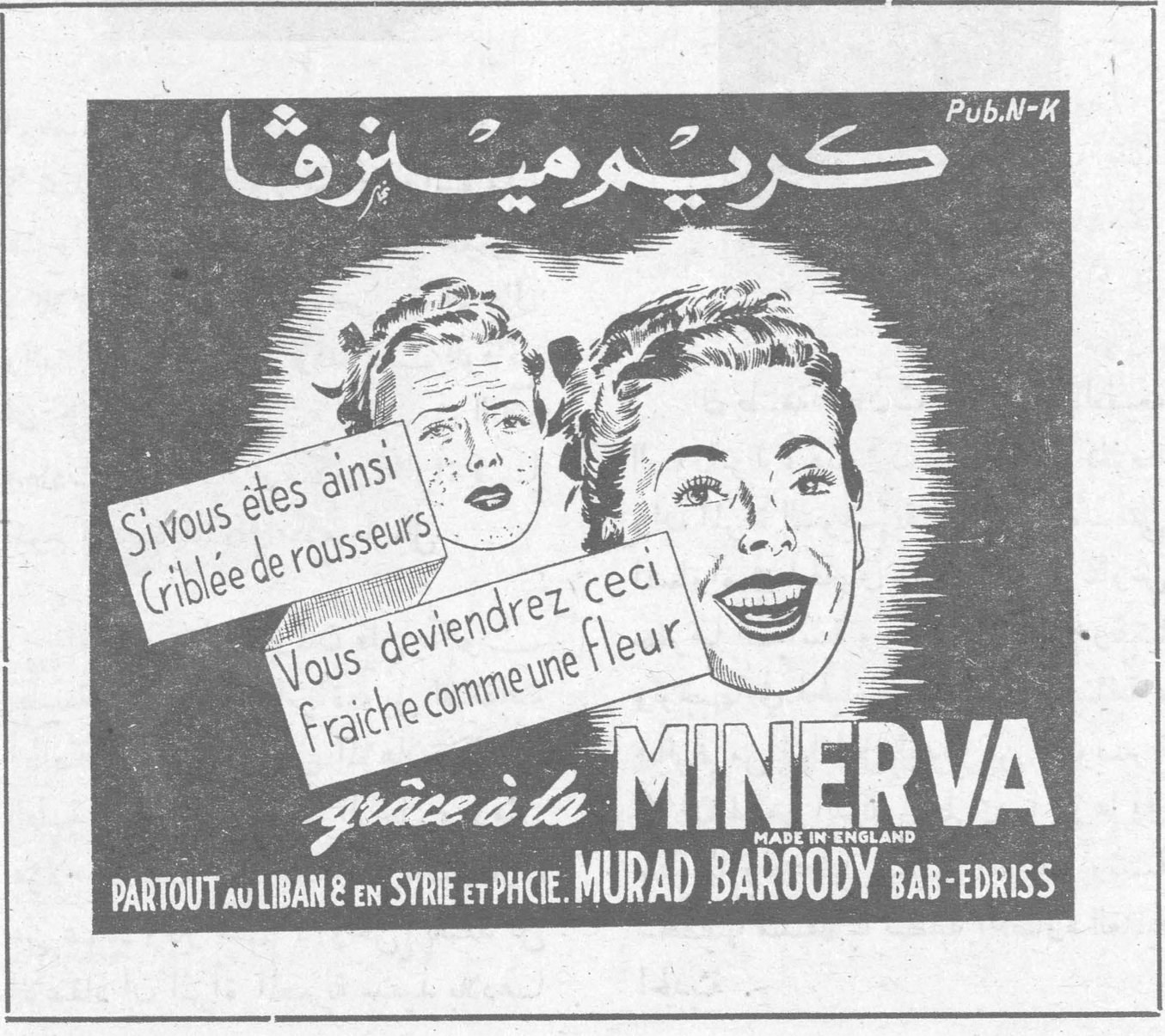
Minerva Cream
If you are riddled with freckles like this,
you will become like this — fresh as a flower —
thanks to MINERVA
MADE IN ENGLAND
EVERYWHERE in LEBANON & SYRIA, and at the Murad Baroody Pharmacy, Bab-Edriss