end, a betrothed pair nestled close to one another, reciting the sweet poems of their love. And these flowers seem a frame for those marble statues representing some of the homeland's martyrs, which appeared like the flowers themselves in luster and beauty, for like them they stand for life and its everlasting freshness.
Let us walk a little along this quiet, clean road — clean but for a few small leaves that the breeze had wronged and brought down, and a few blossoms the wind had shaken until they scattered.
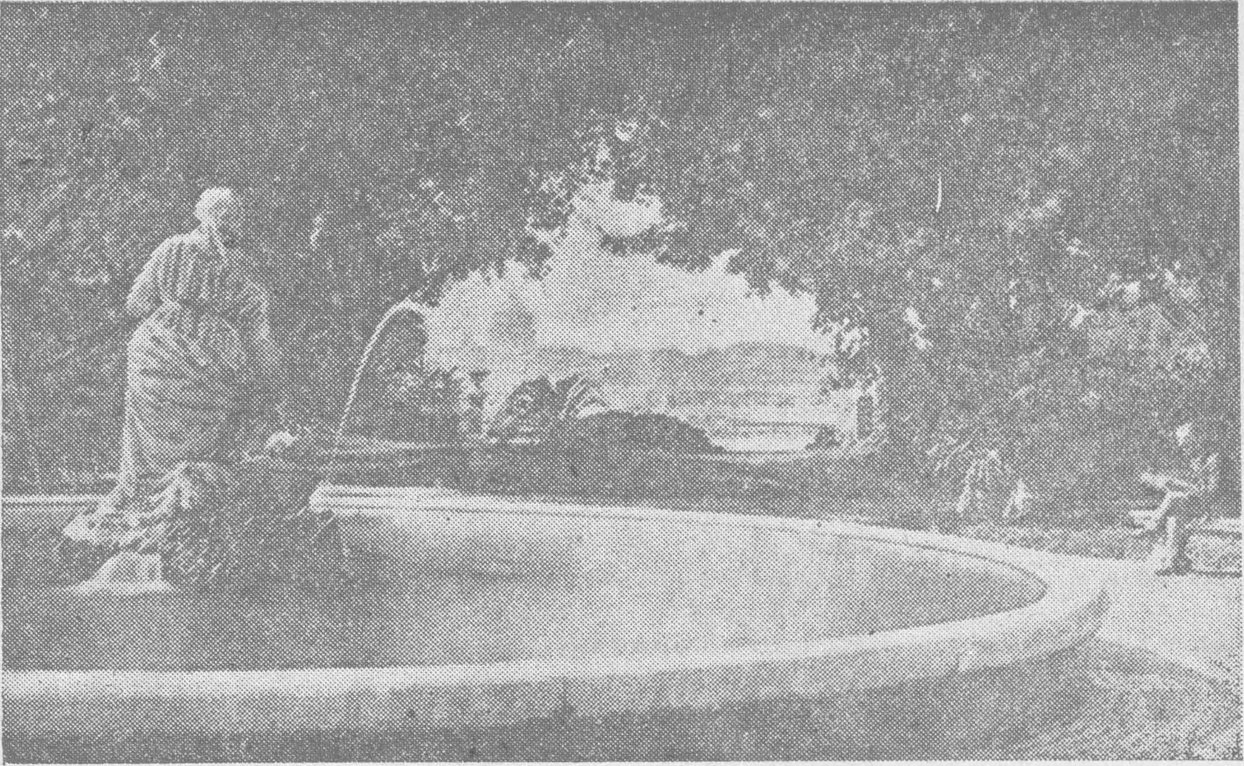
God, how beautiful this fountain is! It is a poem brimming with life; in its form it is an imitation of natural rock, and in its midst is set the statue of a naked beauty, bent upon her knees, stretching out one hand to fill her vessel from the waters of this fountain that overflows with grace and beauty. This naked beauty bends in a marvelously artistic manner. Thus the artist drew forth for us, from the deaf rock, sweet running water, and gave us life; he offered a lesson and gave us guidance — and behold, we are human beings made whole.
Art in this land leaves its mark on everything; in every place there is a school, in every corner a teacher, and on every hilltop a pulpit that preaches to the people and guides them to the right path. How, then, should they not advance,
their taste rise, their feeling grow refined, and they become truly human?
Let us continue on our way, leaving aside the gardens and the many statues that pass before us, and make for one of those beautiful palaces that show themselves through these lofty trees. A massive building, yet well proportioned, its parts so harmonious that it appears small and inviting. A broad staircase, ending in columns of the Ionic style, beautiful, their bases lions' heads with gaping mouths. After a spacious passage you find yourself before three entrances, and then you are in a wide court filled with statues of marble and bronze;
and at its head rises a mighty marble statue, seven meters high, representing Hercules, the god of strength, holding in his hands the son of the god of the shepherds and striving to hurl him into the abyss.
This scene truly inspires awe. The artist Canova succeeded in bringing out, in the lines of Hercules' body, the powerful muscle and the clear meaning, so that this work of his came to represent strength in all its meaning and vigor.
This is a temple of beauty. In this temple you see only people whose eyes are fixed upon the masterworks of art. There is a man stretched out on a bench who has given his imagination free rein; his spirit has slipped its material bonds and gone forth to commune with the spirits of those who left these works behind, and has become one with them — for the work of art is, in the end, the unity of spirit and thought and their harmony.
After going deep into the rooms of the gallery, filled with masterpieces of every kind, you see here a room set apart for the paintings of the artist Morelli, painter of the picture of the poet Tasso as he lays before the Italian princess his poem of "Jerusalem Delivered."
In it Morelli