What I mean by women's literature is what the pens of our honorable educated ladies produce in these days of ours — those who compose the fine, fresh bouquets in society, and raise their voices demanding and rousing, calling for reform, or defending rights that have been trampled, as they claim.
The activity of the women's movements in our societies is a palpable activity, praise God, and the steps that the days have recorded for the Arab woman are swift and successful steps. There is no doubt that woman's awakening, and her turning toward learning — which has widened the horizon of her thought and lit her path — are the two driving factors behind that rise, and behind that rousing from the long slumber. Among its results, women holders of higher degrees have multiplied, and the girl has kept pace with the young man in every field of study, showing in all of it energy, success, and competence.
But if we choose to look closely at the production of the Arab woman — who lives in one of the ages of history most crowded with wonders, widest in civilization, and most brilliant in light and radiance — we find it, beside the production of man, nonexistent, or, to speak more exactly, so meager that it does not meet the need.
Often I ask myself the reason for this, and I am at a loss to find a convincing answer; I can hardly find an explanation for it — nothing, indeed, but suppositions by which I may be persuaded for a while, though others may find in them no justification.
Does this shortfall mean, I wonder, that woman stores up knowledge for herself and does not make of it a means, or a material, for polishing her thoughts and showing them plain and clear? Or is woman falling short in the fields of literature, confining her production much of the time to the "women's topics" to which she gives such great attention?
But if woman today pursues study and learning in order to obtain the higher degrees, her whole concern
being that she be called educated and refined, or that she reach a post that secures her a life of ease and plenty, then this does not raise her much, in my eyes, above the rank of those others who were never given the chance to learn.
I do not overlook our Arab women writers whose names shine today in every sister country, who excel in many kinds of literature and favor us from time to time with beautiful outpourings of their pens. But that is little when measured against the breadth of women's activity today, and against the number of educated, refined women in every Arab land.
In the Jahiliyya, woman was deprived of many of the rights that man enjoyed, and yet she was a writer by instinct, savoring poetry, reciting it, and sending it forth free and beautiful. Then came the Islamic ages, and woman's literary mark did not fade, though she withdrew behind the curtains and into the shadows of the houses — until there came the Andalusian age, in which woman was freed from many of her fetters and was allowed to see the delights of life at close range and to share in many of them. The air opened before her, the horizon cleared, and the field widened for her venture; she came forward and recorded for herself success in every branch of learning, left a mark on every side of life, occupied a distinguished place in literature and art, and established for herself the literary salons, where she gathered with the great scholars, and all studied together, in one atmosphere, the matters of learning and culture.
As for the later ages that followed the flourishing ages of literature, we can scarcely glimpse a shadow of her — and we do not blame
her for it, for the wrongs of those epochs cast a thick curtain over man's production too; they were, in truth, the ages of decadence and literary feebleness.
But today we call her to account, and we blame her for this slackness and that lagging behind; and our hope is that she will not confine her activity to study only to cast off her shoulders, in the end, the concerns of the life of the mind, and give herself entirely to the outward show of life and the husks of modern civilization.
Society thirsts for woman's efforts, and literature needs her striving in its cause; she can supply it from her abundant harvest and her beautiful heritage, and thereby take part in the modern renaissance with a true participation. Life is full of pictures and tragedies and events which none can draw, and cast into an engaging mold, a delicate style, and expressive canvases, so well as the eloquence of the woman who mingles her spirit with events, gives of herself in the treatment of problems, and consoles, as far as she can, every sufferer in distress.
And I wish for my Arab sister that she may cut her way to every summit in life, and that we may no longer be deprived, after today, of the signs of her feeling, the stirrings of her thoughts, and the outpourings of her sensitive, graceful pen. If she turns to her past, she will draw from it strength, resolve, and steadfastness, and be certain that she was never, on any day, a hidden and veiled person.
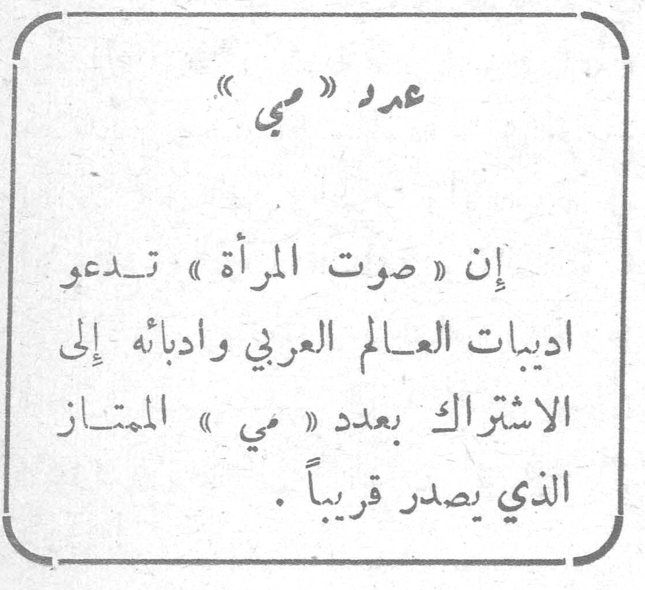
The "Mayy" Issue
"The Woman's Voice" invites the women and men of letters of the Arab world to take part in the special "Mayy" issue, which will appear shortly.