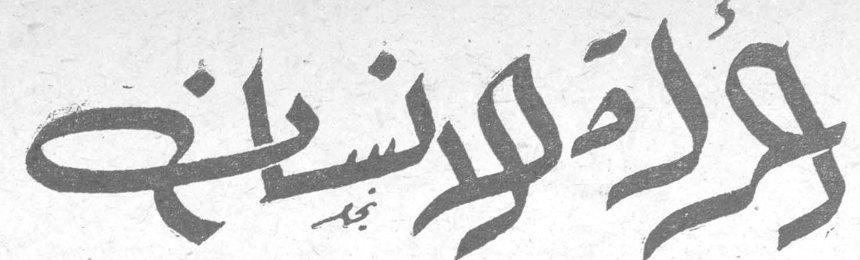
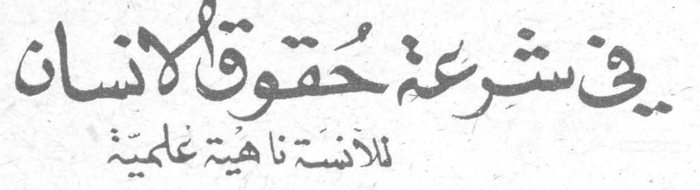
In the Third Committee, emanating from the Economic and Social Council of the United Nations, the state of Lebanon stood with the most advanced states of the earth to say: In the name of man, I proclaim the rights of man!
And Lebanon took its seat there, beneath the dome of the world, around the table of the peoples, in the assembly of mankind; it drew the pen of thought and speech and work and life, and signed the charter of human rights in its own name, writing:
"I proclaim the rights of man to freedom of thought, speech, work, and life!"
And "man," in this momentous document of rights, is man the human being — the living, reasoning, speaking creature: man and woman alike! And woman the human being, like man the human being, enjoys under this solemn charter all that its twenty-nine articles provide, which include, first and explicitly, the right of human beings of every place and every time, of whatever color or race or sect or religion, to freedom of opinion and its expression in speech and in writing, singly and in company; to belief, spiritual or political; in spirit and in matter; in art and thought and literature; in assembly and in national and human education; in man and what is within him and around him, and God and what is before Him and after Him... in a human freedom released from every diminution or fetter or distinction!
And among the rights of the human being — woman and man
— set out one after another in this world document, is every plain right of man to work, as a guarantee of his survival, an assurance of his existence, a security for his livelihood, and a continuation of his life... and to learn and to teach — art and beauty and philosophy and belief...
And among these rights of human equality are the rights of equality between woman and man in social and national life, and the right of the human being — woman and man — to be free to elect and to be elected, and to organize and be organized for the steering of the helm of human existence toward the highest aim, which he sees as the lofty summit of the good... and he has every right to struggle and strive and contend in order to do away with what is corrupt, and to make real what is sound...
These are some of the rights of man in the recent charter of human rights, which the states of the world proclaimed — among them the state of Lebanon — and which the representatives of the peoples of the earth signed — among them the representative of the people of Lebanon!
These are some of your rights, O man — and in them you and I are equal... I am a human being and you are a human being; I work in every field and you work in every field... You and I, my brother, are children of this world: yours is what is mine, and upon you falls what falls upon me, with no more and no less... We are, for peace, the two wings of a dove; and for war, the two wings of an airplane... You and I are, for
goodness and love and truth and beauty, a prayer and a poem, a lesson and an example... You and I are a war upon ignorance and poverty and disease, and messengers of knowledge and plenty and health, in every time and place...
You and I are the world, east or west; you and I are time, night or day... you and I are life, misery or happiness... So let us work together for that in which lies the message of goodness and love and truth and beauty...
You and I are the homeland — a people, an army, and a state; agriculture, commerce, and industry; study, guidance, and organization; house, school, and street; administration, legislation, and execution; parliament, government, and politics — for the charting of the road of life and the deciding of the range of destiny...
You and I, my brother, belong to the beloved homeland, and to the whole world, and to all humanity, and to absolute existence... Let us then be two faithful companions of peace, and two valiant soldiers in the defense of our existence and our rights...
My sisters and my brothers, remember that this charter is not the first of its kind in the history of mankind. Charters preceded it, turning on its very axis, which governed the house of woman and man — in the holy books, on the tongues of the prophets, and in the messages of the great among lawgivers and thinkers and sages...
And remember that none of these charters, nor any one of them, has yet found the occasion to realize