

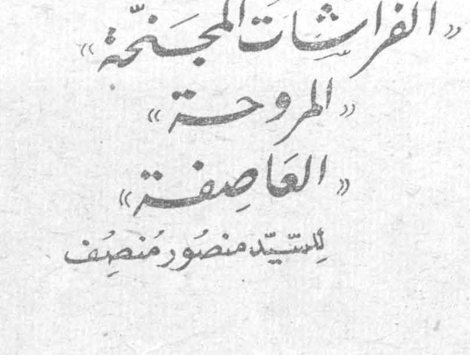
"Winged Butterflies" "The Fan" "The Storm" By Mr. Mansur Munsif
Mr. Mansur Munsif, proprietor of the Modach tailoring and fashion house, has lately returned from Paris, where he spent a period of time following the latest fashions and modes achieved by the Parisian dressmaking houses. "The Woman's Voice" is pleased to pass on to its lady readers this brief talk by Modach, containing some of what occupies woman and the dressmakers in Paris today.
What arrested me in the capital of beauty, this time, was that enchanting exhibition held for flowers. I made my way to it with my heart full of expectation, promising myself the discovery of new flowers it had not been granted me to discover before: and behold, the fair ladies visiting the exhibition were more enchanting and richer in beauty than many a blossom, and behold, you found yourself in an exhibition of beauty, perfumes, and fashions, not of flowers.
You ask me about these fashions and their general lines, so let me hasten to say that they change every season. And woman submits, without any grumbling or weariness, to these changes. Indeed, she takes a supreme pleasure in altering her figure and changing her dress from season to season — nay, from one hour to the next. Today she has taken to padding her shoulders and broadening them like a boxer, or to borrowing that fugitive romantic air that appeared on the Lady of the Camellias in the wake of her stricken love. As for her bosom, it stands out or does not
stand out as the fashion wills; and as for her waistline, it rounds out or draws in as the seasons and the days see fit.
To be clearer and more precise, I should say that the spring and summer fashions in Paris incline toward freedom, gracefulness, and ease of movement, and take every care that the dress be free of all artifice and distortion, so that a woman may move about and stir however she wishes, and be in harmony with the demands of this nimble age of ours. Never before have the dressmakers agreed as they have agreed this spring on preserving the line of the skirt and making it fuller, out of concern to provide comfort for woman — so much so that even the narrow straight skirt has had its cut adapted in a way that does not prevent long strides, running, playing, and free walking.
The dressmaker "Christian Dior" today has a new shade of ingenuity and adornment. He has come out with the doctrine of "deceiving the eye" and showing the dress to people contrary to what it conceals: by narrowing the skirt, for example, and then ringing it behind and before with pieces of cloth, or pleats, or pockets, which trick the gaze and lend the figure the uprightness and splendor it needs — until you would imagine it scattered leaves, or a branch twisted by the wind... Nor has the jacket been spared "Dior's" hand: he has worked on it with cutting and shortening until it has become lighter than before, with turn-backs or winged pockets like butterflies... And in some dresses the colors have turned toward the somber, provided their trimming be light.
The fashions of "Dessès" approach those of "Dior" in certain respects, for he too inclines to adding cloth, pleats, and pockets to the skirt; only he would have the back like a fan. So too "Balmain": while wishing to give the skirt the sense of ease, he follows his colleague in multiplying pieces, pockets, and pleats.
As for "Lanvin," he calls for the simple, natural dress with a free, supple line, and bestows on his navy and black gowns a great deal of sweetness and light, delighting them with white flowered fronts. And there is the dress known as "the Storm," with which the figure twists backward as though a wind had buffeted it hard. This dress is distinguished by its golden or black colors adorned with whiteness and freshness.
There is, finally, one principal element that must be pointed out: the psychological element. A woman's temperament must be in accord with the fashion — indeed, the fashion must be a subtle expression of it. It is wise, then, that a lady neither impose on the dressmaker the fashion she pleases, nor accept the fashion he would force upon her, but that she join with him in choosing what harmonizes with her temperament and the merits of her figure and her complexion.
"The Woman's Voice" presents in every issue the latest fashions from Paris, London, and New York...