In most cases the teacher understands the child better than his mother understands him, because she is a specialist in his education and discovers in him inclinations or habits of which the mother knows nothing; here above all there must be understanding and cooperation in the matter of the child. My own experience has taught me that the educator or teacher cannot understand the child's psychology as it truly is until she has met his mother and gone over his habits and inclinations with her, so that there is between them an exchange of views and a cooperation in carrying out their plans.
Yet there is a great number of mothers who never see the teacher's face except when the child disobeys their orders; then the mother comes to the school to frighten her child by saying she has told the teacher what he did — and so this tender teacher becomes a frightening person whom the child shuns and guards against. In this lies the whole mistake, for the mother must not follow such a method in disciplining her child. This complaint of hers, even if it delivers her from her child's disobedience, leaves a bad trace in his soul, breeding in him a feeling of loathing for school and for study. And how well the mother does, and how pleased her child is, and how he feels her concern for him, when he sees her at the school talking with his teacher, and understands that the two of them are working together for his good! Often the child is present for part of the meeting between me and his mother, so that he may feel for himself the spirit of cooperation between the two parties in his education. Accordingly, dear mother, you should seek, whenever the opportunity offers, to meet the teacher who has charge of your child, to talk with her about him, and to sound out her opinion of his conduct and his diligence.
Our influence cannot be effective unless there is someone in the
home to help the school in its task and to work at developing the good habits and high ideals it
plants in the children's souls — so that they may be the best stones for the best building.
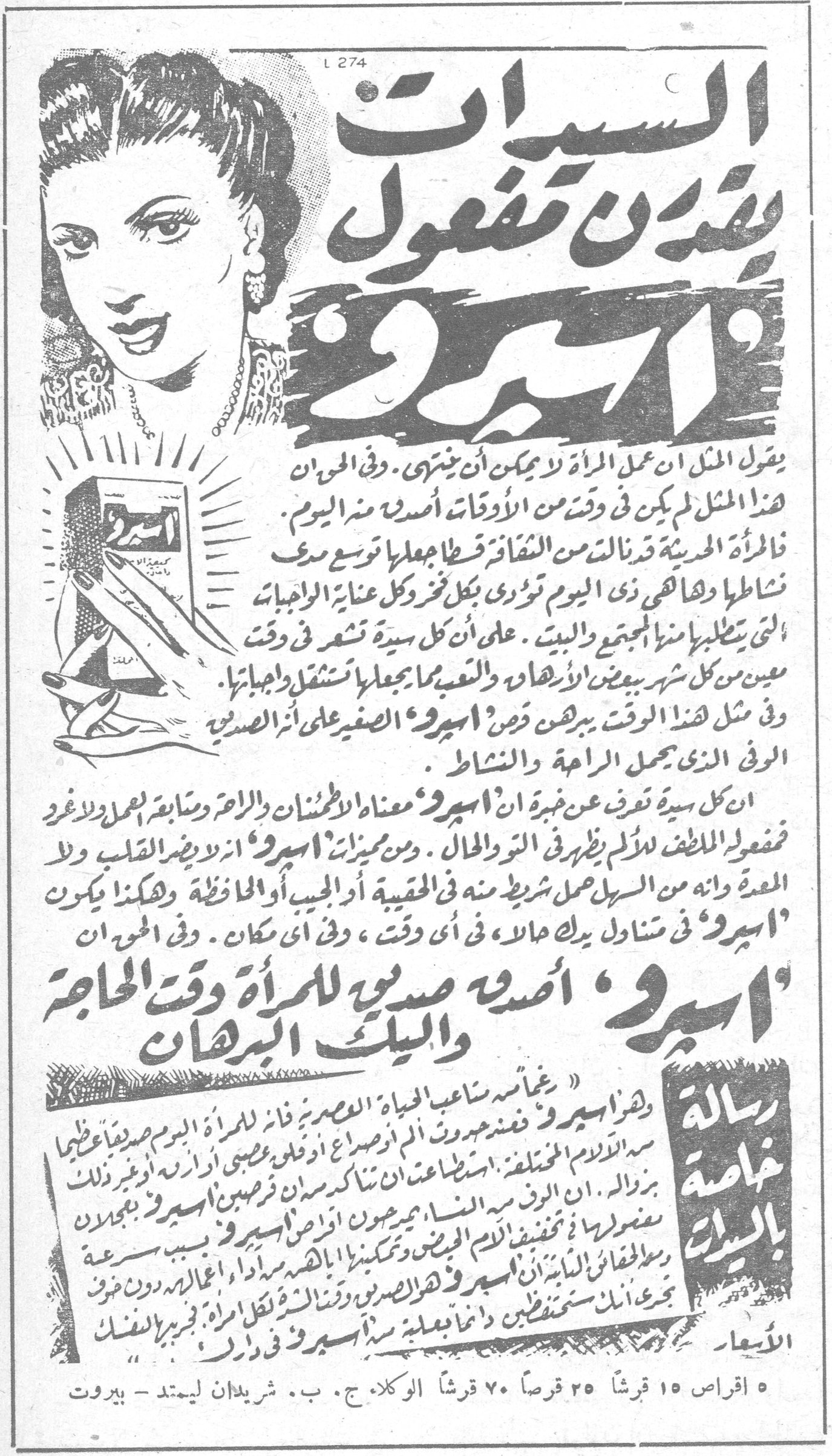
Aspro
The ladies appreciate the effect of 'Aspro'
The proverb says that a woman's work can never be finished. And in truth, this proverb has at no time been truer than it is today. The modern woman has attained such a share of culture as has led her to widen the circle of her activity, and here she is today performing, with every success and every care, the duties that society and the home demand of her. Yet every lady feels, at a certain time each month, certain pains and fatigue which make her duties a burden to her. At such a time the little 'Aspro' tablet proves its powerful effect, which brings rest and vigor.
Every lady knows from experience that 'Aspro' means peace of mind, comfort, and the carrying on of work without excuses, for its gentle, agreeable action appears then and there. Among the merits of 'Aspro' is that it harms neither the heart nor the stomach, and that it is easy to carry a strip of it in the handbag, the pocket, or the purse; and so 'Aspro' is within your reach in every circumstance, at any time, and in any place. In truth, 'Aspro' is woman's truest friend in time of need — and the home is the proof.
A special message for the ladies
"This 'Aspro' — its boons have kept pace with modern life, for 'Aspro' today is a great friend to woman against the various pains. Its uses give assurance that the ailment, with 'Aspro' and the like, passes away. Many are the people who, recognizing their symptoms, find in 'Aspro' what lightens the pains and enables them to go about their work quickly. It is useful for the ladies to read of 'Aspro,' this friend, which spares recourse to the doctor without expense; so always keep a box of 'Aspro' in your home."
Prices: 5 tablets, 15 piasters — 25 piasters — 70 piasters. Agents: J. B. Sheridan Ltd. — Beirut