"Anhelli" — a symbolic national canticle, Polish in origin, translated by Mr. Youssef Daghir, in 116 pages, medium format, elegantly printed.
This canticle is connected with the East in that its author, the Pole Juliusz Słowacki, visited the East in the second quarter of the last century and stayed some months in Lebanon, during which he composed his immortal canticle "Anhelli."
Yet there is nothing in the canticle of the East's inspiration, save what clung to the author's mind of the spirit of Holy Scripture and its poetic style. Taken as a whole it is a symbolic tale describing an imaginary journey, on the model of Dante's journey to the other world, or the journey of al-Ma'arri's friend in the Epistle of Forgiveness — but it is cast in a style that unites all the merits of poetry, imagination and imagery, in ample, most elegant language of a romantic cast.
It is the journey of "Anhelli," the hero of the canticle, who stands for the author himself — a man who lived immersed in national mysticism — in the company of a wise prophet, wandering through the wildernesses of Siberia, where were scattered the Poles whom the Tsar had banished. Siberia here is the symbol of the torments the Poles tasted in their struggle and in their banishment from their homeland. It is a wandering that shows him at close hand the pains and misery to which the condition of the exiles had come, and brings him into touch with some of the heroes of the struggle and its victims, or with the leaders of the parties, whose rivalry led to discord in the ranks of the homeland's sons and drove them to weakness and dispersal.
In the course of the journey the prophet is killed at the hands of certain drunken rowdies whom exile had degraded and misery had made its plaything. Thereafter the hero offers himself up as a victim, to be joined to the victims of his people, that there might be in it some consolation, or an atonement and a ransom for the people from its ordeals, lifting
from it the nightmare of torment.
And it is as though the idea of redemption bears its fruit in the end: for in the last chapter there appears one who calls for a revolution that shakes the thrones of kings, loosens the crowns from their heads, and scatters them to the horizons. But Anhelli remains in his last sleep; the voices do not wake him, and he never knows whether the revolution succeeded in resurrecting Poland or not.
In the canticle are passages overflowing with splendor and majesty, drawing it near to the style of the stately epics upon which
lofty imagination and images of the supernatural bestow varieties of enchantment.
Through it runs the theme of longing for the homeland, and of self-annihilation in its love, in a manner that lets us touch with our very hand the tragedy of the Polish nation, and shows us how national struggle and pure suffering inspire the masterpieces of art.
Mr. Daghir has translated it in a style of the utmost elegance, breathing into its lines the atmosphere of symbol and of artistic splendor. He has prefaced it with a fine introduction on the poet's life and the purport of his work, and he was faithful in carrying over the notes that clarify its hidden meanings and allusions. I noticed, however, some linguistic slips there, and I do not know whether their source is the press or weak proofreading.
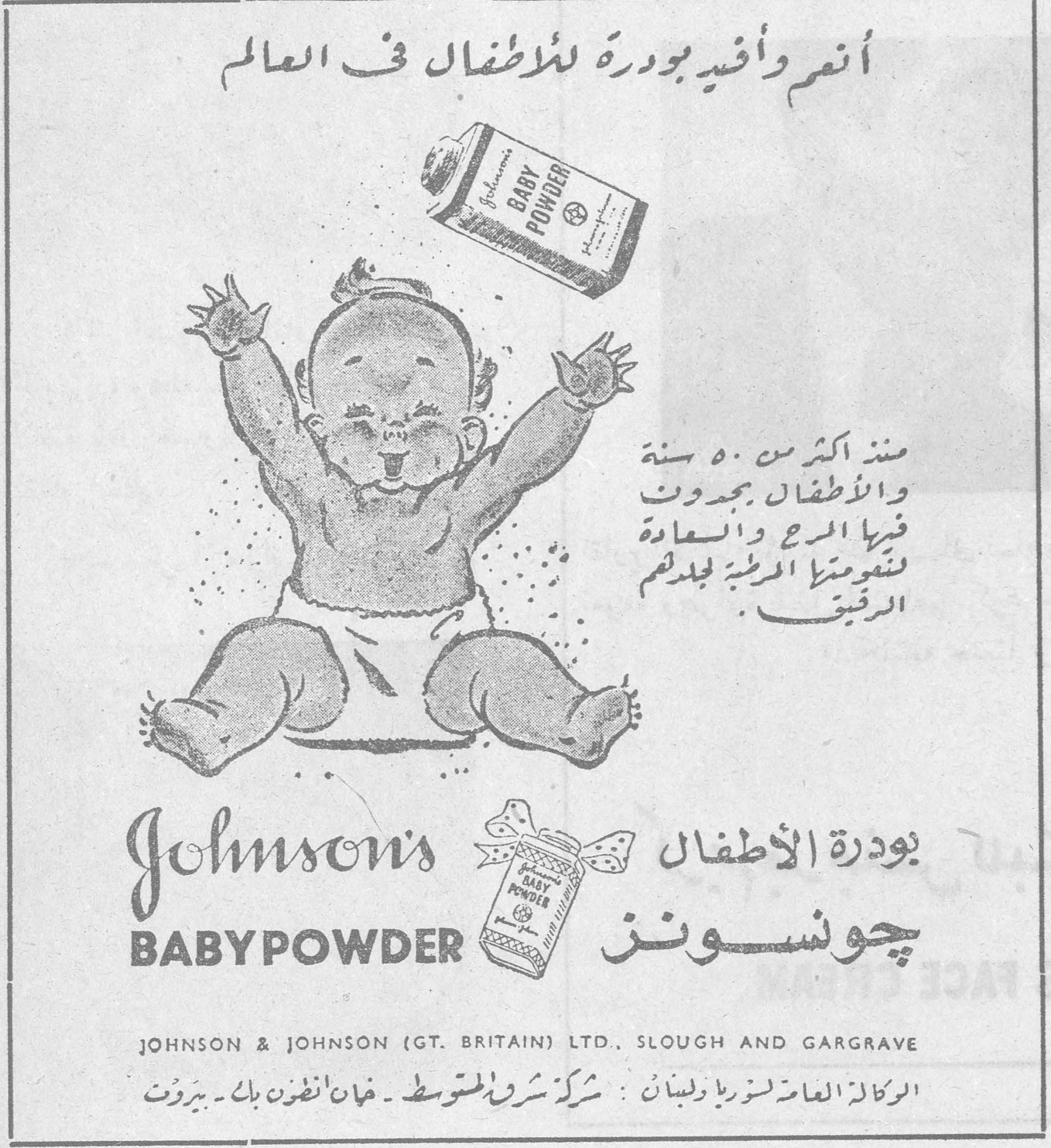
Johnson's Baby Powder
The softest and most beneficial baby powder in the world
For more than 50 years babies have found merriment and happiness in it, thanks to its softness, so comfortable to their delicate skin.
Johnson's Baby Powder
Johnson's BABYPOWDER
JOHNSON & JOHNSON (GT. BRITAIN) LTD., SLOUGH AND GARGRAVE
General agency for Syria and Lebanon: the East Mediterranean Company — Khan Antoun Bey — Beirut