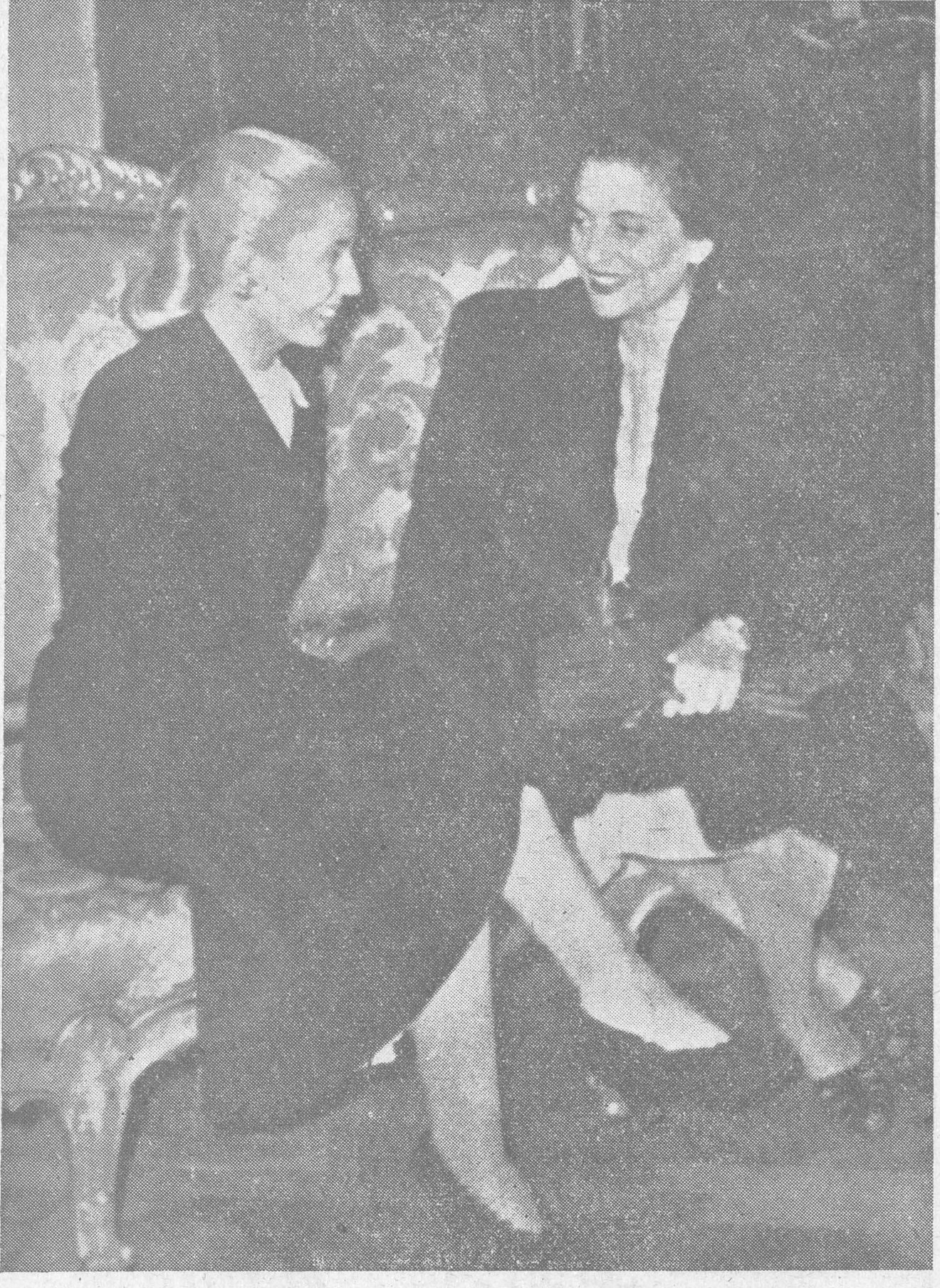
works protected by the new Argentine constitution. That was a short while ago, when I paid a visit to Mrs. Perón in her office at the Ministry of Labor. She was splendid in her reception... gracious in her conversation... candid in inviting me to inspect the labor office, where hundreds of women and children were awaiting her, asking her for medical assistance, food, and clothing; proud of her project, speaking of it as though she were speaking of a piece of her own heart — of this ceaseless movement, with its firm steps, that knows how to cover the road, and knows how to stir the sentiment of charity and lofty compassion, winning the love of the crowds and their cheers. For it is well known of her that she has never passed through a demonstration, or made a journey, or sat on the balcony of a gathering, official or unofficial, without cheers rising in her name, asking for a greeting, a smile, or a word...
...And I expressed to Mrs. Perón my wish to see some of the relief and distribution centers. She was greatly pleased by the request and gave instructions for the following day.
We returned from the labor office to the reception hall, and there I presented to Mrs. Perón, with my thanks, as a token of acquaintance and esteem, a piece of brocade and a handbag made in Zouk. She accepted them, with thanks in her turn, and contemplated them, repeating that she had heard a great deal about the craftsmanship of the East, and especially about our fine handwork.
The next day, Mrs. Perón sent an official from the palace with a private car, which carried me in the company of two ladies — Mrs. Najjar, wife of the counselor of the legation, and Mrs. Hibri, wife of the attaché. We visited three large, spacious houses that receive women with their children: women who have no work to live by, whom husband and family have neglected, and who find there someone to receive them kindly, lifting their spirits so that they may see life from the window of light. They stay in these houses for two weeks, a temporary residence for them and their children, until permanent
work is arranged for them. In every house of these institutions there is a chapel for the residents, and nuns keeping watch. For religion in this country is the first and fundamental factor, and the Argentine people are a very pious people, living in peace, tranquility, and calm, far removed from the spirit of strife and crime...
As for what I saw in these institutions — storerooms beyond counting, of clothing, foodstuffs, household utensils, children's toys, and pupils' books; in a word, everything you could think of is to be found there, fit to
be distributed free of charge to whoever is in need of it...
A request is submitted to Mrs. Perón; she studies it in her office at the Ministry of Labor and issues, on the spot, the order to her staff to grant it — as though they were electric wires carrying out whatever she commands... from morning until evening, five days a week, and very often
she takes her midday meal in her office.
The most prominent idea in her project, as she assured me and
Mrs. Evita Perón and Mrs. Nahhas during one of her visits to her.