
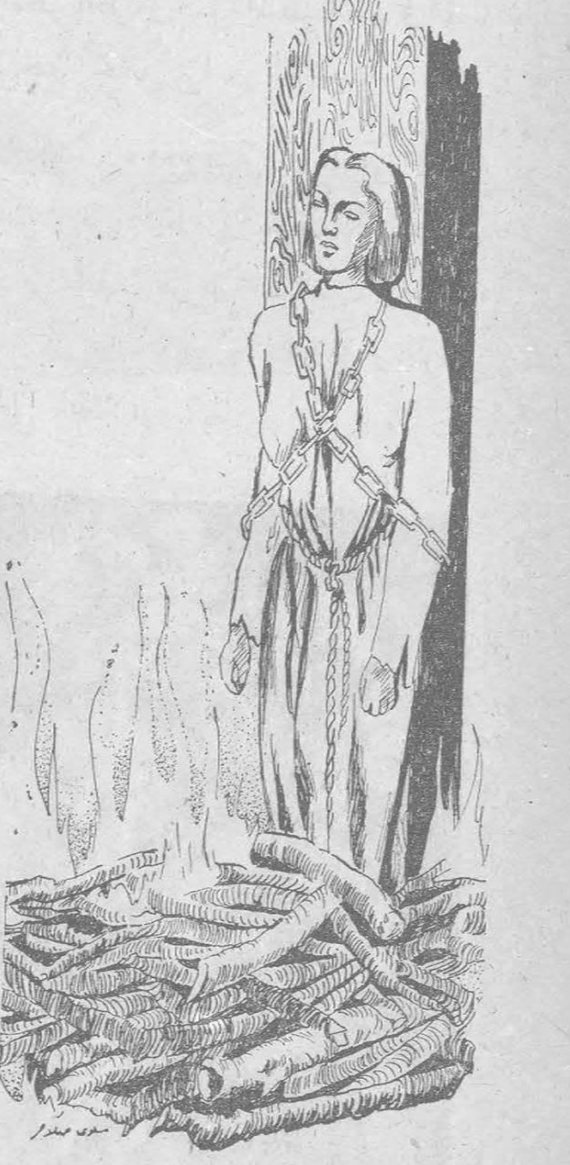
...This article on Joan of Arc was prompted by an article by the writer Nadira Sabbour of Cairo, which The Woman's Voice published in last April's issue under the title "Joan of Arc Is Not Fit to Be an Example for Women," in which the author expressed her
...Europe is floundering in the mire of the dark ages; France's people are being wasted by famine and her land laid barren by invasions and raids; the heir to the throne is a tool in the hands of the feudal lords, and the English enemy surrounds Paris and lays siege to Orléans, the last stronghold of the monarchy. The Dauphin, Charles VII, was but the son of a mad father and a scheming mother — Queen Isabeau — a prince who doubted his own parentage, beset by misgivings, torn among the designs of lords and bishops and chieftains.
And the people?... They were the majority, toiling for bread and for life. They submitted in silence, and in their submission were prayer and supplication.
In the village of Domrémy, in the district of Lorraine, on one of the blazing days of summer, while a girl of thirteen sought solitude in the garden of the house after finishing her household duties, a shimmering cloud rose before her eyes, and she heard voices calling to her, "Little Jeanne, daughter of God." And no wonder — for in that hour of supreme rapture Joan understood that the burden of the nation had been laid upon her shoulders, since God had chosen her to lift the siege of Orléans and to summon the heir to the throne to his coronation at Reims.
The saints' promptings did not come all at once, nor did Joan plunge straightway into battle. The visions and the "voices" stayed with her for four years, and the graver the matter grew, the more closely she kept it secret, until, when she reached seventeen, their urging drove her to leave her family, put on men's dress, cut her hair, and set out to the rescue of the besieged city. What duty is nobler than this
duty? And what of it, if the selfsame duty was performed by a woman? Joan of Arc's guide was not adventure and the shedding of blood; she did not declare war on citadels and fortresses until she had declared war on vice, unbelief, and dissipation.
Under the sway of these burning forces of the spirit Joan of Arc, unlettered and simple as she was, went forth to demand an army and a king for her people and her country. She believed in the sanctity of a mission that the most learned and most upright men of her age laughed at. Logic denied success! Faith looked toward triumph! And it was not long before cold logic melted away in the heat of faith.
The Maid reached Chinon and stood before the Dauphin and confided to him the legitimacy of his descent from his father, and asked for an army to break the siege. How did she know the Dauphin's secret, which he dared not whisper even to himself? Nay, how did she know that Orléans lay under siege, when she had come from a distance nearly equal in length to half of France? All the while the glances of the ladies of the court were fixed upon the roundness of her arms and hips, upon the free and poised neck, upon her prominent breasts, wondering why one endowed with such attributes should have been chosen as God's messenger. The court was a theater for the lusts of the nobles, and they soon perceived that this virgin's coming among them was a danger to their artificial paradise, just as she was a danger to the pleasures of the army about her.
The army was made up of rough-natured, unruly soldiers, or of bands of
thieves and highwaymen, who made up for their
view of woman's duty, saying: we cannot picture woman on the field of battle brandishing the sword...
Mrs. Kanaan shows a boundless admiration for the splendid personality of Joan of Arc, and of her long reply we content ourselves with presenting the life story of the great Joan of Arc.
"The Editors"