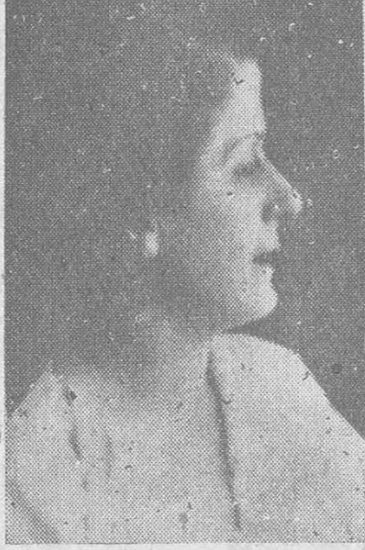
In women's circles there are great personalities at work in every one of the fields, doing great works beyond the power of men. The Woman's Voice will present these personalities to the women's community in pleasant conversations, and we are proud to present in this issue the great woman of letters Salma Sayegh.
The Editors
What was the first article you wrote, and on what date was that?
— The first piece I wrote was on the day the late Sulayman al-Bustani, deputy for Beirut, departed — after the proclamation of the Constitution — for the Ottoman Assembly. I signed it then with a pen name and sent it off with God's blessings. And how my heartbeats quickened, and how my face flushed, when my brother came the following evening and set the newspapers in their place, and I took up the newspaper al-Ahwal and carried it to my room and began to read, scarcely believing my eyes!
What was the subject of the article, and what echo did it have among people?
— The headline was: "A Faint Voice to the Eminent Deputy." That day I addressed the great deputy with much modesty and meekness, and with that feminine gentleness which opens locked doors before us... I asked of him, in something like begging and imploring — as he set out for the place where constitutions and laws are made — to work for the adoption of compulsory schooling for boys and girls.
As for its echo: the owner of the newspaper introduced it with a graceful little preface, of which I remember that he singled me out for much encouragement, and for a measure of praise which it struck me that day I did not deserve!
Now that we have come to this point, can you tell us something of the obstacles that stood in your way at the beginning of your literary struggle?
— That struggle I have not yet brought to its end. Have you not heard the verses of the tender-hearted poet Elias Fayyad, in elegy of Tanyus Abduh, that man of letters who wrote seven hundred books and died destitute? He said:
Weep not for him — today his life begins; the man of letters lives his life in indignity.
They say that the struggle in the cause of literature is like love; I say it is like charity — for love dies, and charity endures forever. As for the obstacles: the least of them is this hiding beneath a pen name — how far that is from true literature, free and unfettered! And the least of them is people's charge that there is a man's hand writing for us! And then there is the mockery of the men of the old school, those who reproach us for our "Western culture" — and what disgrace is there in my adding one fortune to my Arabic fortune?
Whoever reads you notices, from the very first reading, a breadth of learning that the schools before the First World War did not give. Did you, then, enter one of Beirut's two universities?
— When I applied, in 1914, for admission to the medical branch of the American University of Beirut, I was told that applications would have to multiply before the Board of Trustees in America was persuaded of the need to open the door to women. And by the time the door was opened, I had to strive to earn the cost of roof and light and water and the other expenses of living, for myself and for my daughter. I did not go to the university — and in that my case was that of Julia Tu'mah, and Mary Ajami, and Mary Yanni, and Anbara Salam. But the professors of the university all came to me and to my companions, in the books and magazines of Lebanon's matchless men of learning; they came to us in al-Muqtataf and al-Hilal and al-Diya' and al-Tabib...
My great teachers were Faris Nimr and Yaqub Sarruf and Jirji Zaydan and Ibrahim al-Yaziji and Doctor Iskandar Baroudi and his fellows.
Speaking of men of letters — what is the memory dearest to your heart in your literary life?
— Of the writers I have named I knew personally only the late Jirji Zaydan. My oldest friend is George Baz, the friend of all the women writers and teachers, and the helper of every social undertaking in this country.
As for the memories dear to my heart, they are many, and my friends among the men and women of letters have laid me under a great debt. Among my friends is my master and teacher Ibrahim al-Mundhir. And Lebanon's dearest son, that faithful Rihani. I shall never forget his face — that dark face, and the head singular in its build, and the hair through which rippled the whole scale of silver and gray tones. And those two far-off, deep eyes, in which there is revealed to the one who gazes into them the inspiration of infinity...