Health Talk
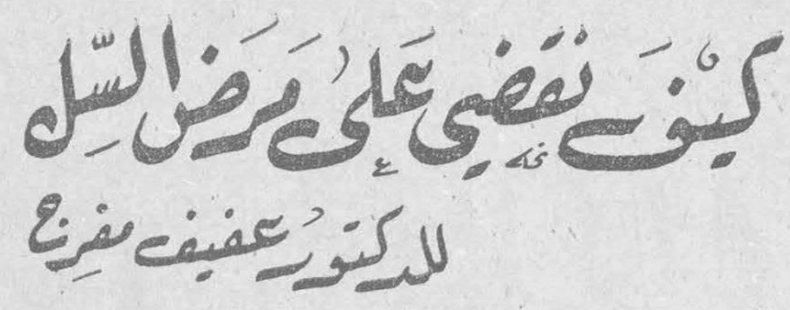
Dr. Afif Mufarrij continues, in this magazine, his deep scientific study of tuberculosis. In the first two chapters he treated the age-old struggle between man and tuberculosis, surveying the phases that accompanied that struggle. Here he returns to pursue the study in this final chapter, calling for haste in wiping out this disease. The Woman's Voice is grateful to Dr. Mufarrij for favoring it with this weighty study on health.
Tuberculosis has never at any time been confined to one particular class of the people, or to special regions; no — it seeps into all classes without exception. Yet it must be said that this tuberculosis has been known since ancient times for its wide spread among the working class and the classes of small income; and there is no doubt that the need which drove these sections of the nation to labor beyond the limits of endurance, and even to put women and children to work, is itself among the causes of its increase and spread.
The statistics compiled in the United States have shown that sixty thousand die annually of pulmonary tuberculosis, and that roughly half this number consists of men and women still in the flower of their youth — at the most productive age and the age of greatest responsibility.
Here I want to put the following question to those in authority: where are the statistics prepared in our country, to which we may refer as a basis for our work in the present and the future, and by which we may know the health situation of the country
and know where we stand in this respect in relation to other lands??
Is it in the nation's interest that such a matter be neglected?
Are not accurate statistics the best way of clarifying our present condition? Are they not the true measure from which we deduce our situation, and by which we gauge the extent of progress or decline, so that we may know in which procession we are marching?!
On knowledge of the actual facts depends — to a great extent — the course of this success and reform. And the fight against tuberculosis must be general and universal, in every land and among every class — among rich and poor, in the cities and in the villages — or else the work will fail. For the world today — thanks to the ease and speed of communications — has become, in the interconnection of its parts, the interlacing of its interests, and the expansion of its trade, like one small country whose parts are bound close together and whose sons are knit one to another, which has made the contagion of this disease swift to travel. Tuberculosis in Lebanon, for instance, threatens the state of health in America — unless all countries follow the method of the United States, namely, that whoever wishes to emigrate there is not permitted to do so unless he produces a health certificate accompanied by an X-ray photograph, to confirm the soundness of his health and his freedom from any tubercular affection. What a wise and prudent plan that is! Would that all the countries of the world abided by it, for it is for the general good to proceed accordingly..
And it is no wonder that the United States has drawn up this plan and acts upon it, when she applies all the strength, science, and knowledge God has bestowed on her to cleansing her people of the germs of tuberculosis; how then could it be conceivable that she should leave the way open for it to creep in upon her from outside?
If we wish the complete elimination of tuberculosis, we are bound to abide by the following instructions:
1 — X-ray photography of every individual of the nation, and especially of those who belong to the class most exposed to this disease.
2 — Treating every sufferer with effective and careful treatment until the cure is complete.
3 — Isolating whoever is stricken with this disease, to prevent its spread and the passing of the germs to others.
4 — Publishing full instruction about this disease, setting forth its causes and the ways of its contagion.
5 — The fight against tuberculosis must not be confined to medical treatment alone; we must treat it medically, socially, and economically, for we all know that poverty — as a rule — breeds disease, and disease breeds poverty, and so on around.
And since, in view of the economic condition of the country, it is impossible for us to accomplish these things in their entirety and in a comprehensive way, let us set about them even within a narrower circle, beginning by applying them to the army, to school teachers and pupils, factory workers, and the staffs of companies, hotels,