accepted her against his will. The hospital's doctors did not welcome her presence among them, and would leave their places when they saw her approaching. The patients themselves refused to let her attend them.
One of them once said to her:
"I am poor indeed, but I will never accept that a woman should care for me in my illness."
At last Elizabeth won through with distinction — yet medical circles did not meet her distinction with the appreciation it deserved. One medical journal commented on the news of her success:
"It is a cause for regret to see an aberrant girl stray beyond the bounds of her natural sphere, and seek to descend into fields fit only for men."
She became a physician, bearing the title of Doctor; and for all that, the medical institutes of Paris went on refusing her application for specialized study. It was rumored among the people that she was mad. And her despair was great when she failed in her first medical attempt: she had been called to give an injection to a sick child, when her foot slipped and she fell to the floor; the medicine flew out of the syringe, and some of it entered her eye; her eye was ruined, and no treatment availed her.. She went about seeking a clinic, but the owners of the houses refused her request; and when she managed to find a clinic, the landlord made it a condition that she hang out no sign bearing her name.
Not a single patient came to her.. So she took to writing the story of her life and publishing it in the magazines, and women began calling on her in secret...
She had a sister who followed in her footsteps in the study of medicine and joined her in her
clinic; and it occurred to her that the two of them should found a hospital whose entire staff would be of the fair sex...
In 1866 Elizabeth and her sister founded a college of medicine for women; and after her, the men of education began opening medical
colleges for women on the pattern of Elizabeth's college.
In 1910 America's first woman doctor died, having paved the way for the eight thousand young women who work today as doctors in America.
(From "Coronet" magazine)
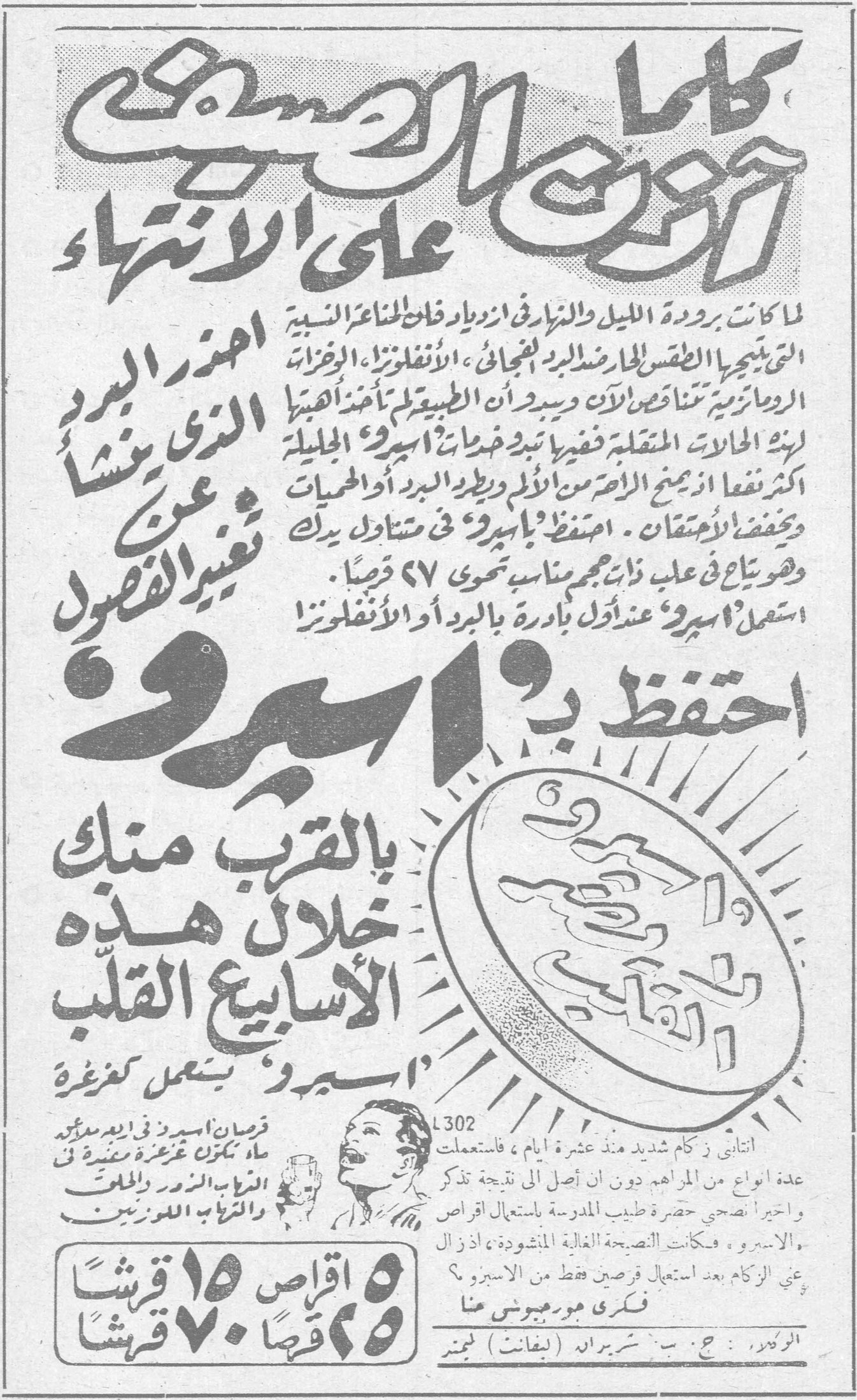
Keep Aspro at Hand
Guard in good time against what is hard to be rid of
Beware the cold that comes with the change of seasons
Now that the coolness of night and day is on the increase, the relative immunity against chill which the hot weather produces is diminishing, and head colds, influenza, and rheumatic twinges appear. Nature has not made herself ready for these changeable conditions, and it is here that Aspro's signal services prove most useful, for it keeps the least cold free of pain, drives off chill or fevers, and relieves congestion. Keep Aspro within reach of your hand; it is sold in boxes of convenient size containing 67 tablets. Use Aspro at the first sign of a cold or influenza.
Keep Aspro close by you through these changeable weeks
"Aspro" works as a gargle
Two Aspro tablets in a bottle of water make an antiseptic gargle for inflammation of the throat and pharynx and inflammation of the tonsils
5 tablets: 15 piasters
25 tablets: 70 piasters
L302
A severe cold came over me ten days ago. I used several kinds of ointments without reaching any result worth mentioning; at last the school doctor advised me to use "Aspro" tablets, and it was the precious advice I had been seeking, for the cold left me after taking only two Aspro tablets.
Fikri Murjiyus Hanna
Agent: J. B. Shibriad (Levant) Limited