... The great artist Moustafa Farroukh continues his artistic musings through the art museums of Europe. Here he now reviews other masterworks on his round of the Italian Borghese Museum.
The Editors
I hurried up the stairway to the museum's upper floor, where several schools of painting are housed, chief among them the Venetian school and the Neapolitan, with others of the sixteenth century and after. Here, in the spacious rooms, the canvases of the geniuses preside in majesty — Titian, Veronese, Palma, Correggio, Caravaggio, and others famed for the allure of their color and the richness of their subjects. Before us appeared the famous picture L'amour Sacré et profane by Titian, one of the most celebrated paintings in the world; then the picture of Venus, goddess of love, selling her cupids to whoever desires them; then the canvas Antiop et Baccus by the artist Correggio — an artist distinguished by sobriety of drawing, richness of color, sweetness of composition, and depth of expression. Then the Veroneses, with their power and their calm, and the pictures of the Virgin with the Child Jesus by the artist Lippi.
Among the most striking canvases of the Neapolitan school, which hold their place there with all dignity, is the painting by the artist Caravaggio, greatest of the artists of Naples, master of the stern method of shadow and light and the intense realist. This canvas of his represents Jesus driving the merchants, the brokers, and the Pharisees from the Temple... and there is his famous canvas, "The Cheats," wrested from the very heart of this human life folded in
fraud and deceit... This artist was hated and cast out by his countrymen because he told them the truth about themselves, portrayed their charlatanry and their deception, and exposed their vile ways; so he lived his life in isolation and misery. Yet he walked the street with head held high, staring at people with his eyes wide open while they lowered theirs to the ground in humiliation and shame... He was once imprisoned for his candor, but before long was set free.
Near his powerful, rebellious canvases we find the religious paintings of the pious artist Carlo Dolce, full of delicacy, love, and tenderness; then his theological colleague Sassoferrato, with his heavenly Virgin and his Jesus, the very model of love and mercy. So great was my admiration for it that I made a copy of it. And from the modern age there is the picture "The Inheritance" by the artist Patini — a piece of humanity overflowing with pain and sorrow, and a portrait of the soul of this tormented, wretched artist. It shows a destitute peasant, dead, laid out on a worn rag in the middle of a small room bare of furniture except for his pickax; and his widow, collapsed on her face in the corner of the dark room, as though she were a lump of grief and misery, weeping for her husband; and before her, her child, and near him an onion and a few potatoes — all the fortune his father left him... The artist
chose to be ironic, and set a picture of the Virgin with an olive branch above it over the hearth whose fire had gone out, nothing left of it but a remnant of ash.
God, how great is truthful art, springing from the heart that seeks the face of truth alone and nothing else... Before this canvas above all I touched the greatness of human art and its effect upon people; every time I visited this museum I found a crowd of people gathered about this painting, all of them hushed, their faces marked with every kind of inward feeling, and often I watched tears slipping down the faces.
It is a kind of education of the conscience which this East has ignored and does not wish to become acquainted with... It wishes to flee from its moral responsibility, and wishes to leave the door forever open on both its leaves, for flight and defeat... for
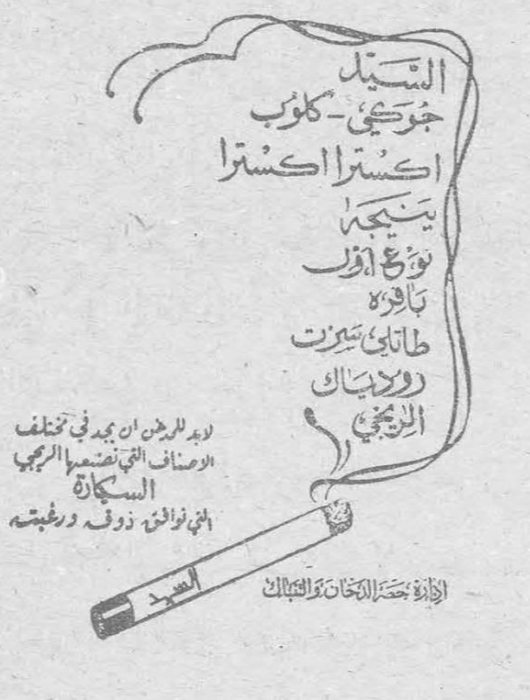
Advertisement of the Tobacco and Tombac Monopoly Administration
Al-Sayyid — Georgie — Club — Extra Extra — Bi'ni — Naw' — Azraz — Tabarz — Tabaki — Tirz — Doumiak — al-Rihani
A man wishes to find, at his varying moments, in al-Rihani the cigarette that suits his taste and his nature
The Tobacco and Tombac Monopoly Administration