"I was thinking of studying medicine... then circumstances willed that I become a teacher..." More than one teacher has repeated this sentence in my presence, and I have listened in silence, all the while sensing through it the inferiority complex that afflicts most teachers — I do not say all of them — and trying to analyze it and bring its causes to light, with bitterness and pain in my heart.
Is a man born a teacher? Psychologists hold that in every human being there is some inclination toward teaching and guidance, but that in some people it is stronger than in others. Let us suppose that no small number of our teachers were born teachers, with an instinctive bent for the company of children and for training them, and with a capacity for artistry in the methods of instruction — and artistry is the first quality of the gifted teacher. Yet most of these gifted ones soon see their talents killed and their ardor cooled under the pressure of the nerve-racking circumstances that surround the teacher and sap his resolve.
He sees that in name he ranks among the members of the intellectual professions, but that in fact he earns no more than petty laborers. And beyond that, he sees for himself no social standing, no esteem from his milieu, to console him for his material poverty. A doctor may fail in his profession so that it yields him nothing, yet he contents himself with people's respect and their awe of him, and consoles himself with the title "Doctor." Not so the teacher; his last refuge is to turn mystic and dissolve himself for the sake of God — a thing feasible only for the chosen few whose natures were formed with mystical leanings. And suppose he does turn mystic and consents to sacrifice himself in the service of humanity: he is still at a loss in which institutes of learning to spend his mystic's life; for our schools, however various their kinds, are
equal in their defects. Some are still in the primitive stage, ruled by chaos. Some are afflicted with the disease of reaction and sectarian fanaticism. And some impose upon the teacher flattery, submission, and the denial of his own personality. The reader will perhaps understand what I mean by each of these categories.
In vain do they try to tempt the teacher by saying that great men — the likes of Confucius, Plato, Aristotle, al-Hajjaj, and al-Ghazali — were teachers. For he knows
that these men became great only when they left teaching, or pushed it to the margin of their lives, or gave it a small share of their time and turned to other work for the rest. They say that Einstein tried to make his living from teaching and pursue his mathematical studies at the same time, but before long he abandoned the profession, saying, "These schools exhaust their teachers and leave them no time to breathe." And in the memoirs of a contemporary American teacher: "An hour spent by the teacher in the classroom — keeping order among the pupils, drilling them, and enduring their coarseness — equals three hours of office work."
There is, however, one position that can tempt the teacher: to hold one of those university
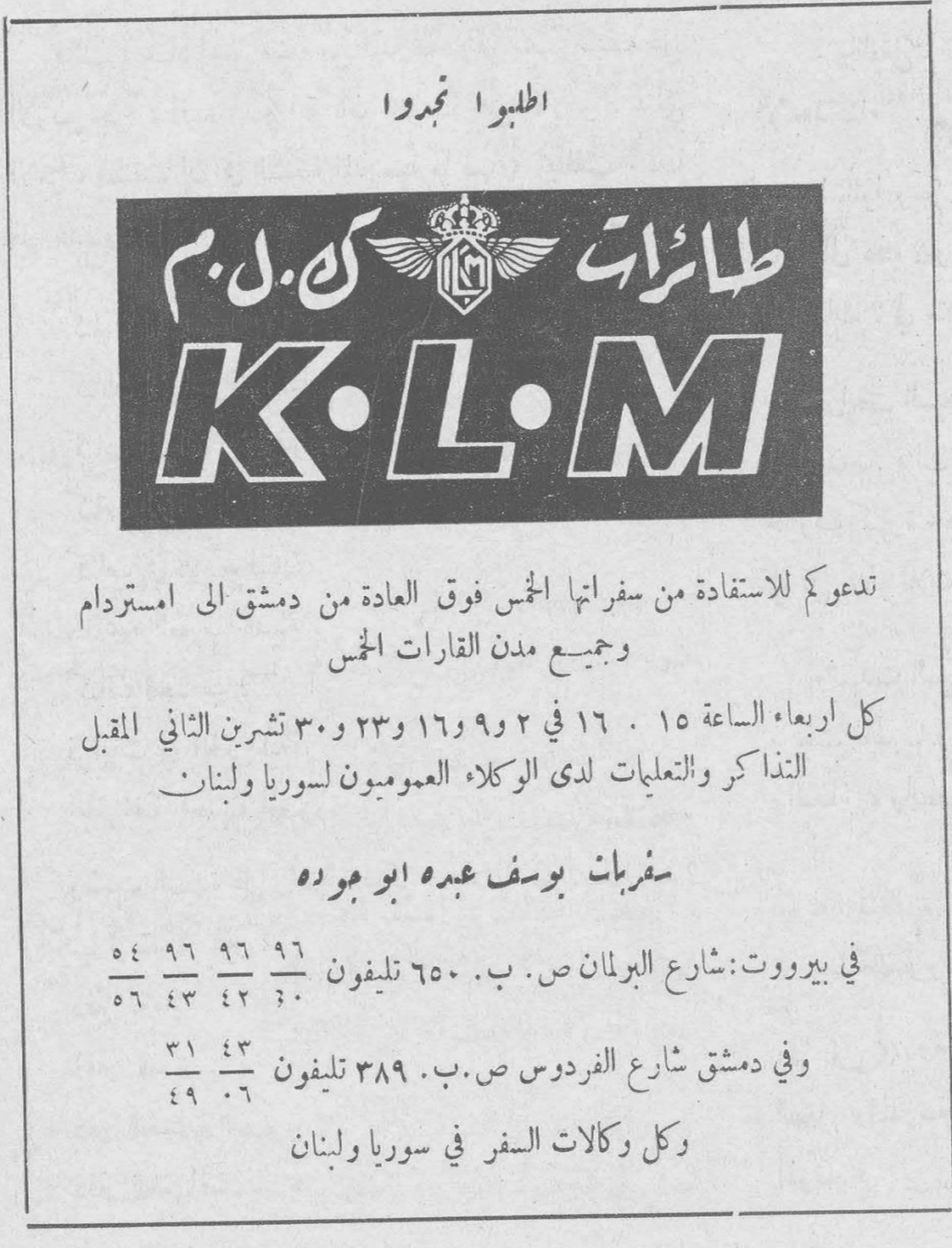
K.L.M. Planes
Ask, and you shall find
K.L.M. planes
invite you to take advantage of their five extra flights from Damascus to Amsterdam and all the cities of the five continents
Every Wednesday at 16:15, on the 2nd, 9th, 16th, 23rd, and 30th of next November.
Tickets and information from the general agents for Syria and Lebanon:
Youssef Abdo Abou Jaoude Travel
In Beirut: Parliament Street, P.O.B. 650, telephone 96 96 54 / 30 42 43 56
And in Damascus: Fardous Street, P.O.B. 389, telephone 43 31 / 06 49
And at all travel agencies in Syria and Lebanon