(1) My friend:
Do you still remember that distant-near past, and those hours we spent exchanging views and thoughts, hopes and memories? This time, which folds away the lifeless and the living, glides past the immortal moments without touching them with harm, as though they stood apart from its flowing.
How often I have recalled the sentences of the thoughts we used to circle around, and tried to weigh them in the balance of society; and it appears to me that I would amend many of them — not to return to theories against which we revolted, but to see in reality what lies beyond reality, and in events what hides behind events.
How much we sang of woman's emancipation and her equality with man — but did we ever ask ourselves what emancipation and equality mean? Did not some understand by them that absolute liberty which borders on chaos and collapses into it? And since we are speaking of liberty, I cannot but think of the limits at which it must stop, or of the foundations from which it springs.
I cannot, my friend, understand man's life except as a form of realization of an immortal essence latent in his nature — the word from which his existence bursts forth. And if I measure things by
these measures, I say: woman's truth and her utmost end is to be, first and last, a woman, with all the force and meaning that lie in this word.
Can there be in woman a secret deeper than the secret of her beauty, and an essence nobler than the essence of her femininity...? Can her release from this golden chain — which pours upon the world a force beside which the force of iron and fire is nothing — be anything but a crime beside which the sin of sinners is nothing?! Man's thought is bewildered when it contemplates this great universe, and it rises toward the supreme Creator who ordered it and asked into it, from His spirit, the riddle of the creating word; and when it fails to comprehend the greatest secret, the secret of creation, it confesses the limits of its faculties. The first Creator, when He placed life in man, placed in it a spark of His light; and when He fashioned woman, He kindled her eyes with a brand of His fire, that she might be the source of his inspiration, and he its instrument.
I have come to loathe democracy, so often have people chewed over its name and contradicted one another in interpreting it and realizing it. It is a veil behind which they hide the cruelest kinds of oppression and the basest patterns of life; and it seems to me that it carries us back to before civilization and history, because, under the cover of saving man, it has turned him into an obscure unit among units driven like herds to work and to battle. It
has soiled what nobility remained in man's head and what purity in woman's glances. And I imagine woman, as she demands her rights, like the moth that makes for the burning light; for she will find in the written and proclaimed laws only a counterfeit garment that covers her true self and tightens the noose upon her, to efface her truth and turn her into a false existence.
We shut in the lily and screened the light from it, and behold, it wilted. As for them, they exposed it to the furnace, and behold, it melted. And all of us have sinned against truth under the name of progress, and hurried toward ruin behind the banner of salvation. Man forever circles about the straight path — now behind it, now before it, and never upon it. It is as though He who granted him of His truth covered His gift with a transparent veil, that he might see it without reaching it, and seek it without laying his hand upon it. And so he begins in sorrow and ends in anguish.
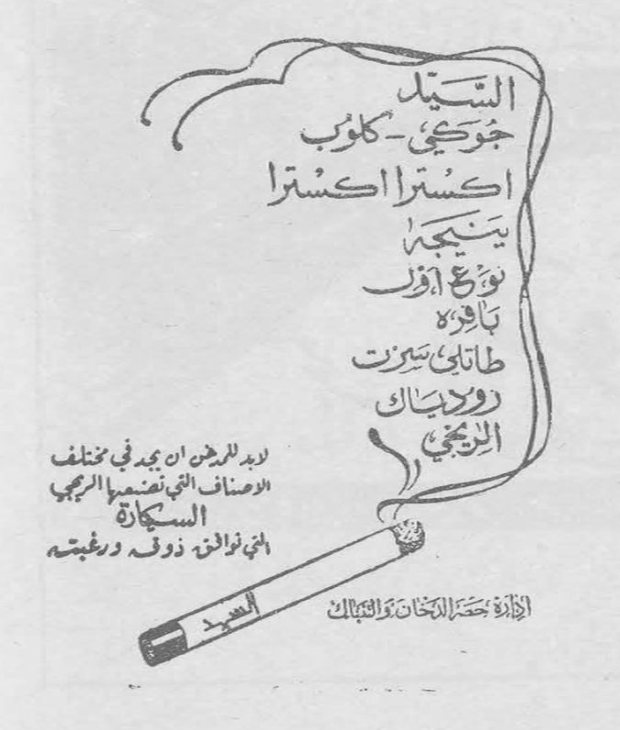
Cigarettes of the Tobacco and Tombac Monopoly Administration
Al-Sayyed
Georgie Kloub
Extra Extra
Bnayha
First grade
Second grade
Tabati Sert
Rosinak
Al-Zirkin
Let customers know that among the various brands the company puts up, each will find the cigarettes that meet his taste and his desire
The Tobacco and Tombac Monopoly Administration