physicians were famed also for the medicine of women.
In the age of Harun al-Rashid, Yuhanna ibn Masawayh composed a book entitled "Why Physicians Have Refrained from Treating Pregnant Women in Certain Months of Their Pregnancy," and a book, "The Treatment of Women Who Do Not Conceive." In Andalusia the sister of al-Hafid Ibn Zuhr and her daughter were famous, and they treated the women of kings and princes.
After the fall of the Arab city we hear no more of theories or inventions in the world of women's medicine. But after the ages of decline we find, in the year 550, the French physician "Paré" coming upon what Soranus had written about changing the position of the fetus in the womb; and "Colombo of Cremona," in the year 1559, opposing the opinion of the ancients concerning monstrous births, saying that such a child was born abnormal through a malformation that befell it in the womb, and that this has nothing to do with jinn and demons. In the year 1667 we find, too, the accoucheur "Chamberlen" using the forceps to draw out the fetus; and the famous physician "Mauriceau," in the year 1668, describing the pregnant woman in his book "The Diseases of Pregnant Women," saying: "The pregnant woman is like a ship on a stormy sea, and the skillful captain is he who steers her with deliberation and precision to the port of safety."
Among his sayings is that pure air, and keeping away from hot and cold climates and from rooms full of smoke, improve the pregnant woman's health. He prescribed nourishing food for her, to be taken at fixed times and in small quantities; forbade her hot and fatty dishes, because they cause gases in the bowels; prescribed for her the eating of fresh river fish, the wearing of low-heeled shoes on her feet, and the eating of apples, stewed plums, and figs against constipation — with an enema if it proved stubborn.
This Mauriceau fought against the tight corset that conceals the pregnant woman's belly; and bloodletting was still widespread in his day.
In the year 1773, "Charles White" of "Manchester" set down some fragments on puerperal fever, as did "Alexander Gordon" in the year 1795.
It is as though these few efforts, appearing within a few years of one another, were a prelude to the great rise of the art of midwifery in the nineteenth century; for
since the Stone Age, man in Asia and Europe had not advanced as he advanced in that fruitful century. The art of midwifery had sunk to such depths of decline only because its reins were in the grip of fallen women who took it up as a trade, of ignorant midwives who knew nothing of its secrets, and of charlatan priests dealing in magic, prayer, and quackery — and how should quackery and prayer save women in childbirth!
To be continued
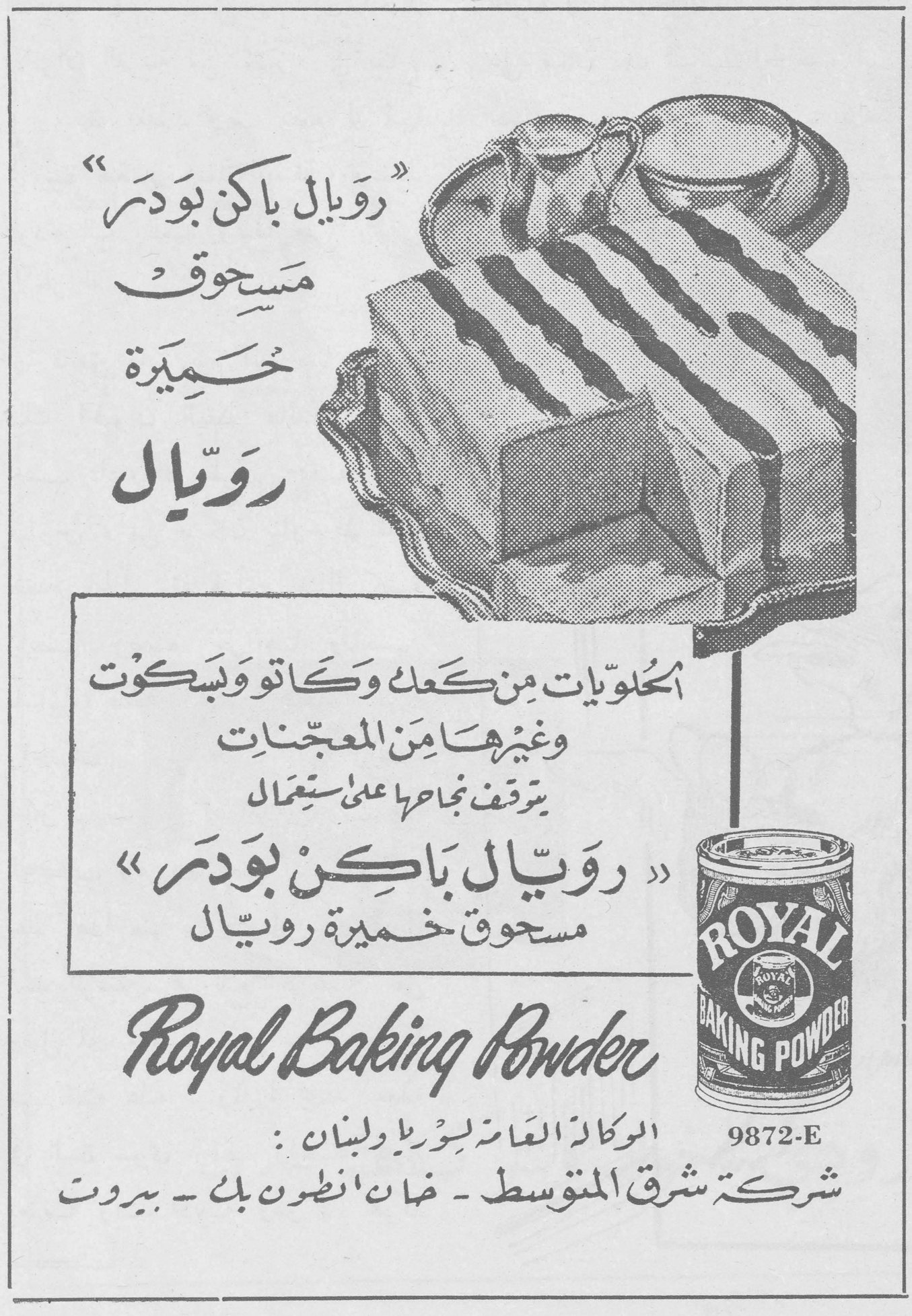
"Royal Baking Powder" — Royal leavening powder
Sweets — cakes, gâteaux, biscuits, and other pastries — their success depends on the use of "Royal Baking Powder," Royal leavening powder
Royal Baking Powder
General agency for Syria and Lebanon:
The East Mediterranean Company — Khan Antoun Bey — Beirut
9872-E