The first thing that strikes you in Nazik al-Mala'ika is that she is a poetess who has given herself over to the study of the two cultures, Arabic and Western — and in particular of English literature, in which some critics see the finest models of European poetry, while others see in it a clear mirror reflecting the distillation of Western civilization, descended from the very heart of the civilization of the Greeks.
We feel her mastery of the language in this poetic gift, so rich in poetic diction both old and new; you observe that she has possessed herself of the secret of finding the fitting word, that she is skilled in discovering words and setting them in place, and that she has made attempts at creating them — in this she is like the artist who sees himself a creator before he is an artist.
And you see her deep application to the study of the literatures of the Westerners in her allusions to their literatures and their myths and her drawing of inspiration from some of their poets; in her sweeping revolt against the rigidity of Arabic poetry and its fetters; in her adoption of most of the methods of modern European poetry — variation and invention in meter and rhyme, strong cohesion between the parts, and the turning to account of the theories of symbol, obscurity, and the subconscious mind; and in her style there is a boldness, a subjectivity, and a freedom that bring it near the level of pure poetry.
You sense that Nazik al-Mala'ika
is a poetess in her blood and her spirit: she lives by poetry and lives for it, and has made it her absorbing occupation and her first profession. It is no wonder that the gifted poet Omar Abu Risha should declare poetry to be his craft, for talent avails nothing without unceasing diligence and persistent work joining night to day. Yet art is jealous: it permits no other to occupy the artist's heart, and it insists that its devotee melt his very soul as an offering upon its altar.
If Arabic poetry has left a mark on the collection "Splinters and Ashes," it is that captivating music which distinguishes Arabic poetry old and new, and which is strengthened here by the variety of meters and rhymes and by the unevenness of the parts — some long and extended, some short, sounding after them like echoes.
In all else there is liberation and a free handling of the meters, and a complete renewal in subjects and titles, in images and expressions, in thought and style.
Most of the poems dispense with the system of the two hemistichs that follows the old manner, and most of them end on the quiescent rhyme. The poetess has a fondness for repetition and verbal refrain; for the short meter, because it is more suggestive and more concentrated; and for long-drawn passages, extended like the pain and the longing in her soul.
Take us back, O train... For the expanse is vast and the road is long And the nights are short...
Her poetry teems with pulsing images, full of gesture and glimmer, movement and color: the meanings of sins that flash with
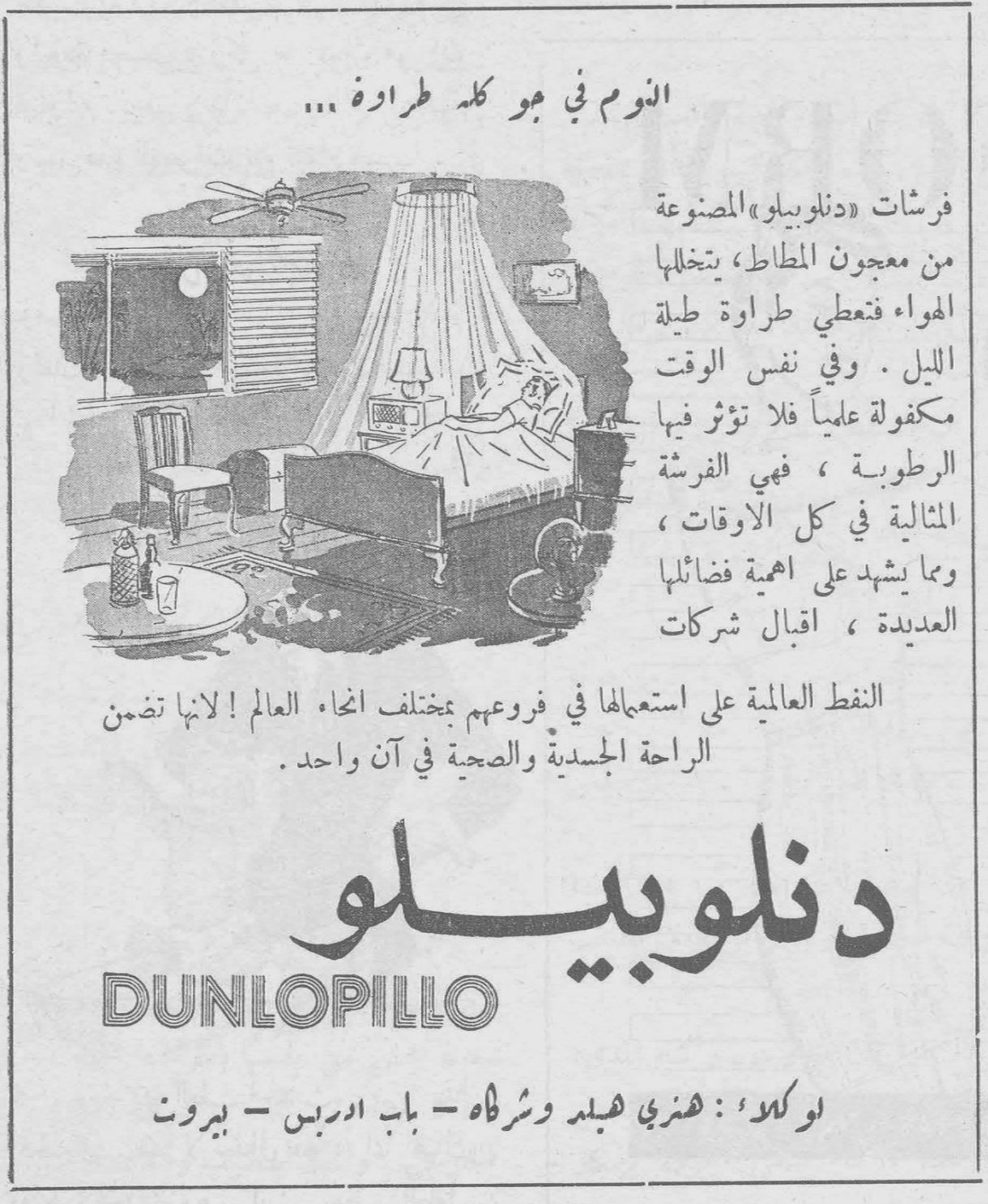
Dunlopillo
Sleep in an atmosphere of pure softness...
"Dunlopillo" mattresses, made of rubber paste, are permeated by air and so give softness the whole night long. At the same time they are scientifically guaranteed: damp does not affect them, so they are the ideal mattress at all times. And what testifies to the importance of their many virtues is the eagerness of the world oil companies to use them in their branches in the various parts of the world! For they ensure bodily comfort and health at one and the same time.
Dunlopillo
DUNLOPILLO
Agents: Henry Heald & Co. — Bab Idriss — Beirut