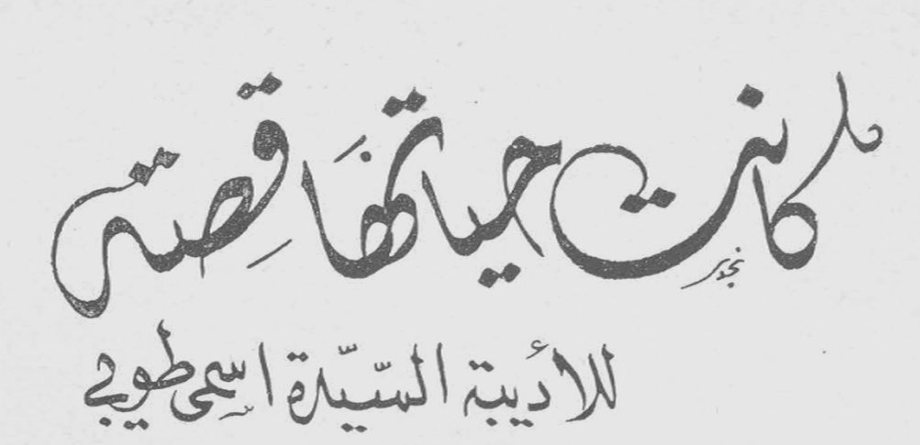

"And May passed away after a life not long; the world gave her much of what she loved — standing, fame, and glory. But May's misfortune was in her heart... Her life was a story in which misery walked beside happiness; but the story ended in tragedy."
That was years ago — and how swiftly the years pass! Who perceives the speed of their passing,
or who can say to them... Stop!
We were a few children playing in front of the house in the town of Nazareth when there passed by us a girl dark of complexion — or, as she herself said afterward, "her color the color of scorched coffee" — and in her company a young slave, tall of stature. And we pressed ourselves against the wall, trying to hide from the slave's face, for fear he might pluck one of us from the ground, lift him to his mouth, and swallow him in a single mouthful, then wipe his hand on his red caftan, and no trace of blood would show on the caftan... But she passed us by laughing, as if she understood, and we were reassured; and we saw the two of them stop at the door of our house, and my mother spoke with her, and we heard the girl offer greeting in an accent that seemed that day like music in our ears, saying: "My mother sends you her greetings and begs the loan of the tambourine you have, for us to use at a wedding at our house"... And we heard my mother ask her about her mother... and when they had come back from Egypt, and how long they would stay — all this while we, having taken courage, gathered round, listening and drawing near; and within minutes the girl and her companion came back, she skipping at his side in her short dress, laughing, and tapping on the tambourine, trying to draw
melodies out of it... And that was the first time I saw May; and the picture that accompanied her memory in my imagination was a radiant picture: a slave, and a red caftan, and laughter, and music.
And that was years ago — and how swiftly the years pass.
And I grew out of childhood and began to read May. I read her "Flowers of Dream," and melancholy ran through the flowers, as when she says: "Sad today is my soul, and its dark sorrow is painful. I think of the scattered leaves, and of the living who went away and returned no more."
And I followed her steps in Egypt. An only child, with parents who cherished her; her father notices her native intelligence, takes her by the hand, and opens for her in his home a literary salon frequented by the likes of Taha Hussein, al-Aqqad, Lutfi al-Sayyid, and others. And what a salon — frequented by such giants of letters as these! And "May" sits to drink from that overflowing spring the ripened thinking and the considered judgment; she listens to the differing opinions and the contending arguments; and when the gathering, or most of it, has dispersed, she keeps back the closest of the friends and gives herself over to them — as Taha Hussein said: gracious and free; we hear from her talk and her playing and her singing what we hear. Then he goes on: and I shall never forget May's voice when she sang us the famous Lebanese songs, or others in the various languages... I see this laughing picture, and I imagine happiness unalloyed for its owner... but the pain dwelling within pushes aside the mask, and behold the hand pressing the heart to still its beating; and behold the pen writing: "How swiftly the garments of the roses wither, and
how precious are hearts quick to feel; how precious the sensitive heart — and how wretched, for the wounds breaking within its folds."
And I followed her steps as she drank from the spring of learning with a great thirst, studying and studying until she mastered five languages, as al-Aqqad says, or nine languages, as she says of herself; reading and reading — and what of a house that holds two great libraries, the first her father's, with 500 volumes, and the second her own, with 300!... Everything there summons to happiness: the platforms come walking to her, and fame befriends her, and her parents — she the wellspring of their pride and the resting place of their hopes — flood her with their tenderness. But the woman's heart kept writing: "I went out to the garden on a luminous morning and stretched out there on the green grass, and a small boy of four drew near me, and I called to him: Come, my little one — won't you sit on my knee? And I felt the weight of his small body, and I remembered my only brother, dead; and my heart leapt to my lips, and I kissed the child, distracting myself with that kiss from my melancholy rising from my heart as the clouds rise from the edges of the sea."
And I followed her steps when she had climbed to the summit. I saw her when ceremonies of tribute were held for her in Lebanon, and the Poet of the Two Countries chanting to her:
"May — and who among men does not know her? For perfume, once it spreads, cannot be hidden."
And I supposed that this happiness which engulfed her would take hold of her heart — and behold, she writes: "Two forces pull at a person: the force of sorrow and the force of misery; yet a drop of