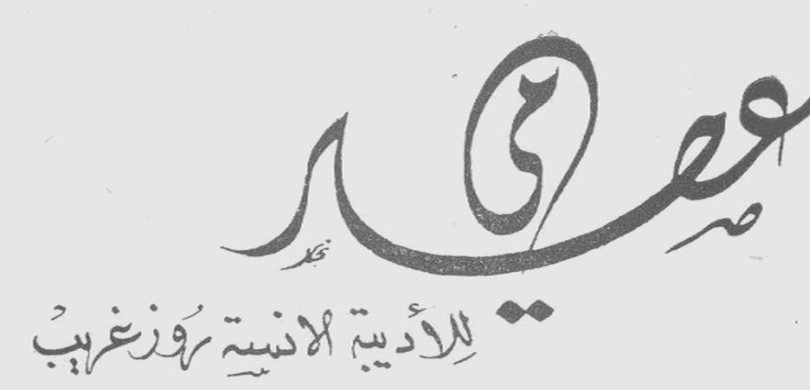
“The age of May is the age of the flowering of Lebanese literature outside Lebanon — the age of Zaidan, Sarrouf, Gibran, Rihani, and Mutran. And it is an age that has passed, or nearly so, since nothing remains to Lebanese literature for refuge but its mountains and its shores.”
The writer is the child of his age and his environment, and each influences the other. If it is right to attribute the writer to the age, it is right also to attribute the age to the writer, so that you say the age of Abu Nuwas, the age of al-Jahiz, the age of Voltaire. And you may also say “the age of May,” inasmuch as this woman of letters represented well, in her writing, the era in which she lived, from both the literary and the social sides, just as she herself represented a unique stage among the stages of women's literature in the Arab East.
Signs of alertness and genius showed in the writer from her childhood, as did signs of eccentricity too. Since she was her parents' only child, they directed to her all their care and concentrated upon her all their affection, so that from her earliest years she was exposed to what every only child is exposed to — an oddity of manner whose source is the parents' excessive affection and overabundant attention. She passed her girlhood in a convent of nuns, and the atmosphere of the convent was a powerful factor in spurring her imagination and directing her toward a life of individuality and contemplation. From that time began the forming of the personality of the thinking woman of letters and the dreaming girl, who before long set her early dreams into verse in the French “Sighs of a Dream.”
In the convent school she gave herself to the study of French literature, above all the Romantic literature distinguished by its unbridled imagination and burning emotion — the literature of Chateaubriand, Lamartine, and Musset — which the nuns' schools take care to teach for the religious spirit and tenderness of feeling in it. In the shade of the convent gardens and among the books of the Romantics, May's soul was reared on the love and adoration of nature, and there grew in her that captivating femininity and that delicate sensibility: three qualities which anyone who reads her writings is bound to discern.
Before long she opened her eyes to the literature of the innovators among the Arab writers — the likes of Wali al-Din Yakan, al-Jumayyil, Gibran, al-Rafi'i, and Rihani — and she applied herself to the study of Arabic in Egypt; the eloquence of the
Qur'an enchanted her as the writings of Gibran fascinated her. Her writing career began in 1911, when she was still a girl under twenty, with an ample share of learning, mistress of four languages besides music, philosophy, and the rest of the social sciences.
From that time she began to form for herself a style influenced by the modern renewal, having in it the echo of Gibran and the music of prose poetry, the imagination of French or German Romanticism, and the elegance of authentic Arabic; and in it the subjectivity of Mahjar literature, its spirituality, its obscurity, and the phantasms of its imagery:
“And I awoke on the morrow, and it startled me to feel a bruising in my soul, a taste of song in my mouth, and burdens welling up on the page of my conscience as though they were loads of blood; and there was weeping in my heart at what I had witnessed of empty pretension, false play-acting, and sickly sentiment.” (From Darkness and Rays)
She was drawn to tales of misery in the manner of Hugo and Saint-Pierre, so she translated from the German Max Müller's tearful tale “Smiles and Tears,” and she did not shrink from shedding tears in some of her articles, for the literature of tears was then a prevailing fashion.
Yet she has, for all that, a style of manifest personality; when you read it you cannot help seeing the woman's psyche standing out through its folds — the woman with her femininity, her charm, her delicacy of feeling, and her quickness of thought; or it seems to you, as you read her, that you hear a soft, elegant, musical voice addressing you or reciting the words to you with grace and taste. In one of her articles she criticized the language of the ages of decadence used in government correspondence, and digressed, addressing the press censor: “I hear you scolding, Mr. Censor (and it appears that censorship of the press then was worse than it is today), as your pen draws near this sentence of mine, meaning to do it violence. So hear me out, if you please: you are no German soldier, nor am I a French soldier, nor is this page the cathedral of Reims. Be forbearing, then, and strike nothing from it!”
If immortality is written for May's style, the credit for it belongs to this singular personality standing out through the lines; for the reign of emotional brilliance and musical prose has ended, or nearly so, in this scientific age, which wants the story