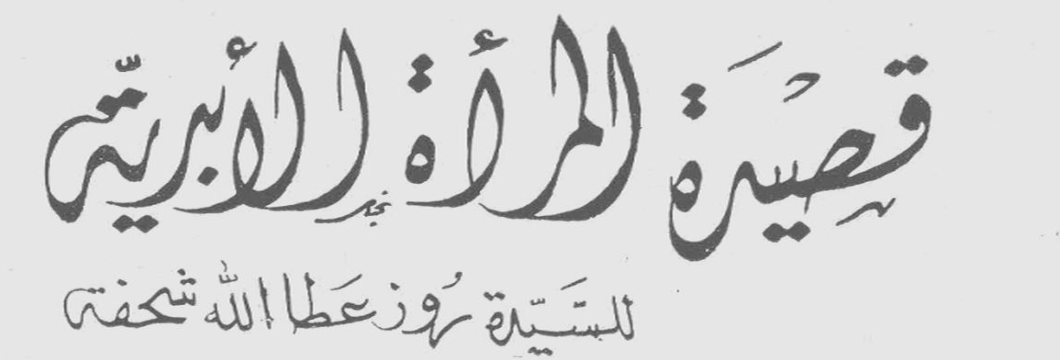
I thought long when I began to write about May — I thought I would not call her a genius or a prodigy — and then I found myself running into it wherever I turned my gaze, and however far I went in touching her blazing intelligence and her inventive mind. She is the genius of this her age, and genius streams from her abundant writings — from the depth of her studies and her soaring with them beyond all limit — to a fineness of depiction — and a spiritual suggestiveness joined to the latent spirit of motherhood. At one moment I see in her fervor and her impetus the spirit of the lioness defending her cubs; at another I touch the spirit of the mother who pats with her soft hand, chanting to her children in her plaintive voice the highest anthem of humanity, to rouse the flagging wills and revive the tormented hopes with tokens of resolve and tenderness — saying to them: "The goal of humanity — the ideal that gives life a delicious meaning and lends it a new luster — and kindles in the soul a fire that burns up its corrupt inclinations and makes it fit to be a temple of lofty thoughts and noble purposes."
Upon what wide horizons of wisdom, poise, and knowledge she made us look out! And how often — how very often — she charmed us with her engaging style, of that easy manner none can imitate. To my eye she is like a circle: one is at a loss from which side to approach her. From her striking, magnetic personality? From her high culture? From the masterpieces of her enchanting writings? Or from her character, her feeling, and her tenderness?
Did she not write with the ink of her heart these writings and those chapters, until by them she became immortal? And is there anything like the heart — a limpid spring which, whenever Providence feeds it from its overflow, gives life abundance upon abundance and draught after draught?
Therefore her overflow was unbroken and its spring abundant and unrelenting, and she endowed mankind with shining treasures that are the inheritance of the generations and the ages, and the pride of the women of the twentieth century.
How happy I was the day May took her last stand on the platform of West Hall at the American University of Beirut, scattering her precious pearls, which set my heart dancing with delight. I began looking right and left to see her effect upon the company, and behold, they were drunk with her wine as I was, anxious even about their own breath, lest it trouble the serenity of that sweetness and cut the electric current that flowed from her to us. And how sweet was the lofty spirit she breathed into our spirits, sealing her magical words with the saying: "The culture of one individual cultivates many individuals; one small light illumines a wide space; the strength of one individual creates a thousand heroes."
And perhaps she, being that one individual, will quicken this spirit of hers in us, and so create a thousand heroes and thousands of individuals, who will be joined to her rich spirit, and it will furnish them with light and strength and heroism and life.
How many times have we women taken refuge with May and sheltered in her shadow, our heads held high! Is she not part of the womanly being that feels the wrong done it and condemns the usurpation of rights? She tried to show man his faults with mildness and his failings with gentleness, without
any self-conceit appearing in her — though she had the right to it, having outdone many of the wielders of pens in her soaring through far regions and her handling of the subtlest subjects; so she earned the testimony of the greatest of our men in worth — the testimony of the late scholar Yaacoub Sarruf, who said in presenting her book "Bahithat al-Badiya": "I do not recall that I have seen, to this hour, any among the writers of Arabic who is her match, nor any among the Europeans who surpasses her."
Her writings, all of them, are the poem of women and their eternal anthem; their music is sweet, their thoughts are lofty, they lay balm upon wounds. How sweet she is when she says to men: "Go on working for the emancipation of woman — the longed-for emancipation — until you hear from your own souls that splendid testimony: O man, you have done well — done well because you have made amends, done well because you have done justice."
Who ever conversed with May and was not bewitched by the grace and sweetness of her talk? And who has read May without crying out in admiration at the beauty of her fresh expressions and her blazing eloquence? She lifts her reader to far-off regions, and he feels the loftiness of her horizon and its splendor — a woman of letters and of society, and a great reformer, eloquent and pure in language — an orator beyond rivalry — she plumbs the unknown with her living feeling and her luminous mind, and sets it before the eye in a supple, captivating style. Does not her reader feel that he stands before a