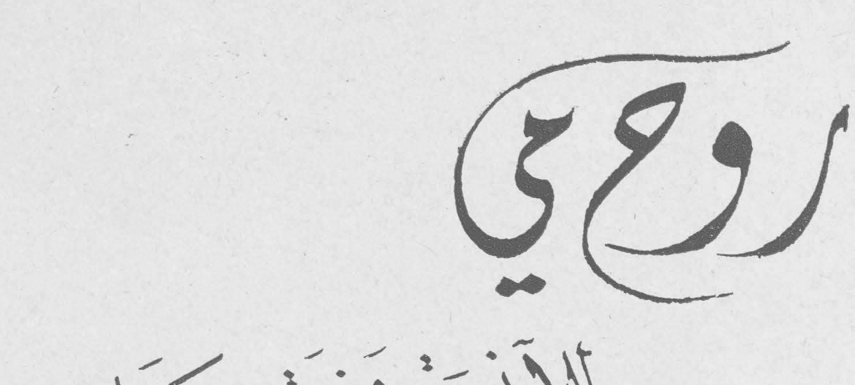
Never have I read a literary article by one of our contemporary women writers without the spirit of May appearing to me through the lines of that article—May, whom I came to know through reading her works while I was still in the last stages of my schooling, and May, whom most women came to know as they passed through a stage of their lives that may be very far from the present one.
God knows I do not remember much of what May said, and were I asked what of her sayings I hold in memory, I would confess my shortcoming in this field; nor do I doubt that what applies to me applies to many of my sisters. Our plea in this is that we are well acquainted with all that May said, yet unable to cite the texts. We do not remember word for word what May said in her article “The Bells of Christmas,” for example; but we can pick the article “The Bells of Christmas” out of the collection of her articles, place that article in the balance, and judge that it is one of the immortal pieces whose writing inscribed the immortality of our woman of letters, May.
Yes, we may not be able to reproduce May's very words, or we may not wish to; but without knowing it we carry a part of May's spirit in our writings—if we are among those who practice the art of writing—and we carry a part of May's spirit in our ordinary daily lives—if we make up the body of women readers whose business is reading.
And what is this spirit of May whose settling in our souls we feel? May's spirit is that spirit which pulses with vitality and brims with activity and shows
clearly in every department of our lives. May's spirit is the spirit that straightens what is crooked and rises up to exalt the right; it is the spirit that affirms uprightness and refuses all else; it is that spirit which loves beauty and adores perfection and soars free at the heights of poetry, literature, and art, including music and the dance. May's spirit is the one that accepts no laxity in matters of language and disdains to commit a fault of grammar; it is the spirit that values the language's majesty and helps it go on in its life without any blemish attaching to sully its good name. May's spirit is that spirit which carried the young woman of our age to leap over the barriers and stand at the speaker's rostrum as May stood, who knew the rostrum while she was still a girl. May's spirit is a breath from the being of an Arab girl who worked, and lifted high the head of the Eastern girl, and made for her a heritage to lean upon should she one day need something to steady her stand in her struggle toward advancement. May's spirit is that free,
songful spirit which is not bound by letters and words and lines and paragraphs, but takes all of these as an instrument by which every girl feels that something stronger than words has taken firm hold in her being—something dearer than lines and articles, something contained in a deep, unseen influence: the spirit of May.
Had May died and had woman among us gone on floundering in the darkness of ignorance and dullness, I would have said there is no good in a literature without influence, and no good in a woman of letters who lives a moment only to die for generations. But woman among us is in a state of wakefulness—we see it in every one of our gestures—and seeing it compels us to say: May has not died; her spirit is alive and free, still spurring pens, whetting resolves, and guiding women ever toward the good, through what May wrote in the days when her spirit was imprisoned within the body, when the spirit moved the fingertips to trace what would have its full effect in a world forever looking toward progress.
Mothers! If paradise lies beneath the feet of mothers, then hell is in their hands; and it is theirs to be, for their kin and for their homeland, bliss and hell, greatness and disgrace...
"Bahithat al-Badiya"