She saw life from outside life; she did not see life from the heart of life. Hence she portrayed of reality nothing but the reality of her own self, and hence she preferred to remain in the ideal.
As for the other phenomenon, it is a philosophical inclination toward “the unity of being.” Indian in origin, the Alexandrians gave it philosophical form after Plato; Ibn Bajja and Ibn Rushd, of the philosophers of the Andalusian West, distinguished themselves in making it rational; and certain mystics kept it current in the West—like the Swede Swedenborg, and the likes of Hoffmann and Hartmann and Max Müller. And this is what Edgar Poe took pains to set forth in “Eureka.”
This inclination shows most plainly in two of her pieces: “The Hymn of the River of Serenity” and “The Day of the Dead”—the first concerning the manifestations of sensible existence, the second what lies beyond the sensible. In the beginning was God, and the emanation of the world was with Him. The world, then, is eternal with God's eternity, everlasting with His everlastingness. And in this emanation all the sensible manifestations mingle: color and melody, light and fragrance, the perfume of the flower and the roar of the ocean. The atom is joined to the spheres, and the spheres to God. And with existence God poured forth an all-encompassing good that floods existence. Thus there is no death in the universe, but abiding; for the worlds are transformed and do not perish, and their final destination is God, and God is abiding, nothing else. The form changes and perishes at the end of ends; but the essence passes upward, takes body, is transformed, and turns into the more perfect Spirit from which it sprang.
It is as though the “strangers” disdained the desolation of this world and took refuge, in their literature, in what lies beyond nature, seeking to discover through the veils of the fading forms truths among which are the most abiding truths of eternity.
Some of them came back to religion; others failed, and went off to deck themselves with the pleasures of the world; and a last group took shelter in spiritual and intellectual mysticism, as though finding ease only in this supposed flight. Of this last group was the soul of May. Where, I wonder, are the spirits of those who have crossed over? Has she cast from her shoulder the burdens of the nights? Or has she carried in her new existence other burdens?
She left on our earth a fragrance connected, on one side, with the roots of the “self,” and on the other, through the relation between man and existence, with abstract philosophical thought—while the masters of prose among the Arabs busied themselves with glitter and embellishment and with amusing the idle, far from binding their pains to existence, and from going forth with these pains into the fullness of eternity.
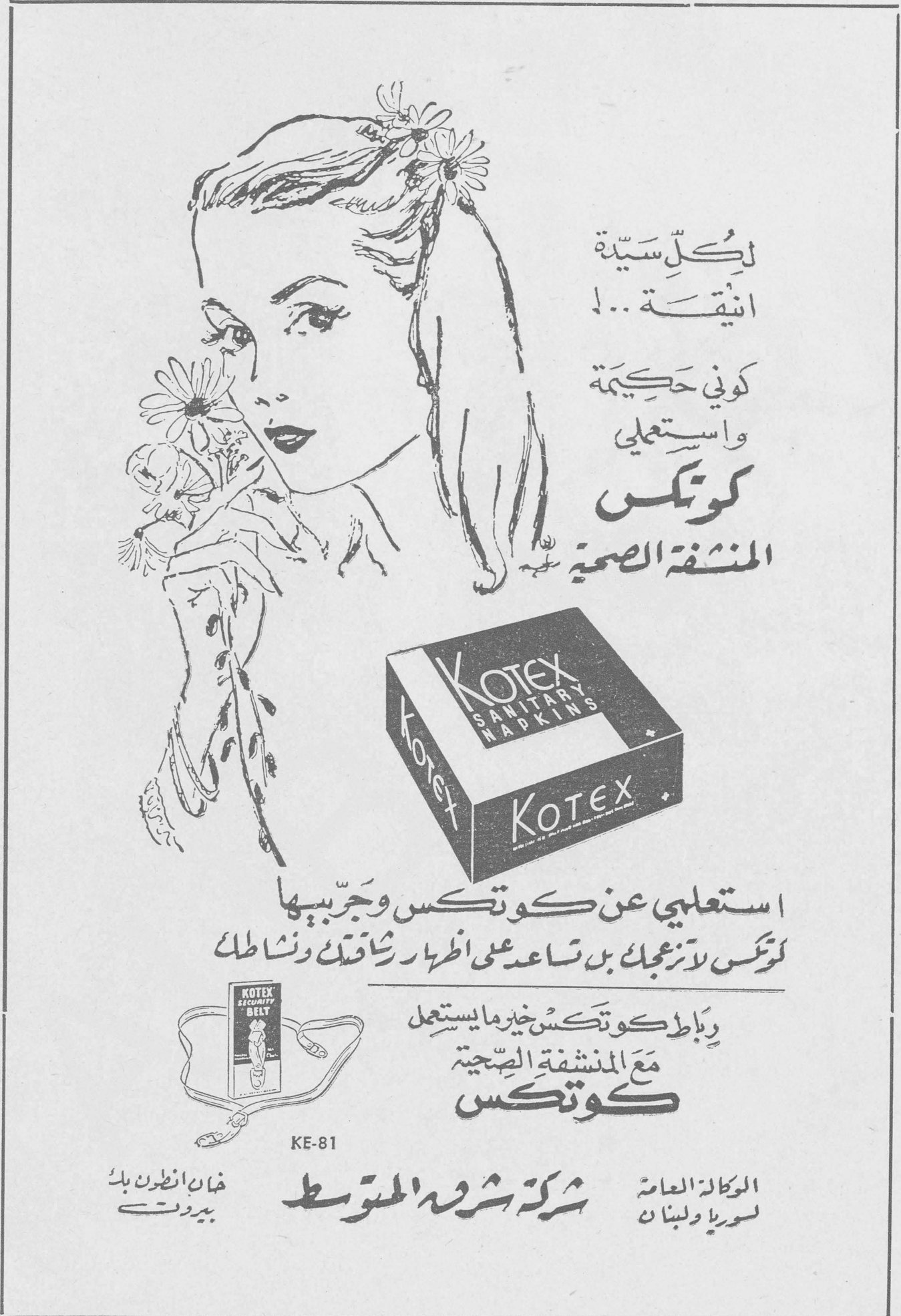
Kotex
For every elegant lady...!
Be wise, and use Kotex, the sanitary napkin.
Ask about Kotex and try it.
Kotex does not trouble you; rather, it helps you show your gracefulness and your vigor.
The Kotex belt is the best thing to use with the Kotex sanitary napkin.
KE-81
KOTEX SANITARY NAPKINS
The East Mediterranean Company
General Agency for Syria and Lebanon
Khan Antoun Bey — Beirut