and left it … no one walked in her funeral.
Your pen, O May, roams … on a subject you never treated, namely the … of man and his ingratitude. You sang of glory and … and friendship; your spirit, to see the … of everything, even glory and fame and … and friendship.
You gave your age wine to drink and … let it enjoy it as it will. You will not be … in fortune than others among the heroes in …
... no friend or companion. And that temple whose walls she had adorned with pictures and books, and where she used to receive the greatest of the people—fate locked its doors and the spider draped its expanses; so she passed her last days in the hospital and went from it to the grave, and no one walked in her funeral.
Where is your pen, O May, to make its accustomed round on a subject you never treated: man's ingratitude and his thanklessness. You sang of glory, of fame, of love, and of friendship; where is your spirit, to see today the vanity of all things—even glory and fame, even love and friendship.
You gave your age its fill of wine and sated it with enchantment; let it enjoy them as it will. You shall be no more fortunate than any other of the heroes in the hands of annihilation.
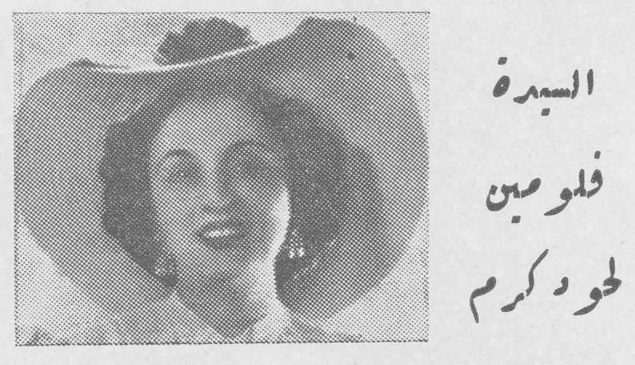
Mrs. Flomen Hawa Karam
That was, for me, something dear to my heart, and it had almost become a pressing need; for May at that time was the talk of every circle, and above all of the circle in which I lived..
May is stricken. No — May is wronged: that is what people were saying.. And there grew in me a longing to see this stricken, wronged woman. And I saw her in Freikeh, in Rihani's house...
Not a single minute of that day escaped me. I gazed at her long; I studied every feature of her face; and I saw nothing out of the
ordinary — save that there was a deep cast of pain flooding the lines of her face — no, flooding her whole being, even her clothes.
And she spoke little; I do not recall that she entered into any talk of her own accord, despite Rihani's attempts at the time to draw her out of her silence.
And when she answered certain questions, a smile would flash upon her face and vanish as quickly, and she would answer with much
I recall my first meeting with her, in the company of my literary friend Salma Sayegh; one of the women's associations had delegated us to welcome her. We made a condition with ourselves that the visit should not exceed a quarter of an hour, since it was a visit of protocol more than of affection.
The meeting took place, and May poured forth her graceful talk and filled our minds and souls with her sweet meanings and her valuable discussions, so that before we knew it two hours had passed like flashing lightning, without protocol driving us to leave the hall and deprive ourselves of the most delightful of sittings with the most delightful of ladies. There followed gatherings and appearances on platforms with which she stirred the hearts of all, and they acknowledged her as mistress of the pen absolutely.
Then came that last confusion, which placed our great woman of letters on the two pans of a scale, between those who doubted her and those who wept for her; and I, in my far remoteness, was among those weeping over a mind being shaken, a soul being crushed, and powers collapsing under the weight of what I do not know, and none knows but God.
Then she made her last stand on the platform of the University, before a gathering holding their hearts in their hands, apprehensive at what confusion of meanings and words they might hear — and behold, she cast upon the people bewitching, captivating marvels of eloquence and expression such as could come only from a mind that
had absorbed the sciences at their broadest and culture at its deepest.
One of those who attended that valuable lecture told me: When May appeared on the platform I felt an aversion at her form and appearance; but she had scarcely begun to speak when I imagined I was beholding the most beautiful of faces and hearing the sweetest of voices, and I felt the weight of a wondrous magic binding my senses. So I confessed with the confessors that May is the messenger of revelation and inspiration, the mistress of platforms and of eloquence, who holds sway over her hearers' feelings and dominates them by her eloquence and the magic of her expressions.
This is May, whose memory the magazine — The Woman's Voice — renews today, publishing about her and for her such words as carry us back to her life, which left behind, among the products of her penetrating mind and her vast learning, the greatest legacy for Arabic literature — a treasure for the generations to come; for she gave, alone, what all the women of the Arabs together have not given, and she pinned upon herself, by herself, the greatest of decorations — of glory, esteem, and immortality — one which has long filled our hearts and stirred our whole being.
I carried to her a bouquet of roses and violets. That was on the eighteenth of February, in the depth of winter, after she came out of the hospital.
In that hour, “May” was not, in my mind, a tormented woman, but a woman of my country who had raised my country's head.
“This is a bouquet of the colors of your country, May; it carries to you the feeling of its young people.”
The woman stretched out on her bed smiled, and pressed my hand.
And she said, in a deep tone: Thank you. May did not know who I was, and when I left the room there was in my mind a pale woman stretched out on a red bed.
And “May” remains in my mind thus, to this very hour.