
One of the most difficult things for the researcher into May's life and her outlook on life is to find, in what has been published about her up to now, much that would cast light on her singular life, or a glimmer upon her ideas through which he might penetrate to the essence of her beliefs and to the core of her social thinking. We cannot, in this brief sketch, trace the details of this thinking, nor go deep into its inward recesses and outward paths, nor see its effect upon her age, for that would demand much research such as we are not able to undertake now. But there is one important matter in May's life and in her thinking which we must broach, and to which we must draw attention, for its importance to the history of our modern renaissance even more than for its importance in itself. The age in which May wrote, and the age which she helped to direct, was an age in which the country was in labor with a new outlook on life — whether in society, in national consciousness, or in politics. These three matters are interlaced with one another; no one of them can be separated from its two sisters or lag behind them, and when that happens the three fall into conflict and actual progress halts until hands are joined anew. This struggle between the two factors of national consciousness and politics and the factor of society was, in May's age, a fierce struggle, and it remains so to a certain degree.
For the progressive conception of politics, and the state of the world of nations, demanded of us that we march forward into the arena of struggle with the weapons of the strong nations. But alas, our social life was a life of backwardness and regression, drawing its inspiration and its direction from the worn-out traditions of the East and from its firm-set fetters.
And if the situation in our country was a struggle between the old and the new, the West had already passed beyond this
stage and stood before a graver problem — I mean the problem of the disparity between the classes and the question of mastery. Why should some individuals enjoy the best of life while others suffer, without any cause? And who should take the helm to wipe out this disparity?
Whoever knows May knows that she lived between East and West; that is, she wanted for this East the open, unbound mentality of the West — that penetrating mentality which does not accept merely for the sake of accepting nor reject merely for the sake of rejecting, but which searches, scrutinizes, understands, and judges. Yet she did not wish the East to lose its soul, to lose that
tenderness which fills its frame and that peace which reigns in the hearts of its sons. In her heart there was a new flame, a flame kindled in her by the sight of her homeland trying to slip free of the fetters of servitude — the servitude of the mind and the servitude of ideas. She lived as though she did not know where, and looked about her with a pressing desire within her to know: where is she? and who is she? Within her was the longing of the Easterner who would have the whole world for his homeland, and the pride of the Westerner in his glorying in his homeland and his nationality. And she was aware that in the
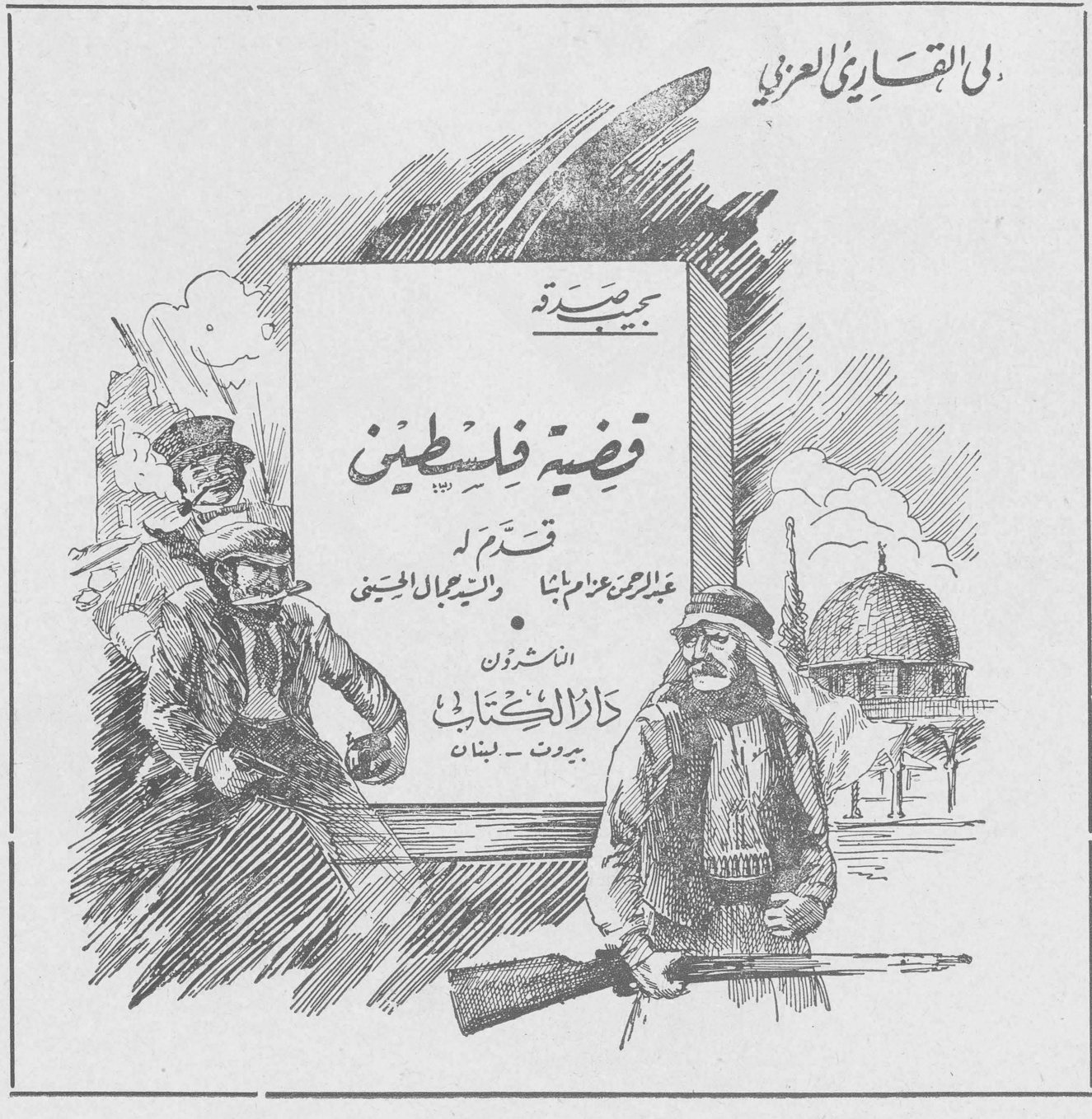
The Palestine Question Collection — Dar al-Kitab
To the dear reader
The Collection:
The Palestine Question
With introductions by
Abdul Rahman Azzam Pasha and Mr. Jamal al-Husseini
Publishers
Dar al-Kitab
Beirut — Lebanon