depths of her soul there was a yearning to belong to her homeland, to take pride in it, and to draw from this belonging and this pride a calm such as certainty adds to the hearts of believers. She knew that philosophy and art and science have no homeland, but she was aware that the artist and the philosopher and the man of science have a homeland; and she wanted her homeland to be hers, and herself to be its. For this reason she saw it as her duty to ward off from this homeland the calamities of colonialism, and that this homeland should carry the mentality of strength and the mentality of victory.
And the Western East in May made her question this cruelty of differentiation: she felt for the poor and felt for the working people, and she saw that there is a disparity between the classes that stirs grief in the soul and tears in the eye; she grasped with her heart this problem which the West grasps with its mind. Can people, one wonders, ever be equal? And what is this equality? And where is it? To these questions May devoted a book unique of its kind in the Arabic language — the first of its kind, if not of its subject — in which she examined the social classes and how they arise, then studied each class separately: aristocracy, servitude and slavery, then democracy; and then she took up the solutions to this new problem, examining the philosophers' attempts to conceive ideal cities, like Thomas More and Campanella and Wells, and studied the latest of these attempts in the theory of Marx and its revolutionary methods, and what this last may lead to in various doctrines, such as anarchism and nihilism — all of which, in her view, constitute problems still more complicated and more constricting, from which no realization of equality is to be hoped.
May believes that the road to establishing equality is not an easy one, and considers it beset with abundant difficulties; so she concludes by saying that it is necessary to establish a kind of nationalization, close to what exists in England today, since
the problem of equality cannot be solved by our human nature. She therefore asks that governments open public restaurants and free lodging-houses to be frequented by the poor and the needy; that begging be forbidden; that elementary education be made compulsory and obligatory; that public offices be established in which qualifications are examined; that the services of physicians, pharmacies, hospitals, and nursing be free for all;
that governments undertake the payment of lawyers' fees; and that in the prisons the prisoners be separated according to their stations and their morals. By such a system the problem can, to a certain degree, be solved.
In this glimpse we look out upon some of May's political thinking, and we see in it her progressive direction and this inclination to break free from national unconsciousness into pure consciousness.
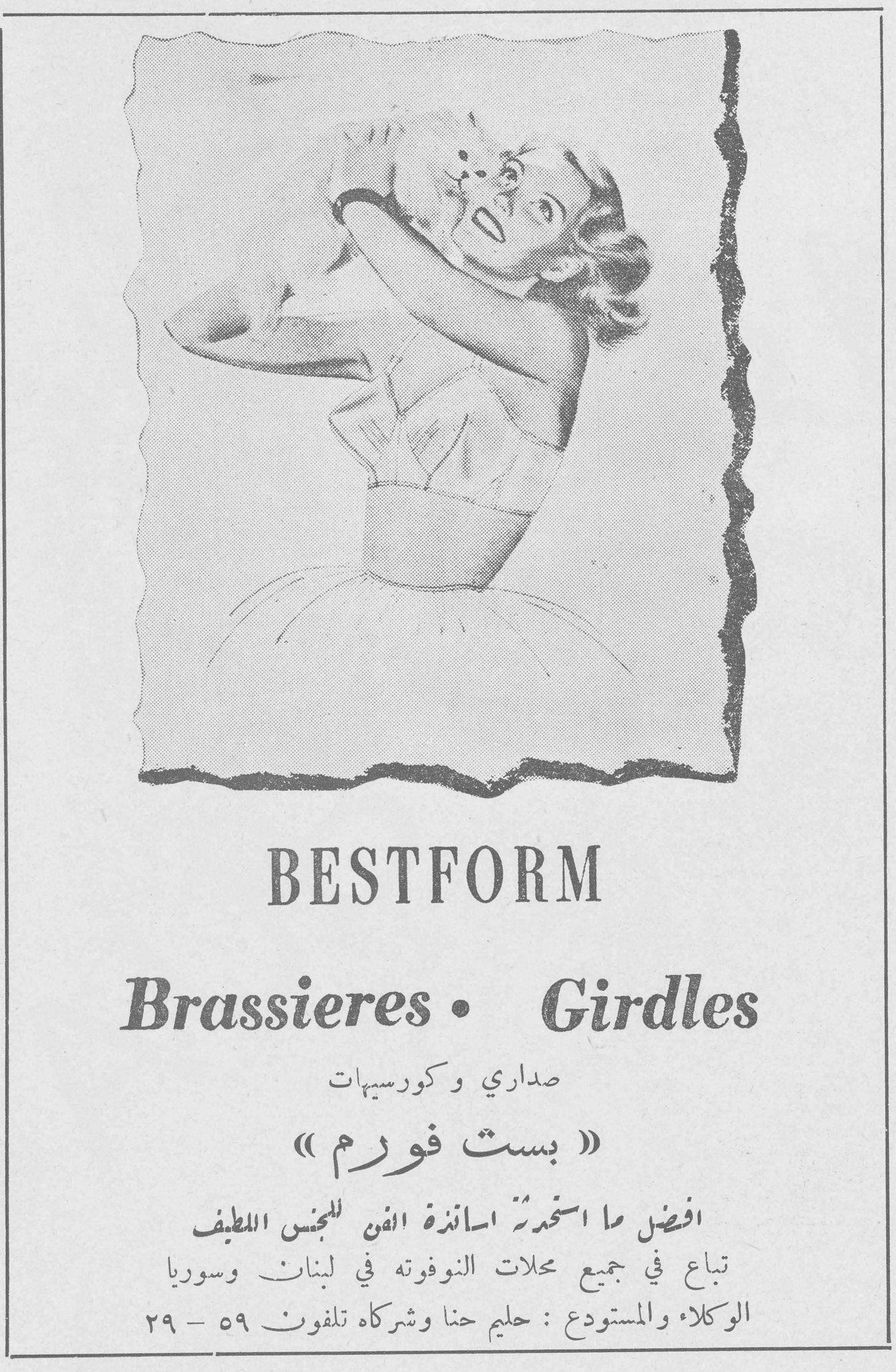
BESTFORM
Brassieres • Girdles
Brassieres and corsets
“Bestform”
The finest that the masters of the art have devised for the fair sex
Sold in all the nouveautés shops in Lebanon and Syria
Agents and depot: Halim Hanna & Co. — Telephone 59-29