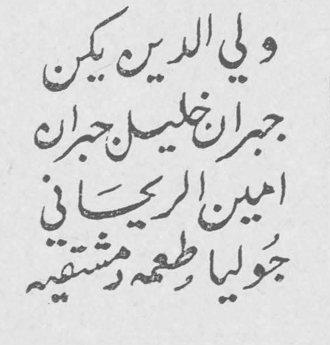

Wali al-Din Yakan Gibran Khalil Gibran Ameen Rihani Julia Tu'mah Dimashqiyah
What was there between Gibran and May?
Gibran and May never met on this earth; between them were sands and seas, then seas and sands... But what lay between them, through their correspondence, may well be among the strongest bonds that can arise between a man and a woman..
Did Gibran love "May"?
Did May love Gibran?
And was their feeling mixed with anything of the earth's dust? Is it true that Gibran wrote to May inviting her to marriage, and that she refused? And is it true that "May" in turn wrote to the great genius inviting him to marriage, and that he answered her, saying: "I am ill, May"? These are all things that remain in the keeping of the unseen, for Gibran died and said nothing, and May died and said nothing... What is certain is that the relation that grew between them was lofty and strong, passing beyond the bounds of friendship to the love that arises between souls.
Here are some of these letters between May and Gibran.
Six or seven weeks passed without my writing, because I kept saying to myself, "We must stop here." But we did not stop; we took a step — rather, we took a leap worth recording in the lyric song. I was in Alexandria, facing the sea that invites meditation and nurtures the love of solitude, and I did not wish to give the meaning of the song any grave importance. So I wrote saying that I wanted our correspondence to be confined to intellectual subjects, and I told you frankly that I seek in your letters the benefit I seek everywhere. You set me down as "guilty" in your notebook and rose to complain that whenever you "gazed at a thing I hid it behind the mask, and whenever you stretched out a hand I pierced it with a nail." Yes, I did that, and I did it deliberately. I deliberately "cut those hidden threads which the hand of the unseen spins and stretches between thought and thought, between soul and soul," and I took to twisting meanings and deforming questions and laughing at the words that fill the eyes with tears. And what other means had I to turn you
away from that subject, and to remind you that I am my parents' only child? In a Western family there may be but one boy, and they fling him from England to India; or one girl, and she travels from France to China without stir or clamor. But what have we to do with those people, we who are Easterners?
I did it deliberately, above all to spare myself a torment I can well do without, and to shun every word that might bring me near that subject which has filled my soul with thorns and brambles these past years. You understood what I wanted, but not in its true meaning; you understood it in a way I did not intend. Then pride assailed you — a man's pride — and you forgot that silence in this fashion does not become us, we who have always written to each other as two thinking friends. You forgot that the other subject came by chance, and since it was not the root, it could have faded away without affecting our literary and intellectual relations. Or were they right who said that friendship between man and woman is the fourth of the impossibles?
Your silence of this kind pained me and sharpened my attention, turn
ing me toward points none of them pleasing: among them, that you did not share my contentment in that intellectual friendship, for had you been as happy in it as I was, you would not have aimed beyond it. I learned that I was alone where I had thought us two. I judged that you had reckoned it no more than a "preface," while I valued it for its own sake. The meaning of your silence became, to me, "either that or nothing" — and you know best what effect this has upon me. — Egypt, December 6, 1920.
... Gibran, I have written all these pages laughing, to avoid saying that you are my beloved, to avoid the word love. In those who do not trade in the outward show of love and its claims at soirées and dance-halls and gatherings, love grows in their depths into a terrible dynamite force; they might envy those who scatter their feelings in surface glitter, because those do not suffer the pressure of feelings that have never exploded — and yet they envy the others