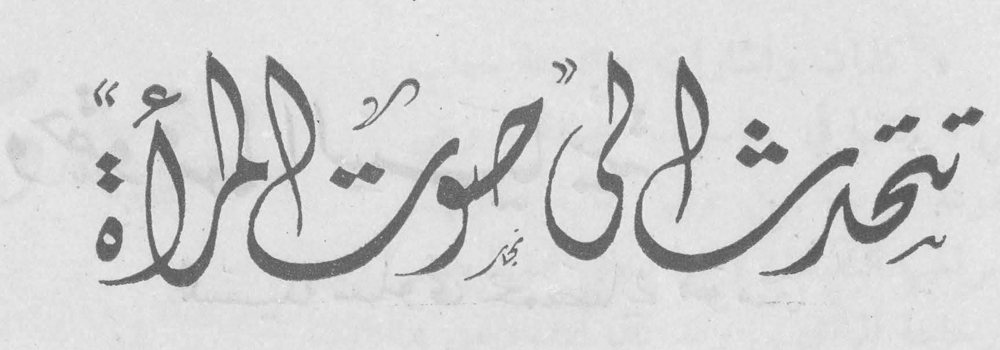
— Would my lady kindly tell us about the Jordanian women's renaissance and Your Majesty's share in it?
Here her private secretary, Miss Emily Bisharat, asks leave to answer this question, lest Her Majesty be made to speak of herself — which would not accord with her democratic Arab modesty. Miss Bisharat says:
— My lady Queen Misbah is the founder of the women's renaissance in Jordan. That was in 1944, when Her Majesty was chosen honorary president of all the women's associations there. Every charitable women's undertaking is carried on under Her Majesty's patronage.
She founded a maternity hospital for refugee women. The hospital began with twenty beds, and it now has forty; and how many times has she visited this hospital in person, bringing the patients gifts and magazines!
When Her Majesty was asked how she felt toward the refugees, pain showed in her eyes and she answered with a catch in her voice: "Feeling is from God.." In her brevity there was eloquence — and what eloquence. And one of the ladies who are permitted to be near her began to tell me of Her Majesty's overflowing feeling, her outpouring tenderness — of the long nights in which she knew no sleep, of the tears racing down her cheeks whenever some case or situation was described to her... And she asked, fear and hesitation in her voice:
"What, I wonder, will become of these wretched people?"
Everyone looks down, unable to give Her Majesty an answer that might calm her alarm and lighten her pain. To rescue this moving moment, I asked Her Majesty her opinion of the Syrian woman's participation in the elections, and she answered deliberately:
— I favor woman's sharing with man in the exercise of her political rights, on condition that this step not come before its time. I believe that were it not for the confidence of the Syrian government and the Syrian people that the Syrian woman possesses the maturity and the national consciousness that qualify her to take up this patriotic responsibility — were it not for this confidence, the Syrian government would not have ventured to grant woman this right. And I am with woman in every step that leads to her progress and the raising of her standing.
— Would my lady kindly tell us something of the education of the Crown Prince, His Highness Emir Talal, and of Her Highness Emira Haya?
— Talal studied at Cambridge — London; and Haya learned Arabic and Turkish in the days when we were in the Hijaz, and English and French in Amman, all at the hands of private tutors. She is married to Emir Abdul Karim Haidar.
— And finally, what is your message to the Arab woman?
— My message to the Arab woman is to strive in the pursuit of learning, so that her culture may stand at the level of the Western woman's. But beware of imitating the Western woman in the husks of civilization without the kernel!
She was born with tenderness, kindness, and mercy: she listens in person to the complaints of those women who come to her with
grievances, wipes away the tears of the wretched, and does not send them away disappointed. This personal side of Her Majesty, together with the majesty, awe, and dignity she possesses, stamps her with a unique and winning character. Her Majesty is devout and pious, with a lofty patriotic spirit and a fine human sensibility.
Her Majesty also performs national and humanitarian duties in a democratic manner that stirs admiration and esteem. She has had the longest reach in animating the women's movement. In 1944 the Jordanian Women's Union was founded under Her Majesty's supervision and honorary presidency, and she still watches over every charitable women's undertaking established in the country. She likewise takes part in all manner of works of piety and benevolence. During the ordeal of Palestine, a maternity hospital for the refugees was founded in Amman at Her Majesty's command, and it carries on its work still. A women's branch of the Red Crescent was also founded, in which many of the finest women of the Jordanian people volunteered. Her Majesty visits those hospitals, comforting the wounded and bringing them sweets and magazines.
She is deeply concerned with the Arab cause in general and the cause of the refugees in particular, and in the Jordanian capital she is called "the Mother of the Refugees." For she is a granddaughter of the Messenger (God bless him and grant him peace), daughter of Sharif Nasser; her father's brother was the late His Majesty King Hussein, the Great Deliverer; her consort is His Majesty the exalted King Abdullah, creator of Jordan's renaissance; and her son is His Highness Emir Talal, our beloved Crown Prince, on whom the hopes of the eager young generation are set.
Her Majesty does not believe in the sudden leap, but in conscious, gradual advance in the renaissance; and she hopes that the women's renaissance will always rest upon the pillars of authentic Arab morals, while keeping pace with the march of time.
Emily Bisharat