The man of letters and poet Youssef Ghossoub published, not long ago, an article in the magazine "al-Mina" in which he examines the causes of the meagerness of literary production in Lebanon, and he concludes his inquiry with one principal finding: that the predominance of foreign culture, languages, and newspapers in this country, its people's eagerness to read the literatures and sciences of the Westerners in their original languages, and the influence of emigration and Frenchification on the other hand — all this stands as an obstacle to literary production here, whereas the neighboring countries, which have not been favored with the great number of foreign institutions, institutes, and influences with which Lebanon teems, remain on the whole in less direct contact with the cultures of the West, and their literature is less exposed to the competition of foreign literature; hence their writers, when they write in Arabic, can find readers for their literature even if it is of slight value.
Although the causes of literary stagnation in Lebanon are many and not confined to one, we cannot but say that there is much truth in this explanation; to prove it you need only take a count of the number of foreign books and magazines sold every day in Beirut, while the Arabic bookshops all but confine their activity to selling the schoolbooks read by the Lebanese students of the certificat and the baccalauréat.
The number of readers in Lebanon is not small, and the rising generation is much given to reading, especially the young men and women who have received a classical education in which theory prevails over practice. But the members of our educated class have a better command of the languages of the West than of their own tongue; indeed many of them recoil by nature from anything of local color and despise it, despite the boasting of some of them of their Lebanese-ness, and they have not the national pride that would move them to encourage local production, however feeble it may be.
And suppose they had mastered their language until writing in it seemed an easy matter — they find no clear practical benefit in this mastery. For
the places of work — the foreign institutions and companies with which Lebanon abounds — require of them mastery of foreign languages. And if they turn to writing in Arabic, they may find no readers among the Lebanese, and the sister countries are more zealous to encourage their own writers than to encourage the writers of Lebanon — a natural thing. One of them may sacrifice
his time, his money, and his energy for a spell, then become unable to sacrifice, or averse to it. And then there are the merchants of literature — the schoolbook committees, the broadcasting stations, the publishing companies, and the institutions of colonial cultural cooperation between East and West — all these new faces stretch out their hands to them and tempt them with commercial literature, which makes men of letters out of dabblers; so why should the rising writers not hasten to them?
Add to this that entry into the field of pure literature grows harder every day
with the rising level of culture, the exactingness of readers, and
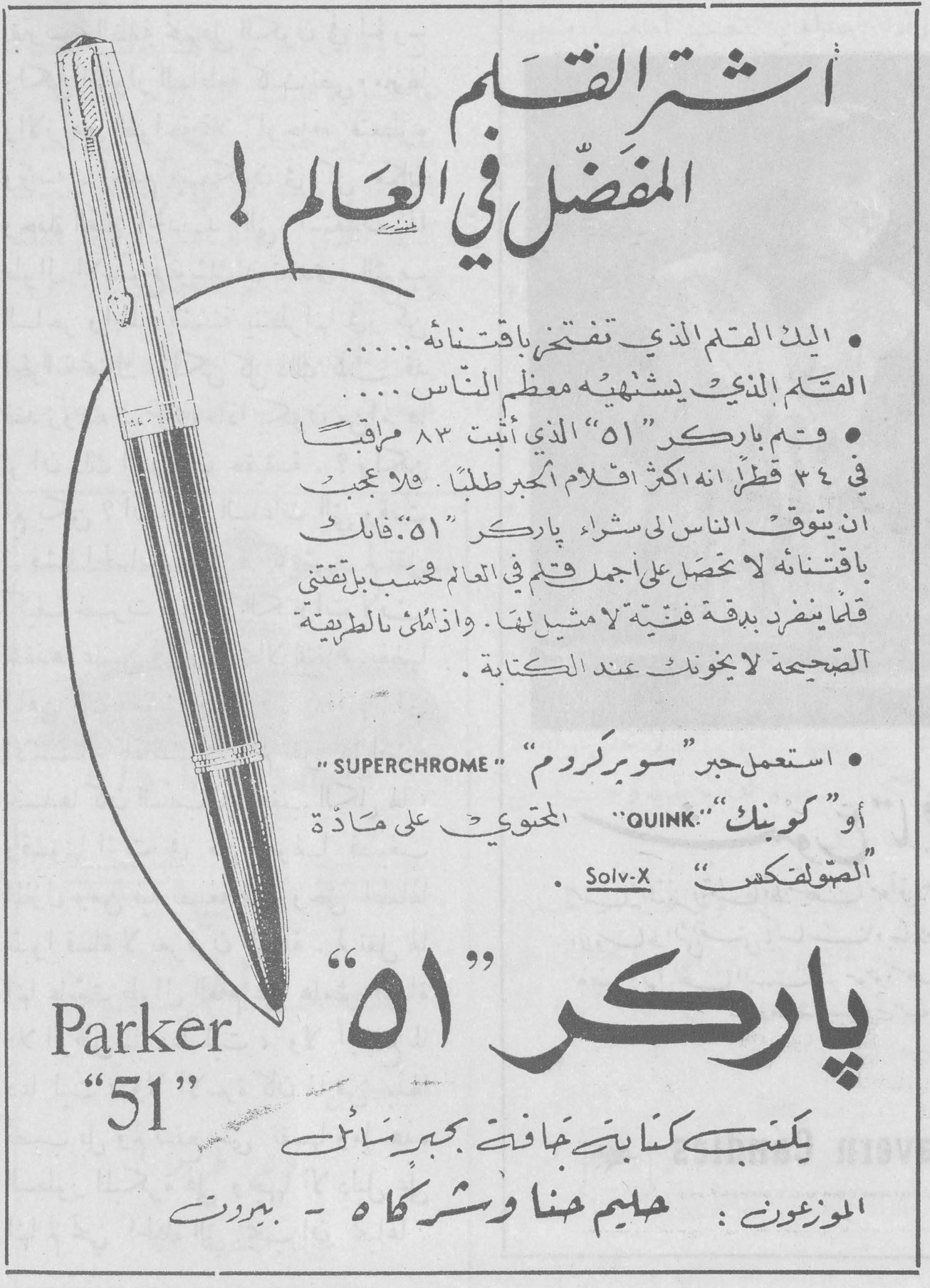
Parker "51"
Buy the pen preferred throughout the world!
• The pen you are proud to own...... the pen that most people covet....
• And the Parker "51," which 83 observers in 24 countries have proved to be the most sought-after of fountain pens. No wonder, then, that people long to buy the Parker "51": in owning it you obtain not merely the most beautiful pen in the world, but a pen unique in a technical precision that has no equal. And if you follow the correct method, it will not fail you when you write.
• Use "Superchrome" ink SUPERCHROME
or "Quink" QUINK, which contains "Solv-X"
Parker "51"
Parker "51"
It writes your writing lightly, with a quiet ink
Distributors: Halim Hanna & Co. — Beirut