the spread of weariness in the souls of the educated elite. What, then, do these people read? The essay has been cheapened by the ease of its making; it is not read unless it appears in some enticing, novel form — in the form of practical experiments and statistics in the American manner, or philosophical truths and deep study or artistic exposition in the European manner — and we do not blame these readers if they turn away from the light essay that is the child of its hour, created without effort. Beyond that, the cultivated want stories of modern style, on the order of the stories of O. Henry and Chekhov, or plays in the manner of Maeterlinck or Gabriel Marcel, or poetry in the manner of the symbolists and the surrealists. And these Westernized literary colors Arabic literature attains only through one who devotes himself wholly to the service of literature, gives his life over to it, and travels for its sake the rough, thorny road on which feet bleed and breath is cut short — and where have we such a mystic, to whom his livelihood comes without toil, so that he may spend it on literature?
In Arabic we read the local news and the political developments. And then whoever is accustomed to reading the foreign papers cannot but set the style of these against the style of those. He reads, for instance, in "Time" magazine: "To so-and-so, owner of such-and-such factories, and to his wife so-and-so, a boy was born weighing so much." And in an Arabic paper: "God has graciously bestowed upon the esteemed merchant so-and-so and his refined wife a male child in whom the parents' eyes delight; he has been named such-and-such, in felicity, after his grandfather of goodly memory, and we ask God to make him one of the children of well-being, to keep him in the shadow of his noble parents, and to make him the apple of the eye of the happy household, etc."
Here I ask: how can one accustomed to reading the foreign papers endure such a waste of words?
We may read translated literature, but without pleasure, for whoever can read a literary piece in its foreign original cannot relish it in translation. For this reason I see no benefit in transferring the world's masterpieces
into Arabic, since whoever has attained a degree of culture that enables him to understand these masterpieces in translation must know enough of the languages of the West to be able to understand them in their original tongues. And what culture do you expect of a person who knows nothing but Arabic? And how do you expect him to understand the translated masterpieces of the West when he is ignorant of the spirit of the West and its civilization, because he knows nothing of its languages?
There remain the popular magazines and newspapers read by the common people and by those of limited culture. The political ones among them may find a market, while the literary and social ones sell only if they escape the competition of their Egyptian counterparts, brimming with pictures, news, jokes, and colors.
Finally, where shall we find a solution to the problem
of Lebanese literature? The solution may come through the Arabization of the schools, together with care for the mastery of one foreign language. But this makes up only part of the solution, for our literature would still remain unable to compete with foreign literature; and there remains the financial problem, whose solution may lie by way of the emigrants, if they would donate to establish endowments set apart for writers and for serious literary magazines — and the hope of that is faint, because most people consider Lebanon's need of the emigrants' donations for the necessities of life more pressing than its need of them for luxuries.
Or it may come by way of the government, or through the cultural committee of the Arab League, which has shown no tangible activity up to now. In any case, the problem still arrests our gaze and calls for our thought.
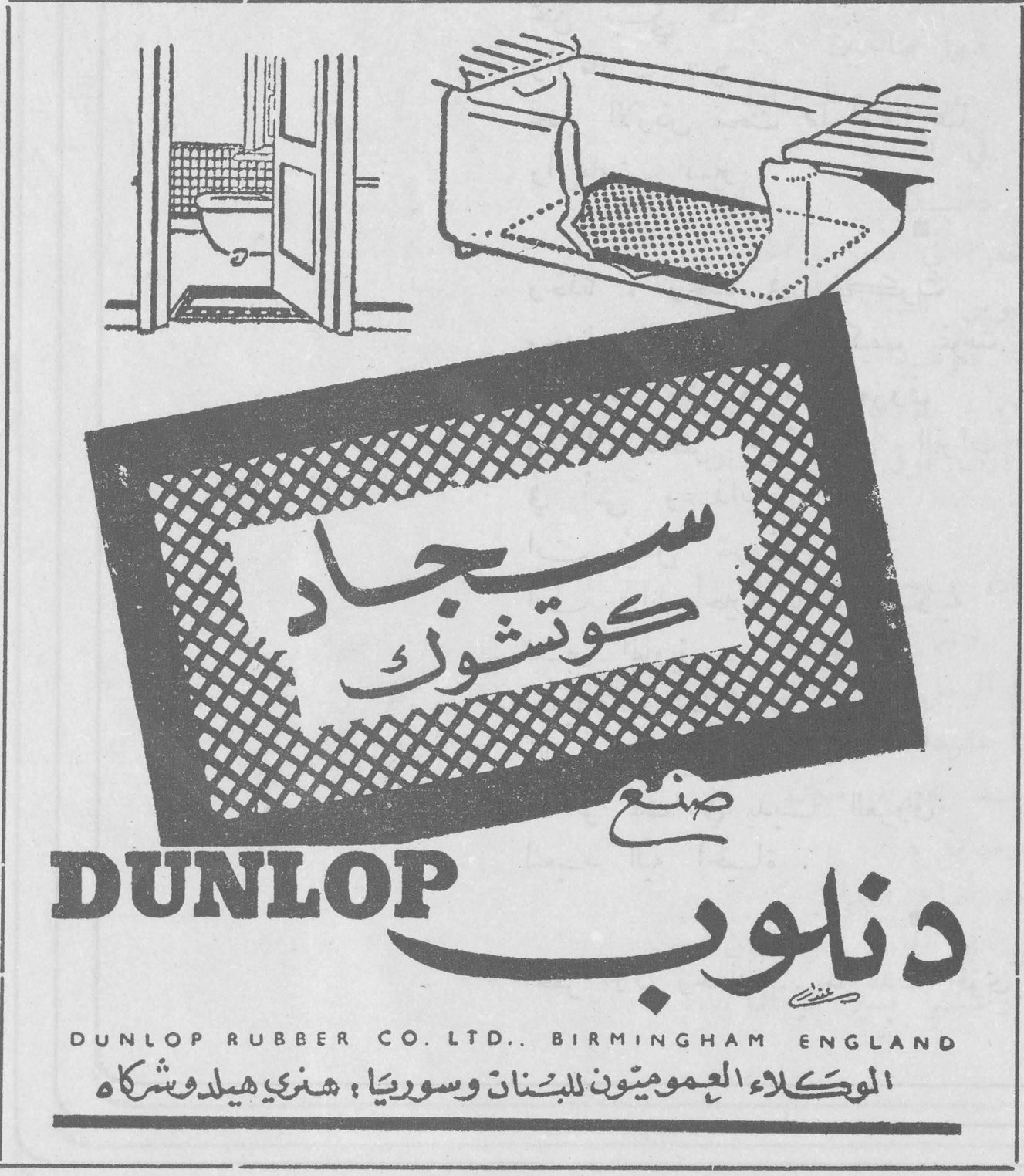
Rubber rugs made by Dunlop
DUNLOP
DUNLOP RUBBER CO. LTD., BIRMINGHAM ENGLAND
General agents for Lebanon and Syria: Henry Heald & Co.