One wonders why woman consented, for this long stretch of time, to hand the reins of her education over to man, for him to decide what part of it suited her according to his wish and his fancy — when history has proved that women, whenever sufficient opportunity is given them, can turn their genius to proper account. It was easy for man to carry off the palm alone in the fields of the arts and sciences, when he monopolized them; just as it was easy for him in the past to point to the extent of woman's mental inferiority compared with himself, when he was able to lay down the social rule which holds that woman is fit for only two tasks — motherhood and household management — and that she is unworthy of instruction and cultivation. Yet woman had scarcely awakened and risen before she proved the contrary. In fact, were it not for the work of two brilliant women scientists, the scientists of the male sex would still be floundering to this day in their attempts to unlock the closed doors of atomic energy.
One of these two scientists is Marie Curie, and the other Lise Meitner. To the first, the French scientist, goes the credit for delivering the world from its pains and afflictions by her discovery of radium for the treatment of cancer. She likewise discovered the theory of the chemical action of radiation — that great theory on which all subsequent research into the nature of the atom was founded. For by her discovery that the metal radium disintegrates continuously and turns into helium gas and the metal lead, she enabled scientists to determine the age of the earth with precision, and she also supplied them with the information
that led to the discovery of the nature of solar energy.
Lise Meitner, who is still living, in America, was forced to flee Nazi persecution. She had spent some twenty-five years in Berlin
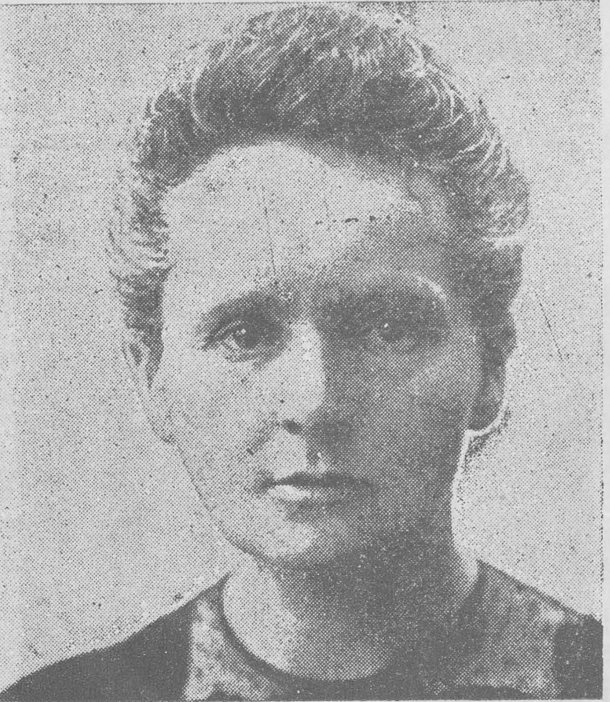
Madame Curie
working with Professor Hahn on the study of the ultimate physical forms of matter. They were on the verge of finding their way to the splitting of the uranium atom, and they devised a special microscope for observing the changes that come over uranium under the blows of neutron atoms. And when they saw — although they had used nothing but uranium in their experiments — the appearance of a new element, the metal barium, they knew that they had succeeded in transforming the essential atomic composition of uranium.
Then the horizon darkened with the clouds of the Nazi terror, and
the learned Lise fled to Sweden, carrying with her the secret of atomic energy, whose gravity the world had not yet grasped. She was a woman of gentle character, slight of body, plain of dress, who was approaching sixty without ever having thought of marriage. Often she laughed at the opinions of the great thinkers in their mockery of woman — whether it was that Roman who said that if a woman thinks alone, she thinks of evil; or the English writer Addison, whose disdain for women, despite his genius, went so far that he said that if a woman turns herself wholly to serious thought, she becomes a lost soul. And she refuted the sayings of that great philosopher Erasmus, who declared four hundred years ago that a wise woman is twice a fool.
Erasmus was skilled at dissecting the soul of man, while Addison regarded him as a kind of social animal; yet neither of them was capable of dealing with a question so vast as the atomic composition of the living and the inanimate — the question that this slight, plainly dressed woman set herself to deal with. As she rode the tramcar in Sweden she was not thinking of embroidery or needlework; she was thinking of the universe in purely mathematical terms. For she was occupied with testing the soundness of her calculation by the logic of scientific figures — and with solving a thorny problem: the discovery of the splitting of the atom into two unequal halves, thereby releasing an energy exceeding by 50,000,000 times the energy generated by burning coal. These problems occupied her wherever she went, and at last they carried her to America, where she joined the scientists in solving the problem of the release of