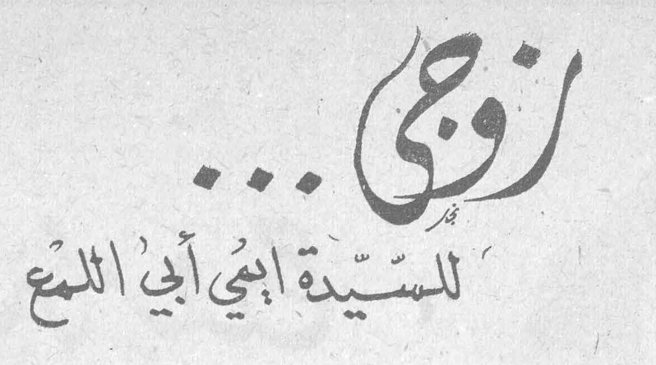
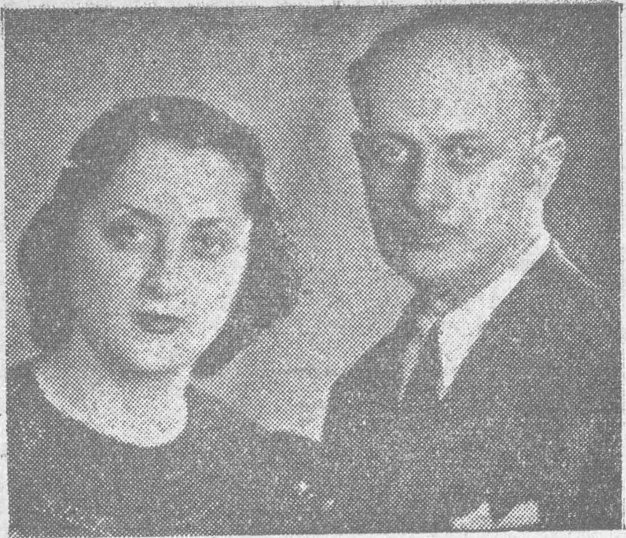
... The Woman's Voice continues its publication of the delightful conversations held with the editorial secretary by each of two ladies: the wife of His Excellency Dr. Raif Abillama, and the wife of His Excellency Sheikh Bahij Takieddine. Each speaks of her husband...
As I wait for the mistress of the house, I feel that I am in an Eastern atmosphere. The colors are somber, and the damask curtains leave the room in a half-darkness restful to the eye. I lean back on the broad Oriental divan and let my gaze wander around the room... Before me is a collection of ancient weapons: pistols, rifles, swords, and daggers. Surely they have some connection with the family's history...
On the wall hang two large oil portraits of the parents of His Excellency Dr. Raif Abillama, facing two portraits of his grandfathers. And as my gaze rises higher, it is captured by the ornamentation and the colors... Here are maxims written in a beautiful hand, girdling the salon from above... My eyes pass over them:
"A man's manners are better than his gold. The wise man's breast is the strongbox of his secret. Look after your father, and your son will look after you. Had you known the unseen, you would have chosen what came to pass. The best of emirs is he who is emir over himself."
Here Mrs. Emmy, wife of His Excellency Dr. Raif Abillama, comes in to me and welcomes me warmly; and seeing me still absorbed in these wise maxims, she explains that His Excellency the Minister chose them himself the day he personally supervised the building of this house.
— Would you, Madam, tell me about His Excellency your husband as a physician?
— You are well aware that a doctor's life is a hard one. How often, in the early days of our marriage, I found our irregular life difficult, never knowing when we would lunch or when we would dine. But before long I grew used to this life — a situation every doctor's wife knows: work... work... and nothing in this work that could be called "routine."
— That is his life as a physician; what change came over it after he became a minister?
— You can no doubt draw some conclusion about that yourself! Today I remember fondly those first days, when the Doctor's activity was confined to his profession and a few secondary duties, such as the presidency of the Physicians' Syndicate. Today we scarcely see him among us, for every minute of his time belongs to the people. What I admire in him is that he turns no one away, and lends every petitioner an attentive ear, in the hope of arriving at some part of the truth and of lifting injustice where possible.
— Yes, I can imagine the weight of the responsibility laid upon His Excellency the Doctor's shoulders. The ministry whose chair he consented to occupy is in such ruin as to leave him perplexed, not knowing where to begin! This feeling pervades Lebanese public opinion, which now looks to His Excellency as to a rescuer, and waits to see the first fruits of his reforms.
And now, would Madam kindly tell me about His Excellency as a father?
— I do not know how to describe him as a father. He inclines to give his two boys, Farouk and Jihad, complete freedom — I mean that he is of the modern school. He has given them plenty of pocket money ever since they were small children, in the belief that this accustoms them to learning how
to spend and when to spend. And then he leaves them without personally checking their accounts. He often used to help them prepare their lessons, especially the literary and health subjects; now, however, he has replaced himself with private tutors.
The Doctor has treated Farouk and Jihad, ever since they were little boys, as two friends... Even now, in this flood of unceasing work, Jihad often confronts him in protest at his neglect of them, saying to him on a Sunday morning, for instance:
"We need to have a talk, Papa!" — as though this big child of thirteen, with his literary bent, cannot forgive his father this neglect, and claims his share of his father's time as one equal claiming from another.
— Has His Excellency the Doctor any particular inclinations apart from his profession and the ministry?
— Yes, the Doctor has a literary bent no weaker than his medical and political ones. Until only yesterday he would read literary books in the evenings; he has a special fondness for poetry, and a sharp memory that helps him recite a great store of beautiful verse. I feel that this inclination is in my two boys as well... And when he returns home he must have complete quiet, so that his nerves may rest from the strain of the whole day. He prefers a small number of close friends, with whom he spends an evening at bridge; he takes no pleasure in noisy official soirées — rather they oppress him, and he wishes he might be allowed to escape them!