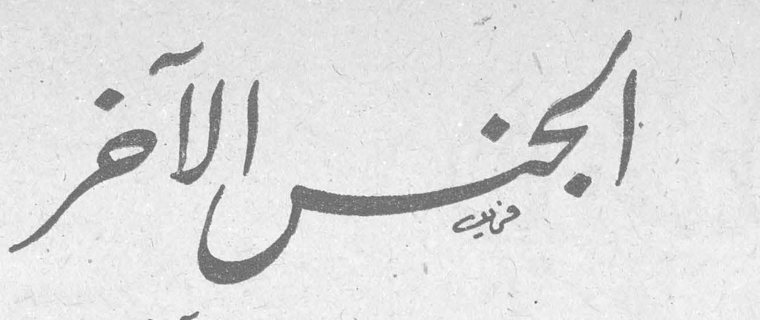
A review of a recent book by Mrs. "Simone de Beauvoir," presented by Miss In'am al-Saghir:
Those who follow the modern schools in science, philosophy, and the various literatures know something, little or much, about that existentialist school of which many have begun to speak, and about which writers write, some in support and some in opposition. The particular character this school has taken on in France generally, and in one quarter of Paris in particular, has drawn much attention to it — and perhaps has diverted its purpose, so that form and appearance have come to prevail over meaning and substance! Is not the quarter of Saint-Germain-des-Prés the seat of the leader of existentialism among contemporary Frenchmen, Jean-Paul Sartre, and of his followers?! Among his most brilliant disciples, and those closest to him, is Mrs. Simone de Beauvoir, author of various novels such as "The Invited Woman" (L'Invitée) and "The Blood of Others" (Le Sang des Autres), and the tragedy "The Useless Mouths" (Les Bouches Inutiles), in addition to the valuable study Pyrrhus and Cinéas. And now the French press sends us a valuable new book of hers under the title "The Other Sex" (Le Deuxième Sexe), in two volumes; the first part appeared a few months ago and deals with "Facts and Myths" (Les Faits et les Mythes), and a short while ago the second volume appeared, but it has not yet left France.
As for the first volume of this book (comprising 395 large-format pages), its author has divided it into three parts. In the first she examined the
natural facts of the constitution of the female body and the composition of her organs, then the psychoanalytic view, then historical materialism; in the second she treated the subject from the historical standpoint; and in the third part she spoke of certain authors and their differing opinions in the analysis of woman, her social position, and everything connected with the subject. This massive work contains everything that can be said in orderly discourse, precise in expression and elevated in its clear style; it presents all that is essential about woman from the dawn of history down to our own day. The subject is not new to readers, but it has never before been treated with such precision and detail, or with such a broad, worldwide, comprehensive view. The writer supports her statements with principles drawn from psychology and biology, from medicine and history, likewise from sociology, physiology, and psychoanalysis — and in addition to all this she has not forgotten to cite the various literatures of the world.
The natural phenomena and the natural constitution of woman have placed her in a position in which her strength is less than man's. But the human being is subject to custom and nature, and his value is measured against particular values, not against himself. Thus it is not physiology that determines these values, but society, with its customs and its laws; nor is man's bodily strength the ruling factor, for if custom had it — as is the case among certain Indian tribes — that the girls choose their husbands, or if the parents had the right to
decide the marriage, the preference for the male sex would have no active, positive force here, and it would enjoy no superiority over the other sex. Even the relation of a mother to her child differs according to the prevailing social systems: the child may be a source of pride and glory to the mother, or a source of misery and wretchedness. In short, biology does not suffice as an answer to the question that the author of this book attempts to treat and to answer, namely: why is woman regarded as the Other (L'Autre) — that is, the holder of the secondary, passive position — while man holds the positive, active place?! Here we should mention the influence history has exerted upon nature, and what humanity in general has done, and its effect upon the human female.
Woman — or rather the girl — begins with a feeling of deficiency in her position and her power from her first awareness of things as a child. She observes the dominance the father holds in the home; and — according to psychoanalysis, which makes of the father a hero for the girl to follow, and of the mother a heroine for the boy to follow — this idea creates in her a leaning toward the veneration of man and toward considering herself of lower rank than he. The girl also feels that her mother contests with her for her father's love and attention, and so from childhood on through girlhood she grows up carrying within her that view of herself as the "other" person — that is, the secondary one. This is the summary of what the writer sets forth in detail in the chapter devoted to psychoanalysis, before she comes to treat the subject