Questions and medical consultations that every mother would like to learn from her own physician, or from her friend. "The Woman's Voice" helps you by presenting these answers...
Q — Are complications frequent in the common diseases of children, and how do we recognize them?
A — Yes; and each disease has certain complications that occur with it and with no other. High fever and chest symptoms in a child may develop into pneumonia and inflammation of the ear; and these complications may also come as independent illnesses, without any previous connection with another disease.
Q — And do these complications leave bad effects upon the child?
A — Usually not, but they always demand exceptional care and additional effort; and their cure comes down to two things: the speed with which they are traced out and recognized, and the measure of the physician's skill in treating them.
Q — Can a simple ailment like "the common cold" give rise to complications?
A — Certainly. Many acute earaches, "sinusitis," and difficulty in breathing arise from a simple
cold or catarrh, and it is wise that we should know this.
Q — How can these complications be guarded against?
A — Before everything else, protect the child by always vaccinating him against those diseases to which he may be exposed—whooping cough, croup, smallpox, and tetanus. It is never permissible to be lax about vaccinating the child, or about keeping always in touch with his own physician from the first months. So much for prevention; as for treatment, penicillin and sulfa, when given at the right time and in the right doses, rarely allow any complications.
Q — And does good home care of the sick child prevent the occurrence of any complications?
A — Naturally. Good home care prepares the atmosphere for the sick child to regain his strength, overcome the disease, and acquire immunity. Make certain that he stays in bed according to the doctor's orders, and beware of indulgence in this; for if you are indulgent, you will yourself have made the way easy for these complications.
Q — Why do physicians advise that children keep to bed for at least three days after a high fever?
A — To prevent complications; and because the child's body, after its violent battle and its victory over the fever, has less immunity to
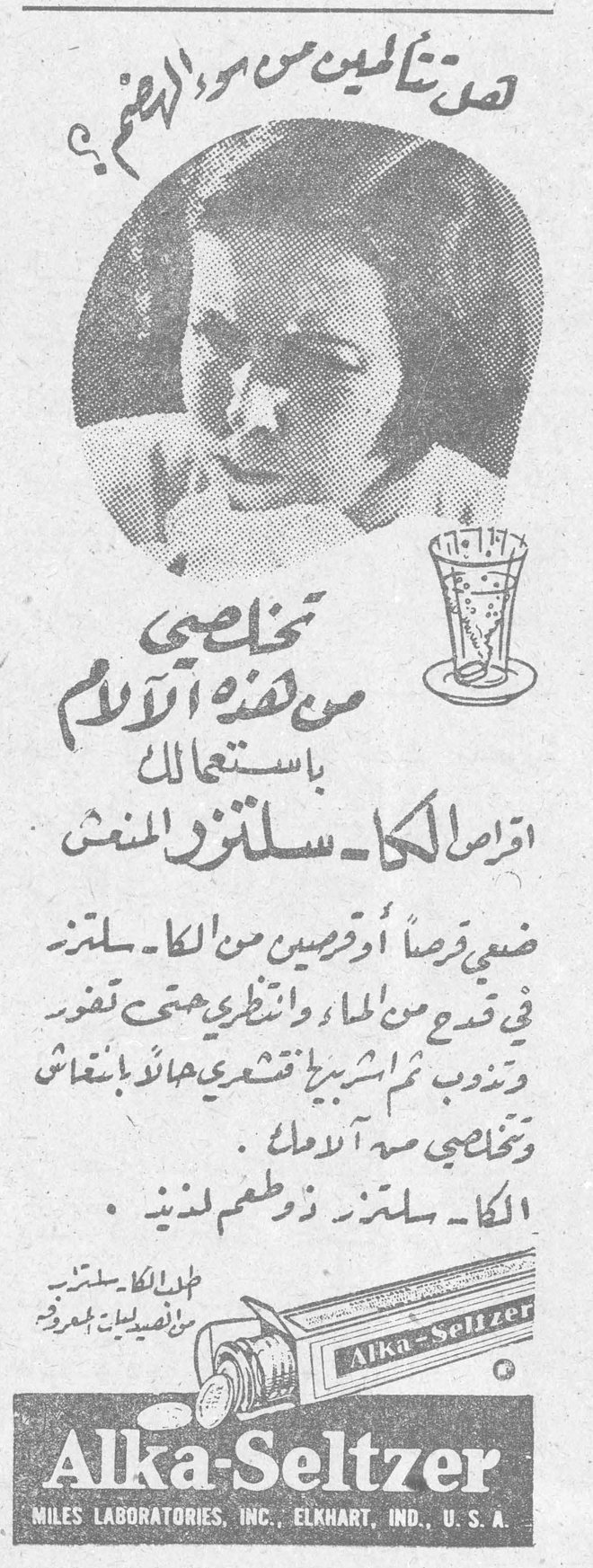
Alka-Seltzer
Rid yourself of these pains by using the refreshing Alka-Seltzer tablets
Put a tablet or two of Alka-Seltzer in a glass of water and wait until it fizzes and dissolves, then drink it: you will at once feel refreshed, and with it be rid of your pains.
Alka-Seltzer has a delicious taste.
Alka-Seltzer
MILES LABORATORIES, INC., ELKHART, IND., U. S. A.