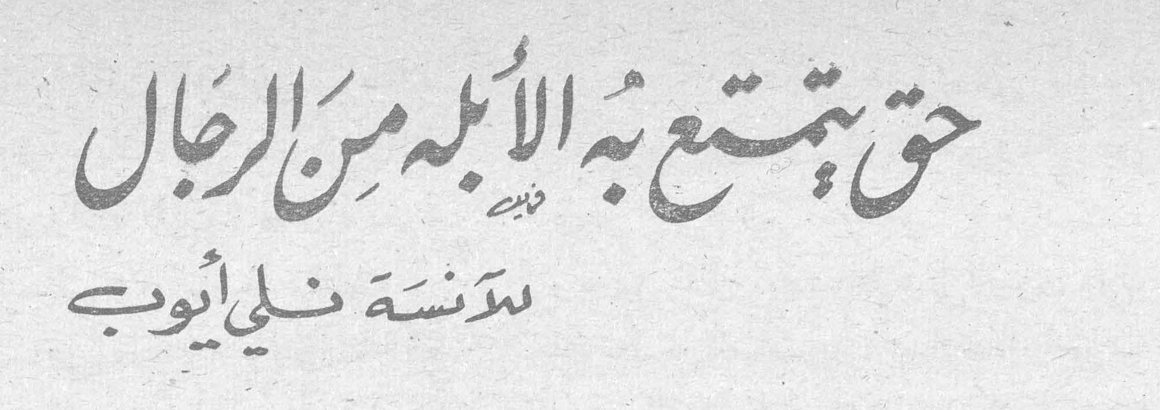
It is regrettable that in the middle of the twentieth century, while the nations of the earth race toward the summits of progress and civilization, there should still be room for dispute or debate over the problem of woman; and that man should need more than all the ages and experiences he has passed through to grasp the reason for the world's backwardness and the slowness of its advance.
The women's movement, on the occasion of the convening of the international women's congress in Beirut, has stirred up opinions in circles everywhere: some applauding and some opposing, some content and some asleep, some supporting and some scoffing, some mild and some despotic. Woman has had her fill of remarks and verdicts which man would have done better to keep to himself rather than utter with a boast; for if he mocks woman, he is only mocking a mother of his own, or a sister, or a wife; and if he pronounces her degraded, he is only pronouncing the degradation of the cause of his own existence, his guide, and his companion. How can he accept that for himself — he who boasts of everything connected with him? Do the educated, one wonders, strip themselves of every tie to woman when they raise this question with all the force at their command, for mockery and disdain — priding themselves on their belief in woman's mental weakness and in the utter hopelessness of her ever excelling, and then declaring with all pride that her intelligence is of the cheap sort!
Naturally — after such a belief — man plants himself in woman's face, pointing and decreeing that she is fit for nothing but the pursuit of household tasks, and declaring her deprived of all the rights that he himself enjoys.
On what basis, my brother, do you rest this presumption of yours?? I do not suppose you mean bodily strength — there are creatures stronger than you by degrees!! On what, then, do you rest? On religion? And what law divided up
the stations, disinheriting woman and decreeing her enslavement? We know nothing in the religions but what calls to fairness, harmony, and concord — and can there be fairness or concord unless the doors are opened to both sexes alike, each choosing the work that suits it, without one party lording it
over the other except by way of mutual understanding?
And if your basis is her weakness and degradation throughout all these generations, and her failure to distinguish herself as man has in the various fields of life — then what dragged her into this degradation and torpor? Was it not the nightmare you deliberately cast upon her, whose effects last to this very day, and which she is now trying to push off? And despite your injustice to her, you cannot deny her excellence at every opportunity in which she managed to glimpse a little light. Go back to history and leaf through it: you will find many women whose lights blazed out amid that darkness and through those chains. And what merit is there for man if he distinguishes himself while the doors stand open wide before him, while he is fed, from the womb, on the notion that the world is his alone, that woman is nothing but his plaything or a servant and no more, and that inquiry into the possibility of her progress is a matter settled in advance?
But if you set yourself against woman for fear she will neglect the home and take up what does not suit her nature and her sacred function, then let it be said: it is man, with his barren policy, who drives woman to neglect her home and the affairs of her children. For who belittled household work in her eyes and made her recoil from it, if not the man who mocks her, forever repeating that she is fit only to keep the house and mind the children,
washing his hands of every responsibility save the handing
It is well known of "Mark Twain" that his ways were odd to a certain degree, and that his wife used to call him "untidy" for his carelessness about his dress.
One day he went to call on a lady of quality, and it happened that he realized, after coming back from that visit, that he had been without his "necktie"!
A little later the noble lady received a letter that looked as if it were of some importance. She opened it hastily, wondering what it could possibly be — and out of it appeared a black silk "necktie," together with the following note: —
"This is my 'necktie.' Take it and look at it well. I believe I spent about half an hour with you this morning without it... Kindly return it to me at about this same hour, for it is the only tie I own!.. Mark Twain"