If you ironed a piece of cloth in the wrong direction, it would lose its shape; whereas if you ironed it in the right direction, you would remove from it all the creases and folds that had crept into it in the wash and restore it to its original shape — which is what you intend.
You should remember this, for it applies exactly to massage. If the operation of massage is performed in the right way, it yields astonishing results. But if it is performed in the opposite way, it leads to grievous consequences. I know certain ladies who tried to remove the creases and wrinkles beneath their eyes, and this only increased the signs of advancing age through the slackness it left in the muscles of the face and the stretching of its skin. The one sound rule of massage, then, is that the operation be carried out in the correct way, as will become clear to you from the following instructions:
It is well known that the shape of the face and its structure depend on two factors: the first, its bony framework; the second, its membranous muscles. It is also known that the muscles of the forehead, the cheeks, the neck, and the chin take different directions. There is no single, simple direction in which to move the massaging fingers. This is why separate rules must be followed for each part of the face. And every muscle has a particular cellular composition that we must take into account.
You may perform this simple experiment if you think our words are no more than chatter to no purpose. Place the two middle fingers, one from each hand, on the two sides of your nose beneath the eyes, then move them in horizontal, sideways movements toward the temples: you will feel that the skin and the muscles beneath it have tightened. Then reverse this operation, and move the fingers from the temples toward the nose. This time you will feel no tightening at all. The first operation is the wrong one, and you must avoid it; while the second operation is the correct one, for you must never feel any painful pulling.
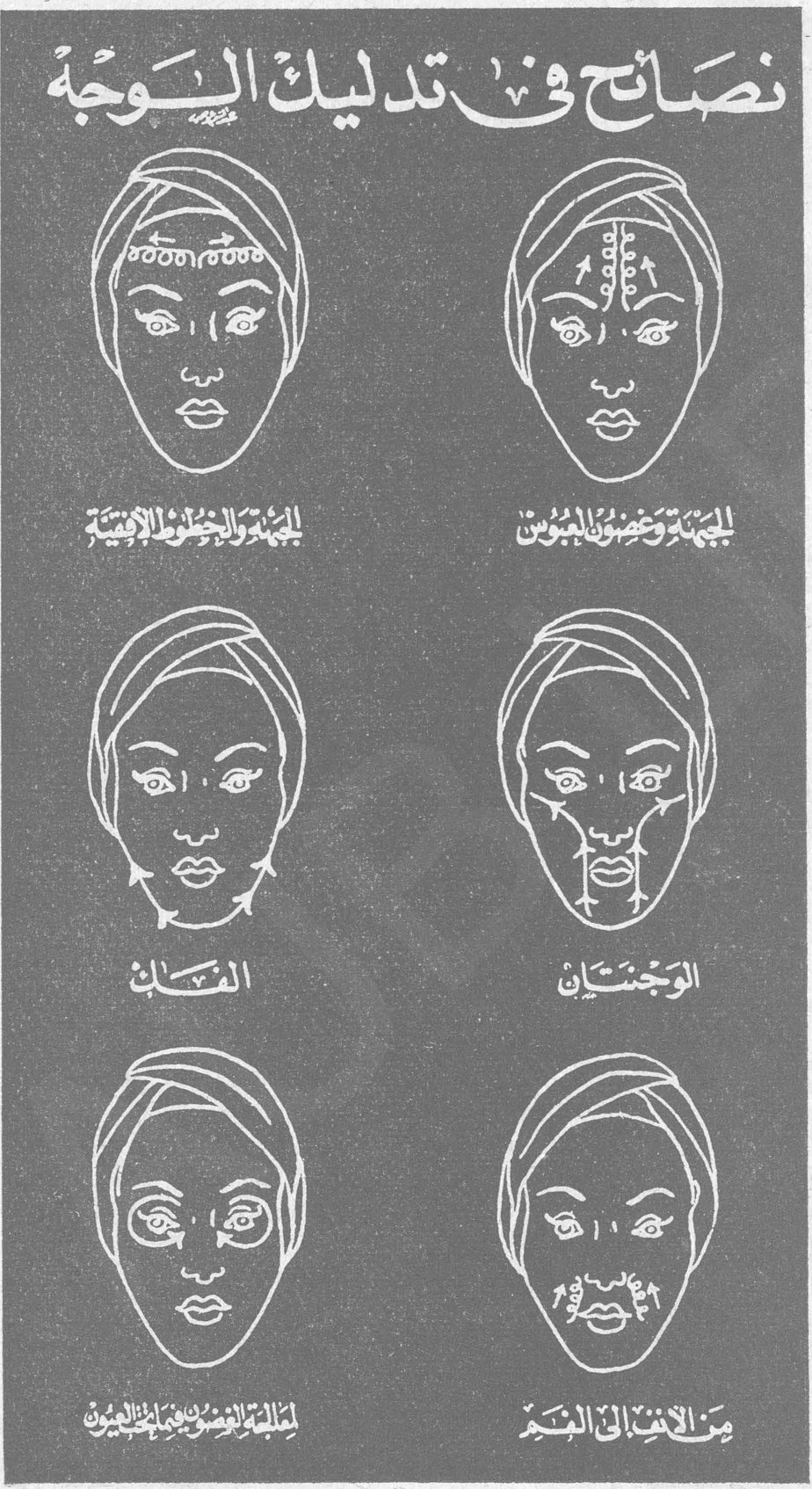
There are several points for treating, by massage, the face that does not keep its natural freshness: the cheeks, the forehead, the jaw, the neck, the part between the base of the nose and the sides of the mouth, and the part beneath the eyes. Here are some exercises to practice, accompanied by rough sketches so that you may be sure of following them correctly.
First exercise — the cheeks:
Place a large amount of cream on the first and middle fingers of each hand — it is best to warm
it a little, so that the massage is made easier and stretching of the skin is avoided — and begin with your chin: spread the cream and smooth it in with steady pats, moving your fingers in the direction of the cheekbones, and from there to the ears.
Second exercise — the forehead and the frown lines:
The smooth forehead of youth becomes creased with two different sets of lines. One is the long horizontal lines, which give the face of the woman who does not treat them a permanent cast of anxiety. The other consists of two or three vertical lines which, if left to themselves, make a woman look peevish and nervous of temper. Begin, then, first with these three vertical lines. And since the space of this part is very small, you must use one hand at a time in your exercise. Place the first and middle fingers of your right hand on the top of your nose and move them in horizontal, circular movements in
Tips on Facial Massage
The forehead and the horizontal lines
The forehead and the frown lines
The jaw
The cheeks
For treating the creases beneath the eyes
From the nose to the jaw